
Helen's father had a tunnel built at his estate so that the mill workers could cross the grounds without being seen.
Not because he was cruel. Because he was rich, and in the world he had built himself into, that was simply how things were done. The family on one side. The workers — the very people who had made the family — on the other.
Helen Leech grew up on that estate. She learned her lessons well.
The Tunnel at Gorse Hall
Her father, John Leech, was known in Stalybridge as "Ready Money Jack" — a cotton magnate of the old school, utterly self-made, worth £200,000 at his death in 1861, which is somewhere in the region of £24 million today. The Leech family had started as yeoman farmers in Derbyshire. They had built themselves into an industrial dynasty through sheer relentless effort, and they knew exactly what that effort had cost and exactly what it had bought.
What it had bought, among other things, was distance. Distance from the mills. Distance from the workers. Distance from anything that might remind you of where you had come from.
Helen was born in 1839, into that distance. She was educated for one purpose: to marry well, and to maintain what the family had achieved.
She married Rupert Potter in 1863 and moved to London. She spent the rest of her life making sure no one could tell she was from trade.
This requires some explanation, because to a modern reader it looks like simple snobbery. It was more complicated than that.
The Potters' wealth came from the Lancashire cotton industry — the same industry as the Leeches. In the eyes of London's established elite, that made them "new money," a category regarded with polite contempt by families whose wealth was old and landed. The Potters were not aristocrats. They were not even gentry. They were industrialists who had bought their way into a neighbourhood where industrialists were quietly looked down upon.
To survive in that world, you performed. Every afternoon call, every visiting card left on a silver tray, every silent breakfast conducted with impeccable formality — all of it was labor. Social labor, relentless and largely invisible, aimed at one goal: convincing the right people that you belonged.
Helen was very good at it. She was also, by every account, exhausted by it. And she passed the exhaustion on.
Two O'Clock
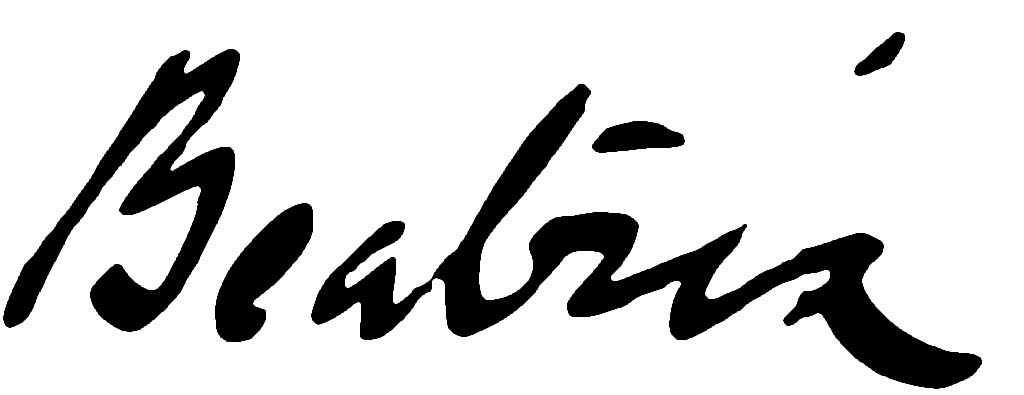
Beatrix documented her mother in the coded journal she kept from the age of fourteen — the private record she encrypted precisely so that Helen could not read it. The portrait that emerges is not a monster. It is something more recognizable: a woman of considerable intelligence who had channeled almost all of it into the maintenance of appearances.
The center of Helen's day was not the morning. It was two o'clock in the afternoon.
At precisely that hour, she would descend to the entrance hall, collect her gloves and her card case, and enter her carriage. She would then be driven across Kensington and beyond, stopping at the homes of other ladies of her class to leave her calling card — a small printed rectangle bearing her name — on the silver tray in their entrance halls. If the lady of the house was receiving, she might be admitted for tea. If not, the card was sufficient. The visit had been made. The relationship had been maintained. The social ledger had been balanced for another day.
This was not, by any modern measure, an enjoyable way to spend an afternoon. But it was not meant to be enjoyable. It was labor — the labor of belonging, performed with the same regularity and the same underlying anxiety as the work in the mills her father had built. The difference was that this labor was invisible, which was precisely the point.
The house itself ran on the same principle. Helen managed the domestic staff with what Beatrix called "exacting" standards — the right rooms cleaned in the right order, meals served at fixed hours, the bookcases in the drawing room kept just so, though the housemaids rearranged them during spring cleaning with an irregularity Beatrix noted with dry disapproval. Silence at breakfast. Silence at dinner. High spirits actively discouraged. The children's meals sent up the back stairs to the nursery rather than eaten at the family table, because the family table was for the performance, and children complicated the performance.
Helen worried about germs. She worried about bad influences. She worried about whether the right people had been invited to the right occasions, and whether the house looked as it should to the people whose opinion mattered. None of these anxieties were irrational, exactly. They were the anxieties of a woman who understood, at a cellular level, how quickly social standing could be lost — and how much work it had taken to acquire in the first place.
Beatrix described the household as a "dark Victorian Mausoleum." The phrase is vivid, and accurate. The house was run as a performance of respectability, and performances require discipline. Everyone in the cast.
From Mama, 1872
What is less often noted is that Helen had her own artistic life.
Before her marriage, she had been an accomplished watercolorist — a standard accomplishment for women of her class, but genuine in her case. She had a watercolor set inscribed with her own name that she eventually passed to Beatrix. She kept a scrapbook for her daughter between 1872 and 1878, carefully preserving Valentine's and Christmas cards, noting the donor and the year in her own hand: "From Mama, 1872."
That scrapbook survived. It is now held at Princeton. It is not the record of a cold or indifferent woman. It is the record of someone who valued beauty, who understood the importance of preservation, and who expressed affection in the way her world permitted — through curation, through objects, through the meticulous keeping of things.
She just could not express it any other way.
The Wrong Direction
Helen actively encouraged Beatrix's drawing during their summer holidays in Scotland and the Lake District. She provided materials and opportunity. She understood, at least partly, what her daughter was doing.
What she could not accept was that it might become professional.
When Beatrix sold her first illustrations to a greeting card company in 1890, Helen was shocked. Not because the drawings were unworthy. Because selling them was trade. And trade was the thing the family had spent thirty years and a great deal of careful social effort trying to leave behind. The tunnel at Gorse Hall, the calling cards, the silent breakfasts, the aspidistras in the drawing room — all of it constructed to put distance between the Leech fortune and the Leech origin.
A daughter who sold drawings to publishers was pulling in the opposite direction.
The Question of Suitors
The conflict came to a head twice, both times over marriage.
In 1905, Beatrix became secretly engaged to Norman Warne, her publisher. She was thirty-nine years old. Helen led the parental opposition. The Warnes were publishers — which meant, in Helen's precise social taxonomy, that they were in trade. The fact that the Potters' own wealth had come from cotton mills was not, apparently, relevant. The family had moved on. The Warnes had not.
Norman Warne died of leukaemia that same year, before the engagement could be resolved. The question became moot.
In 1912, Beatrix announced her intention to marry William Heelis, a solicitor in the Lake District. Helen fought this too. Heelis was a "country solicitor" — provincial, modest, insufficiently elevated. Beatrix was forty-six years old, financially independent, the owner of a working farm and a considerable amount of land. She secured what her biographer calls a "reluctant consent." The wedding took place in 1913.
Helen lived another nineteen years.
Lindeth Howe
After Rupert Potter died in 1914, Beatrix bought her mother a house in the Lake District — Lindeth Howe, on the edge of Windermere, with six acres of gardens and a view across the water. Helen was seventy-five. She filled it with zebra finches in an aviary and maintained the formal routines of her Kensington years until the end.
She died in 1932, at the age of ninety-three.
Beatrix, by then, had been running a working farm for nearly thirty years, had been elected the first female President of the Herdwick Sheepbreeders' Association — a body whose members were hardened hill farmers who did not hand out titles sentimentally — and had been quietly, systematically buying up land to give to the National Trust. None of this was what Helen had wanted for her.
None of it would have existed without her.
The Cage and the Artist
That is the uncomfortable conclusion the research arrives at, and it is worth sitting with.
The tunnel at Gorse Hall, the silent house at Bolton Gardens, the barred windows, the rice pudding sent up the back stairs — all of it constructed a world so constrained, so quiet, so devoid of the ordinary social texture of childhood, that the child inside it had nothing to do but look. At the mouse on the floorboard. At the fungus on the log. At the precise way a rabbit moved.
Helen built the cage. The cage built the artist.
She would have hated that framing. She would have considered it a gross misrepresentation of everything she had worked for. She was probably right, and wrong, in equal measure — which is to say, she was a person, doing the best she could with the world she had been handed.
The scrapbook is still there, at Princeton, with the cards dated in her careful hand.
"From Mama, 1872."
Leave a Visiting Card
Consulting the visiting cards...