
William Heelis's office in Hawkshead was cold, gloomy, and largely unchanged since the seventeenth century. He worked there anyway, every day, for decades.
He was a solicitor — specifically, a land solicitor, which in the Lake District meant something particular. He knew the boundaries of farms that had existed for four hundred years. He knew who owned which strip of fell, which rights of way crossed which pasture, which sale would collapse if the title search turned up an anomaly from 1847. The Lake District ran on stone walls and complicated histories of ownership, and William Heelis knew both.
Rooted
The firm of W.H. Heelis & Son had been serving the communities of South Lakeland since the early 1820s. William had been born into it, in a sense — his family was the professional yeomanry of Westmorland, the class that kept the machinery of rural life running quietly and without fuss. Church of England. Rooted. Unimpressed by London.
He was born in 1871 in Dufton, in what is now Cumbria, and had spent his entire working life in the Lake District. This was not a temporary posting or a stepping stone to something larger. It was simply his life, and he appeared to find it entirely sufficient.
By all accounts, he was a man who listened without domineering. Contemporaries described him as quiet and steady, entirely at ease in the landscape he worked in. He was also, in the villages around Hawkshead and Near Sawrey, simply a neighbour — a man who turned up at agricultural shows and local dances and knew everyone by name.
He was good at dancing, actually. That detail survives.
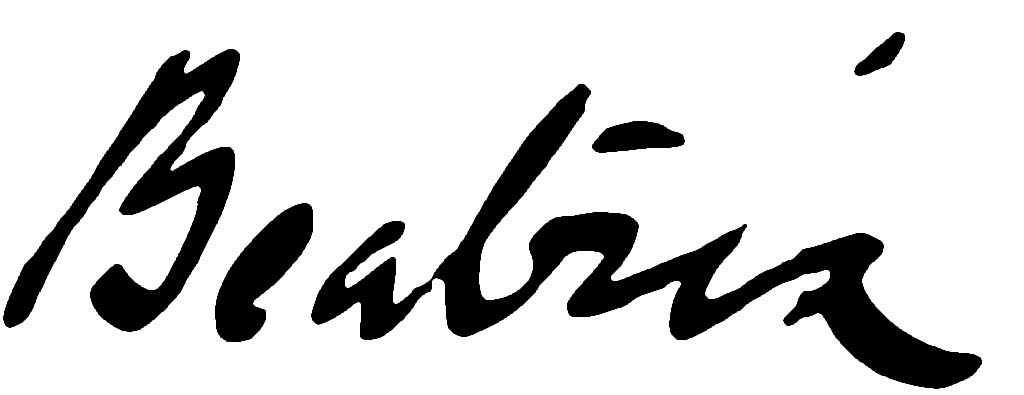
Beatrix Potter first walked into his office in 1905, newly arrived in the Lake District and in need of a solicitor who understood hill farming and the particular complexities of local property law. She had just bought Hill Top Farm in Near Sawrey with the royalties from her books. She needed someone who knew what she had bought.
William knew exactly what she had bought. He also, over the following years, advised her to buy more.
The Work They Did Together
The professional relationship deepened through work, not sentiment. As her landholdings grew — Hill Top, then Castle Farm, then the surrounding fields and cottages she acquired one by one to protect the landscape she was becoming absorbed in — the collaboration with William grew more intricate. He was not simply her solicitor; he was the person who understood what she was trying to do and knew how to make it legal.
What she was trying to do was save the Lake District from being bought up and built over. This required constant acquisition, careful management, and a working knowledge of the Herdwick sheep that grazed the fells — a breed so specific to the landscape that it was considered, by those who knew it, inseparable from the land itself. Potter had become a serious breeder, exhibiting at local shows, winning prizes, and learning the flock management that had sustained these hills for centuries.
William was present at the shows. He understood the sheep. He did not need to have it explained to him why this mattered.
Why He Suited Her
He suited her in ways that are not difficult to understand, once you know what her life had been before.
She had grown up in a house where her movements were tracked, her independence curtailed, her professional work tolerated rather than encouraged by parents who expected her to remain at home indefinitely. Norman Warne had seen her clearly — had understood her precision, her wit, her seriousness as an artist — but his world was London, and publishing, and the careful production of small books. Had he lived, her life would have remained anchored there.
By the time she met William Heelis, the books were already becoming secondary. The farm was the thing. The land was the thing. The slow, methodical accumulation of fell and pasture and working farmhouse — that was where her attention had gone, and it was not coming back.
William Heelis was not interested in the books. He was interested in the land. That was the point of him.
There was also the matter of what he was not. He was not impressed by her fame. In the Lake District, she was not the celebrated author of Peter Rabbit — she was a neighbour, a farmer, and in due course a friend. She could walk into his office in her working clothes, talk about drainage and tenant disputes and the price of Herdwick tups, and be taken entirely seriously. The literary celebrity that occasionally brought visitors from London to her door was, to William, more or less irrelevant.
For a woman who had spent decades performing the role of dutiful daughter, then professional author, then the woman who drew rabbits — the relief of being simply taken at face value must have been considerable.
He was five years younger than her. He was not famous, not literary, not part of any world her parents would have considered impressive. He was a country solicitor who worked in a cold office and spent his evenings at village dances.
She made her interest sufficiently clear that the question of marriage was not long in coming. By 1912 they were engaged. Her parents disapproved, predictably and loudly. She was forty-six years old and owned several farms outright.
The Bull at the Station
What made him the right person is perhaps best captured in a single detail from their life together.
On the day they returned from their honeymoon in 1913, a new bull was arriving at the farm by train. They went to meet it at the station first. The honeymoon could wait; the bull could not.
He understood this completely. He had probably suggested it.
They were married for thirty years. When Potter died in December 1943, she left over four thousand acres, sixteen farms, and her Herdwick flocks to the National Trust — the UK charity that preserves historic land and buildings. William survived her by twenty months. When he died in 1945, he left the remainder of their estate to the Trust as well.
The quiet solicitor from Hawkshead, working from his cold office for four decades, had helped assemble one of the largest conservation gifts the Lake District had ever received. He had done it the only way he knew how: carefully, methodically, and without making a fuss.
Leave a Visiting Card
Consulting the visiting cards...