
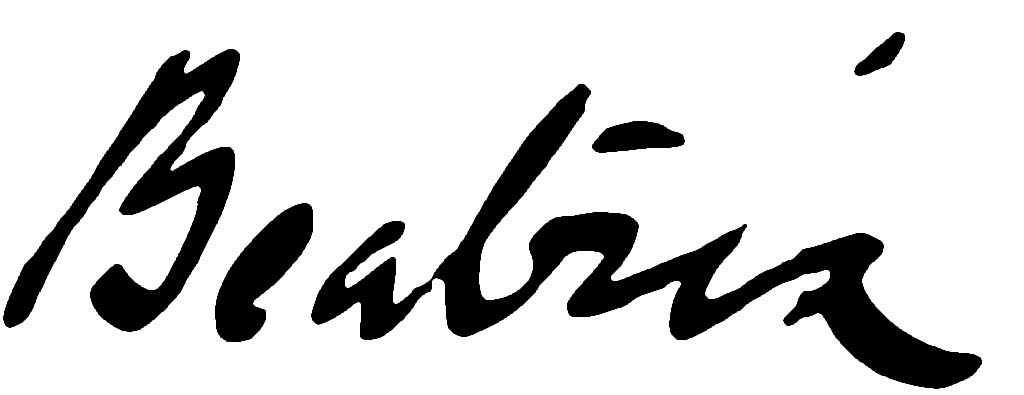
Without Annie Moore, the letters would not have existed. Without Annie Moore's children, they would have had no audience. And without Annie Moore's suggestion, in 1900, that the letters might become books — they would have stayed exactly what they were: private correspondence, written for specific children, eventually lost in the general disorder of family life.
Annie Moore is not a footnote to the Peter Rabbit story. She is one of its foundations.
The Governess Who Became a Friend
Annie Carter arrived at 2 Bolton Gardens on 18 April 1883. She was nineteen years old, hired to teach German to seventeen-year-old Beatrix Potter and provide some degree of social companionship in a household that offered very little of either.
The age gap between them was only two years. This mattered. The typical Victorian governess occupied an awkward middle position — not quite servant, not quite family — and often maintained a careful professional distance. Annie did not. She shared the third-floor schoolroom with Beatrix, tolerated the rabbits and mice and hedgehogs that Beatrix kept as subjects for study and drawing, and seems to have recognised, without making much of it, that her pupil was unusually talented and unusually isolated. The two became genuinely close — close enough that when Annie left in 1885 to marry a civil engineer named Edwin Moore, the friendship continued without the salary.
What Beatrix gained from Annie during those two years was not primarily German grammar. It was the experience of being taken seriously by someone her own age. In a house where her mother managed every detail of domestic life and her brother had been packed off to boarding school, that was not a small thing.
The House in Wandsworth
Edwin and Annie Moore settled at 1 Baskerville Road, Wandsworth Common, and began filling it with children. By 1903 there were eight: Noel, Eric, Marjorie, Winifrede, Norah, Joan, Hilda, and the youngest, named Beatrix in honour of her mother's old friend.
The Moore household was everything that Bolton Gardens was not. Edwin was a left-wing radical and a founding member of the Fabian Society — he would go on to work as an engineer on the Aswan Dam in Egypt. Annie was, by all accounts, a staunch Conservative. The house ran on healthy argument, domestic chaos, and a great many children. Beatrix visited regularly, often arriving with a basket containing her latest pet.
These visits were important to her. The Moores offered the kind of warm, ordinary family life she had never had access to, and the children offered something more specific: they were a real audience. They were interested, uninhibited, and entirely unimpressed by her social standing. If a story was boring they would have said so. If a drawing was funny, they laughed.
She tested things on them. The Moore children were, in effect, the first readers of almost everything she went on to publish.
Eight Children, Eight Correspondents
The picture letters she sent to the Moore children began in the early 1890s and continued for years. Each child received letters calibrated to their age and temperament. Noel and Eric, the eldest, got the letters that would eventually become the foundational books — a rabbit in a blue jacket, a frog who went fishing. Norah received letters full of squirrel riddles in 1901, the seed of Squirrel Nutkin. Freda received, as a Christmas gift in 1901, a handwritten manuscript of The Tailor of Gloucester — the story Potter always said was her personal favourite — dedicated to her specifically because she was fond of fairy tales and had been ill.
The dedication Potter wrote for Freda was among the most personal things she put on paper during this period: a story made entirely for one child, written out by hand with watercolours, given as a gift rather than published.
When The Tailor of Gloucester was eventually published commercially by Warne in 1903, Potter borrowed Freda's copy back to use as the template. The publisher cut many of the nursery rhymes Potter had chosen with care. Freda's original manuscript — the full, unedited version — survived because Annie had raised children who understood that Beatrix's letters were worth keeping.
This was not accidental. Annie had encouraged the children to hold onto their letters from the beginning. The result was that when the moment came to think about publication, the originals existed. They could be retrieved, copied, revised. The story could be reconstructed and turned into something permanent.
The Suggestion That Changed Everything
In 1900, Beatrix Potter was thirty-four years old and financially dependent on her parents. Her scientific work in mycology had been rejected by the Linnean Society, which did not permit women to attend meetings. She had no clear professional path. She was still living at Bolton Gardens under the terms she had lived there since childhood.
During a visit to Wandsworth that year, Annie made a suggestion. The letters Beatrix had been sending for nearly a decade — had she considered that they might be published? Annie had watched her children respond to them for years. She had kept the letters. She knew what they were.
It was not a casual remark. Annie had observed, practically and from close range, that there was an audience for what Beatrix was making. She offered to return the letters so that Potter could copy and revise them for submission to publishers.
Potter took the suggestion seriously. She borrowed the letters back, revised the narrative, refined the illustrations, and began approaching publishers. Six of them said no. She then printed 250 copies herself, in December 1901, using her own savings — and sold them, in large part, through the network of family and friends that included the Moores. The commercial edition from Frederick Warne followed in October 1902.
The sequence from suggestion to publication took two years. Annie's intervention was the beginning of it.
What Came After
The friendship between Annie and Beatrix outlasted the letters, the books, and the years in London. As Beatrix moved toward permanent life in the Lake District — buying Hill Top Farm in 1905, marrying William Heelis in 1913, becoming Mrs. Heelis in everything but her publisher's records — the Moore family remained a fixed point of connection to her earlier self. Even as she shed the identity of Beatrix Potter the author, the Moores remembered who she had been when she was still becoming that person.
Annie Moore lived to eighty-six, seven years longer than Beatrix. She stayed at Baskerville Road for sixty-two years — the same house where the children had received their letters, the same house where the rabbits had arrived in baskets. Her daughters Marjorie and Joan cared for her in old age, eventually moving to a house they named Hill Top, built on Eric's farm in Buxted.
Noel, the eldest son — the boy who had been ill with scarlet fever in September 1893, the five-year-old who had received the letter about four little rabbits — became an Anglo-Catholic priest, spending his career working with the poor in London's East End. He cooperated with Potter's early biographers, making sure the origin of the letters was accurately recorded. He understood what he had been part of.
Beatrix Potter kept two small watercolour portraits of the youngest Moore children — Hilda and the baby Beatrix — in the living room of the Hill Top dolls' house. Not on display for visitors. Just there, in the private interior of a miniature room — the children of the woman who had kept the letters, kept close in the only way she knew how.
Leave a Visiting Card
Consulting the visiting cards...