
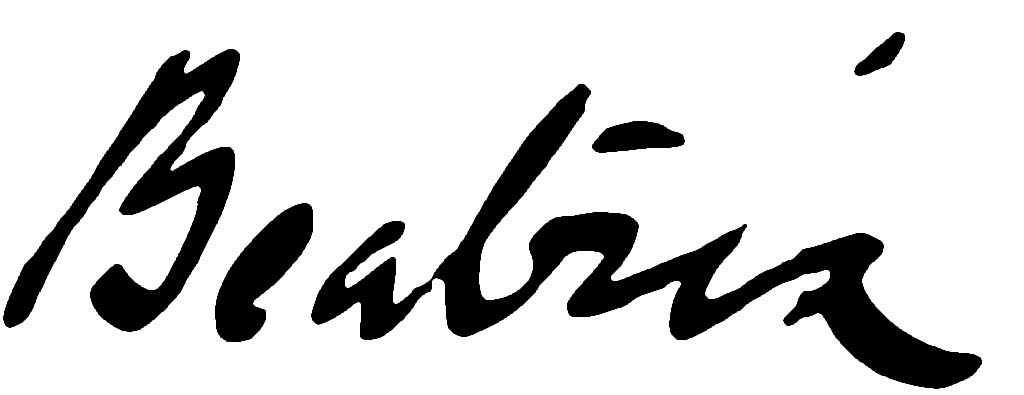
On the morning of September 4, 1893, Beatrix Potter sat down in a rented house in the Scottish Highlands and wrote a letter to a five-year-old boy named Noel Moore, who was in bed with scarlet fever in London.
She had no particular plan. She said so herself in the first line: "My dear Noel, I don't know what to write to you so I shall tell you a story about four little rabbits whose names were — Flopsy, Mopsy, Cottontail and Peter."
She folded the pages into a small booklet, tucked in sixteen pen-and-ink sketches, and sent it south.
That was the beginning.
The Day Before
The day before she wrote the letter, Beatrix had painted a fungus.
Not just any fungus. Strobilomyces floccopus — the Old Man of the Woods — a species so rare it had no official record in the British Isles until 1899, six years after she found and painted it on the banks of the River Tay. She was twenty-seven years old. She was in the middle of a period of intense scientific observation, working at a level of precision that put her alongside the professional naturalists of her era.
The following morning she wrote a story about a rabbit in a garden.
This does not look like a coincidence. It looks like what it was: the same eye, applied to different material. The same care she brought to the gills of a mushroom, she brought to the way a rabbit moves when it's frightened, the way a jacket can catch on a gooseberry net, the exact vegetables that would be growing in a Scottish kitchen garden in September. She was not relaxing into fiction. She was doing what she always did — looking carefully at a real thing and drawing what she saw.
Noel
Noel Moore was the eldest child of Annie Moore, who had been Beatrix's governess and was now one of her closest friends. He had been ill for weeks. Scarlet fever was still dangerous in 1893, frequently fatal in children, and even when it wasn't fatal it meant long convalescence — lying in a sickroom while the summer wound down outside.
Beatrix wrote to him as she would write to a person, not as adults usually wrote to sick children: no empty reassurances, no getting-well-soon. She offered him somewhere else to be.
The letter ran to eight pages, folded into a booklet small enough for a child to hold. The format was not accidental — it was almost exactly the size of the "little books" she would publish nearly a decade later with Frederick Warne & Co. The story it contained was essentially the story that became The Tale of Peter Rabbit, complete: the mother's warning, the garden, the feast, the chase, the loss of the jacket, the escape, and the camomile tea at the end.
Noel recovered. He kept the letter. So did his brothers and sisters — Beatrix sent picture letters to all the Moore children over the years, and they treated them as something worth saving, "almost as good as a visit."
The Letter Survives
Beatrix did not keep copies of her correspondence. She wrote, she sent, she moved on.
When Annie Moore suggested, in 1900, that Beatrix's picture letters might contain the material for several books, Beatrix had to ask the Moore children to lend them back. The children, now teenagers, still had them. Every one of them. The 1893 letter to Noel had survived seven years of being a much-read, much-loved object in a household of eight children.
Beatrix borrowed it, copied it out in ink onto fresh paper — the copy that now sits in the Beatrix Potter Gallery in the Lake District as National Trust item NT 242253 — and used it as the basis for her first attempt at a proper manuscript.
The copy is nearly identical to the original letter. The same illustrations, very minor changes to the text. The shape of the thing had been right from the beginning.
What She Changed
Between the 1893 letter and the 1902 book there was an important difference, and it wasn't the plot.
It was time.
The letter was written in a rush — almost no punctuation, sentences tumbling into each other the way they would if you were telling a story out loud to a child who was listening hard. "Mr. McGregor was planting out young cabbages but he jumped up & ran after Peter waving a rake & calling out 'Stop thief!'" Everything happening at once, no space to breathe.
The book slowed that down. "Mr. McGregor was on his hands and knees planting out young cabbages, but he jumped up and ran after Peter, waving a rake and calling out, 'Stop thief!'" The pause at the comma. The weight on each action. Room for the page-turn that lets a child hold the suspense before seeing what happens next.
This is not a small thing. The letter was a personal dispatch, written for one sick boy on one September morning. The book was a different kind of object — designed to be read slowly, more than once, by children in many different rooms. Beatrix understood the difference and rebuilt the pacing accordingly. By 1902, she had stopped being someone who told stories and become someone who made them.
"Not Made to Order"
The one thing she was clear about, throughout all of it, was that the letter had worked because it was real.
Years later, after Peter Rabbit was already famous and seven more of her little books were in print, she wrote to a friend about sending picture letters to a new child — the young daughter of one of the Warne brothers:
"I hope I shall write Winifred lots of letters, it is much more satisfactory to address a real live child; I often think that was the secret success of Peter Rabbit, it was written to a child — not made to order."
The phrase she reached for was made to order. She had seen what happened when publishers got involved in the process from the beginning — the suggestions, the adjustments, the commercial considerations. She had resisted most of them. What she trusted was the original impulse: a story that started because a specific child was ill, in a specific place, in the middle of a summer she was using to look closely at the world.
Noel Moore grew up, recovered fully, became a priest, and spent his adult life working with children in the poorer parts of London. The letter he received in 1893 is now in the Victoria and Albert Museum. The copy Beatrix made in 1900 is in the Lake District. The book that grew from both is in print in forty-five languages.
The story began on a Monday in September in Scotland, when she didn't know what to write, so she told a story instead.
That was the whole of it.
Leave a Visiting Card
Consulting the visiting cards...