
The Tale of Tuppenny
Tuppenny is a long-haired guinea-pig in the town of Marmalade, where the other guinea-pigs are smooth and short-haired. His friends persuade him to visit the Barber's for a hair-growing tonic. The tonic works. It works too well. Tuppenny's hair grows another inch on the way home, and another inch by morning, and won't stop. Eventually he sells himself to a travelling show — "TUPPENNY, the HAIRY GUINEA-PIG, who lives in a caravan!"
Beatrix wrote it during a wet week's holiday at Hastings in late November 1903, in the same exercise book that produced Two Bad Mice and Pie and Patty-Pan. Frederick Warne chose the mouse story. Tuppenny was set aside.
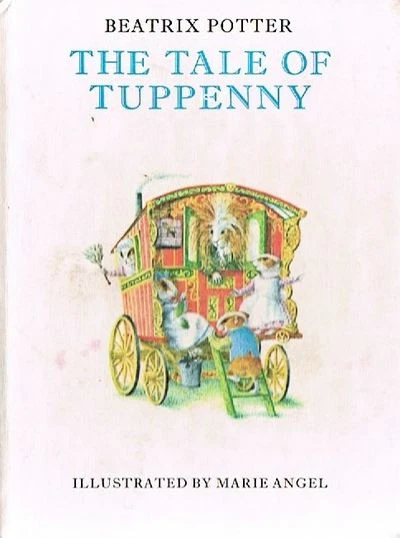
Twenty-six years later, when Beatrix was assembling The Fairy Caravan, she lifted Tuppenny back out and made him Chapter 1 — the long-haired guinea-pig who sells tickets at the door of the travelling show. The original 1903 version was finally published, on its own, in 1973 — using Beatrix's original drawings, seventy years after she wrote it.
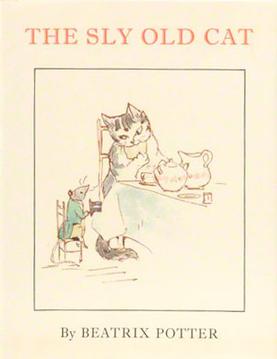
The cover shown is the original edition. Amazon carries the copies in print today.
Buy on Amazon→❦ Everything else in the Sanctuary is free, and this is the shelf that keeps it so. Bea's Corner is an Amazon Associate — buy through these links and a little comes back to us, at no extra cost to you. With thanks for keeping the doors open.
Particulars
- Posthumous edition
- 1973, Frederick Warne & Co. (seventy years after the manuscript)
- Manuscript
- Hastings, late November 1903 — same exercise book as Two Bad Mice and Pie and Patty-Pan
- Setting
- The town of Marmalade; the Barber's shop; the travelling show
- Position
- Lost for twenty-six years, then revived as Chapter 1 of The Fairy Caravan (1929); standalone book in 1973
- Companions
- Three Hastings stories sat together in the exercise book; the other two became books in 1904 and 1905
Curiosities
- ❦Tuppenny's name reappeared on the dedication page of his sister-book — Mr. Jeremy Fisher — though Beatrix scrambled the chronology over the decades.
- ❦The tonic at the Barber's costs "8 peppercorns" per bottle. After Tuppenny becomes a public sensation, the price rises to "20 peppercorns."
- ❦The Barber's shop closes when his customers vanish: "After a time he put up his shutters and ran away. Then the rats took possession. They ate up all the pomade and drank up all the remaining bottles of the celebrated hair-wash; but it had no effect upon them (they being bailiffs)."
- ❦At the end of the 1903 version, Tuppenny sells himself to a circus that includes a "menagerie of five Polecats and Weasels; and a troupe of performing fleas; and the Fat Dormouse of Salisbury." The same circus, decades later, would become The Fairy Caravan.
- ❦The book is one of the few cases where Beatrix's work was published exactly as she wrote it as a young woman — without later revision.
From the same shelf
Your Sanctuary Collection
Your collection is currently empty.