The Story of a Fierce Bad Rabbit began with a complaint. A small girl told Beatrix Potter that Peter Rabbit was much too good. She wanted a thoroughly naughty one instead. Beatrix took the challenge and wrote one — a short, sharp tale about a rabbit with no manners at all, and what happens to him.
It is one of her simplest books, made for very young children. It is also one of her most interesting experiments, because of the unusual shape she chose to print it in. That shape is the reason the book is less well known today than it might be.
The Child Who Asked for a Naughty Rabbit
The book was written for Louie Warne, the little daughter of Beatrix's publisher, Harold Warne. Louie was about six. She had decided that Peter, for all his trouble in Mr McGregor's garden, was simply too well behaved. She wanted a properly bad rabbit.
Linder records the origin plainly: the story "was written specially for Harold Warne's little girl, Louie, who had told Aunt Beatrix that Peter was much too good a rabbit, and she wanted a story about a really naughty one." Her biographer Linda Lear says the same — Louie "thought that Peter had been too well behaved and wanted a story about a truly naughty rabbit."
So the book is an answer to a child's request. There was a feeling about that the little books were gentle and mild, and here was a young reader saying so to the author's face. Beatrix did not argue. She wrote the naughty rabbit Louie had asked for. The manuscript is dated 23 February 1906, and she gave it to Louie, whose father had it specially bound.
A Very Short, Very Blunt Story
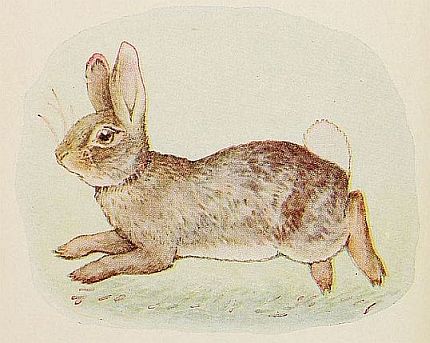
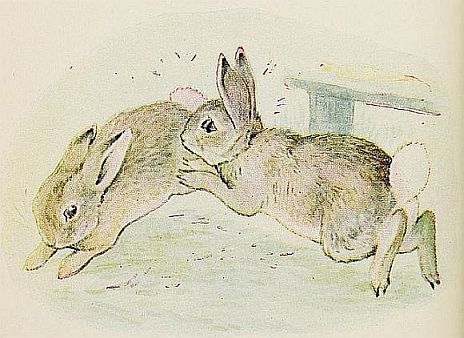
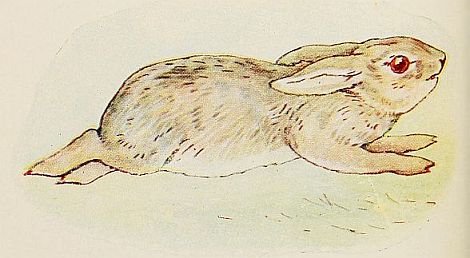
The tale itself is brief and almost without words. A good rabbit sits quietly with a carrot. A fierce bad rabbit comes along, snatches the carrot, and scratches the good rabbit for good measure. He has no charm and no excuse. He is simply bad.
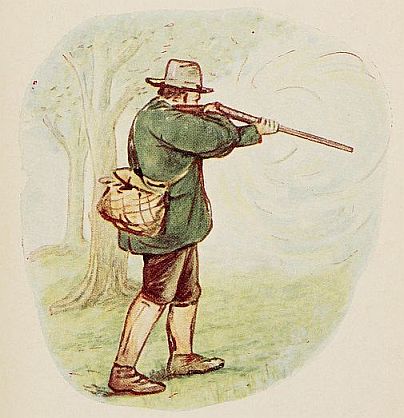
Then justice arrives, suddenly and without a lecture. A man with a gun sees the bad rabbit's tail and mistakes it for a bird. He fires. The bad rabbit loses his tail and his whiskers and tears away in fright. He survives, but he is humbled. The good rabbit gets his carrot back.
There is no moral spelled out, and the rabbit is never even given a name. The whole thing is over in a handful of pictures. It was made for children too young for a longer story — a small, plain lesson in cause and effect, delivered fast.
Years later, after she married the solicitor William Heelis, Beatrix made a wry remark about one of the pictures. "My husband undertakes to hold a gun properly," she wrote, "which was a defect in the Bad Rabbit pictures." She had drawn the man holding his gun wrong, and a country husband had noticed.
The Fold-Out Experiment
What makes the book stand out is not the story but its shape. Beatrix did not print it as an ordinary little book. She printed it as a panorama.
The fourteen pictures and their short lines of text were set out in pairs along a long band of linen. The band folded up concertina-style — back and forth, like a paper fan — and tucked into a flat wallet with a flap. To read it, a child unfolded the whole strip and looked along it. It was a different object entirely from the familiar pocket-sized book.
It was part of a small set of experiments. Beatrix planned three of these panorama stories at once. The second, a companion piece about a kitten and a mouse, was published the same year. A third was made but never came out in her lifetime. The idea was to do something fresh — a new format for the youngest readers, unlike anything else on the shelf.
→ Read The Story of a Fierce Bad Rabbit
Why It Failed
The experiment did not work, and Beatrix was clear-eyed about why. The problem was not the children. It was the shops.
"Bad Rabbit and Moppet were originally printed on long strips," she explained near the end of her life. "The shops sensibly refused to stock them because they got unrolled and so bad to fold up again." A strip that fanned open was a nuisance to refold. Shopkeepers did not want stock that came apart on the counter and would not go neatly back into its wallet.
There was a second problem. Customers liked to handle a book before buying it, and the panorama did not allow it — you could not flip through a folded strip the way you could leaf through a bound book. Booksellers protested. The format got in the way of the sale.
So the strip books sold poorly, for reasons that had nothing to do with the stories inside them. It is a sharp little lesson in how a good idea can be defeated by the practical world of selling. The book that a child had demanded was beaten not by its readers but by the shape it was printed in.
A Book for the Very Young
It helps to see what Beatrix was aiming at. The Fierce Bad Rabbit was not made for the readers of Peter Rabbit or Benjamin Bunny. It was made for much younger children — for babies, almost — who could not yet follow a real plot. That is why the words are so few and the story so blunt. A snatched carrot, a loud bang, a tail gone: a small child can grasp that without help.
This shaped the format as much as the story. A fold-out strip with a single picture and a single line at each step was a kind of first book — something to spread out and point at, more toy than tale. Beatrix and her publisher were trying to reach down to the youngest end of the nursery, below the age her famous tales served.
She planned three of these little strip stories together in early 1906. One was the fierce rabbit. One was a companion about a kitten. The third, a story called The Sly Old Cat, she finished and had bound — but it was never published in her lifetime. The format failed before it could appear, and The Sly Old Cat waited more than sixty years to reach print, long after her death. So the experiment cost her not only poor sales but a whole finished book that simply could not come out.
Set beside an ordinary little book, the difference is plain. A bound book sits on a shelf, opens flat, and survives handling. A folded strip does none of these things easily. The story was sound and the pictures were good. The object was the problem.
Rescued in 1916
The story did not stay lost. In 1916 Beatrix and Warne brought it back, this time as an ordinary bound book — in a format close to the other little books, though slightly smaller. She drew a new frontispiece for it. Freed from the troublesome strip, the tale could finally sit on a shelf and be picked up like any other.
That is the form most readers know it in now: a small book, not a folded wallet. But the original experiment is worth remembering. It shows Beatrix willing to try a genuinely new idea — a fold-out picture story for the very young — and willing, afterward, to see plainly why it had not paid.
The Story of a Fierce Bad Rabbit is a minor book by length. But it carries two things that matter. It is proof that she listened to her readers, even a six-year-old who told her Peter was too good. And it is a record of an experiment that failed honestly, taught her something about her trade, and was quietly put right ten years later.
Read It in Full
That's how it was made. Now read The Story of a Fierce Bad Rabbit itself, in the Complete Tales. Open The Story of a Fierce Bad Rabbit →
Sources
The facts in this article are drawn chiefly from Leslie Linder, A History of the Writings of Beatrix Potter, and Linda Lear, Beatrix Potter: A Life in Nature, cross-checked against Judy Taylor's edition of Beatrix Potter's Letters to Children. The origin with Louie Warne and the account of why the format failed are from Beatrix Potter's own words as recorded by Linder. The history is theirs to record; the words here are our own.
Leave a Visiting Card
Consulting the visiting cards...