Beatrix Potter opened The Tale of Mr. Tod with a sentence she had been working up to for years. She wrote: "I am quite tired of making goody goody books about nice people." It is the most direct statement in all her published work. She was announcing a change of register, and she meant it.
The book, published in 1912, is the longest and darkest of the small books. It has two villains, real violence, and an ending that withholds the resolution readers had come to expect. It is the book where Beatrix stopped softening the world and showed it as it was.
Two Villains in One Book
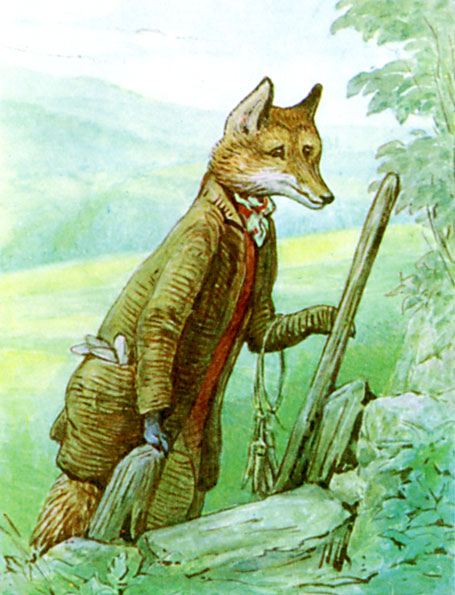
Mr Tod is a fox. Tommy Brock is a badger. By Beatrix's account, neither of them was pleasant.
She introduced both characters in the same sentence of the opening, making it clear that this book would not have the usual moral architecture — a well-behaved animal, a danger to be avoided, an escape, a lesson. Here both figures were predators. Both were unpleasant. Neither was going to redeem himself.
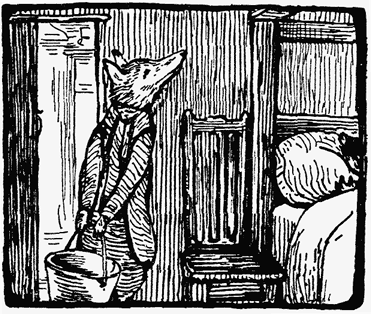
Mr Tod is the more stylish of the two. He moves houses frequently, leaving each one dirty for the next occupant. He speaks in a polished way. He has opinions and standards. The surface manner is agreeable. The substance is not.
Tommy Brock is coarser. He is dirty, slow, heavy, and almost impossible to get rid of. He takes what he wants, digs himself in, and waits. His tactic is endurance rather than charm. He and Mr Tod dislike each other with a consistency and depth that Leslie Linder described as the sharpest portrait of sustained mutual contempt in Beatrix's canon.
The Rabbits' Crisis
The story is driven by the kidnapping of the Flopsy Bunny babies. Tommy Brock, who has been eating supper with old Mr Bouncer (Benjamin's father, not a careful guardian), takes the babies in a sack while Mr Bouncer is asleep. He carries them to Mr Tod's house, where he settles in and falls asleep in Mr Tod's bed.
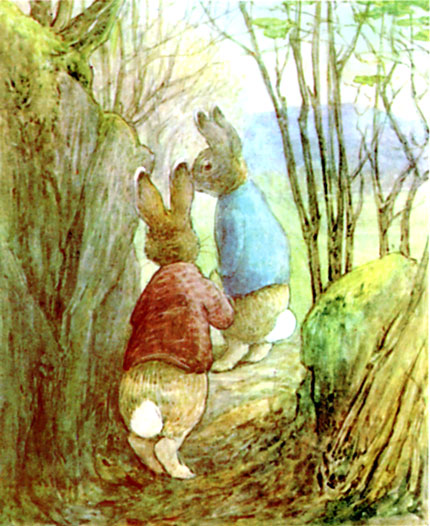
Benjamin Bunny discovers what has happened. He goes to find Peter Rabbit. Together they track Tommy Brock to Mr Tod's house — a place in the hills above Owl Island called Bull Banks and Oatmeal Crag. The journey takes most of the book. It is dark, cold, and full of bad smells.
The natural setting here is more oppressive than in any of the earlier books. The fell above Sawrey, the damp places between rocks, the dim light inside the house — Beatrix used landscape to create a mood of genuine unease. She had spent years observing the Lake District in all its moods, and she knew how to make it feel threatening.
The Fight
When Mr Tod returns to find Tommy Brock in his house, what follows is a fight. A real one.
Beatrix did not spare the details. The two animals tear the house apart. Furniture breaks. Water spills. They fall through the floor. They injure each other. The fight has none of the cartoon energy of a conventional children's story — it is ugly and exhausting and ends without a winner.
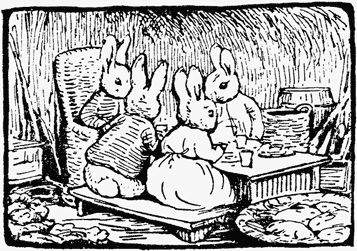
While Mr Tod and Tommy Brock destroy each other's peace, Peter and Benjamin break in through a window and recover the babies. The rescue is possible only because the two adults are too busy fighting to notice anything else.
There is no triumph here. The villains are not defeated. They simply damage each other. The babies are saved by timing rather than heroism.
"Never Cared One Tuppenny-Button"
Beatrix was aware that The Tale of Mr. Tod was different from what her readers expected. She did not apologise for it.
Throughout her career she had expressed a consistent independence from critical opinion. She did not read reviews. She did not adjust her work to please people who wrote about books. In one of her later letters, she put it in a phrase that became characteristic: she had never cared one tuppenny-button about public opinion.
This was not entirely true — she was attentive to her readers and responsive to her publisher — but the spirit of it was genuine. She made Mr. Tod the way she made it because she thought it was right, and the fact that it was darker than her usual work did not trouble her.
She acknowledged, in correspondence, a debt to the Uncle Remus stories of Joel Chandler Harris. The tradition of animal stories that did not shy from violence or cunning was something she respected and drew on. The animals in her Lake District books had always had a sharpness to them. In Mr. Tod she let that sharpness come fully forward.
The Dedication and the Refusal
The book was dedicated to Francis William of Ulva — a child in a family Beatrix had come to know through her farming connections. The dedication was quiet and personal, as her dedications usually were.
She had also, at this period, resisted pressure from Warne to change the format of the small books. The standard Warne format — the square, pocket-sized picture book — was what she believed in. When commercial suggestions were made for alternative formats that she thought unsuitable, she declined them without much discussion. She knew what the books should be.
Mr. Tod was, unusually, larger and longer than the standard format. She permitted the expansion because the story required it. The chase across the fells, the fight in the house, the recovery of the babies — none of this could be told in the tight space of the shortest books. She gave the story the space it needed.
The Setting
The landscape in Mr Tod is more precisely used than in almost any other book.
Bull Banks and Oatmeal Crag are real names. They are places above Near Sawrey, on the fell above the valley. Beatrix knew these fells well by 1912 — she had been farming at Hill Top for seven years, she walked the land regularly, she understood the character of different parts of the fell in different weather.
The journey that Peter and Benjamin make to find Mr Tod's house is a real journey uphill into a different kind of country. Below Hill Top the world is domestic, ordered, farmed. Above it, on the open fell, the rules are different. The cold, the distance, the smell of fox — these are not decorations. They are what the fell is actually like.
Beatrix used this geography to establish that Mr Tod's world was not the same as the farmyard world. The animals who lived up there — the fox and the badger — operated by different laws. Peter and Benjamin had come into country that was not theirs, to deal with animals who were larger and stronger and entirely indifferent to the small rabbits' distress.
The setting earns the book's darkness. It is not simply a dark story. It is a story set in a place where dark outcomes are possible.
What She Built
The Tale of Mr. Tod is the furthest Beatrix went from the domestic safety of the earliest books. She had been building toward it for a decade — the small books with their safe endings and their warm kitchens had been one mode, and she had worked it thoroughly. Mr Tod was the other mode. It is set high in the fells, in cold weather, in the dark. Its main characters are predators. Its tone is grim rather than warm. The rescue, when it comes, is lucky rather than earned.
And yet it is unmistakably her work. The natural observation is meticulous. The characters are fully imagined. The landscape is drawn from real places she had walked. The language — particularly in the fight sequence — has a precise, unsparing quality that she brought to everything.
She had been building toward this book across ten years of publishing. She made it when she was ready. She was not afraid of it. She was, as she said, tired of good books.
Read It in Full
That's how it was made. Now read The Tale of Mr. Tod itself, in the Complete Tales. Open The Tale of Mr. Tod →
Sources
The facts in this article are drawn chiefly from Leslie Linder, A History of the Writings of Beatrix Potter, and Linda Lear, Beatrix Potter: A Life in Nature, cross-checked against Judy Taylor's edition of Beatrix Potter's Letters. The history is theirs to record; the words here are our own.
Leave a Visiting Card
Consulting the visiting cards...