Most of Beatrix Potter's small books follow a simple pattern. An animal encounters danger, gets into trouble, and finds a way out. The danger is real but the ending is safe. The Tale of Squirrel Nutkin does something different. Here the danger comes not from outside but from within the main character — from a kind of cheerful, relentless insolence. And the ending is not safe at all.
The Letter That Started It
Beatrix wrote Squirrel Nutkin as a picture letter in September 1901, sent to a child named Norah Moore. It was a companion piece to the letter she had written to Norah's brother eight years earlier — the one that became The Tale of Peter Rabbit.
The letter told the story in its essentials: a group of squirrels visits an island, brings offerings to an owl, and collects nuts. One squirrel — Nutkin — refuses to behave like the others. He dances and jibes and asks riddles while his brothers work. He does it again the next day, and the day after that. Eventually the owl loses patience.
When she turned the letter into a book, Beatrix kept the riddle structure at the heart of it. This was unusual. Most picture books of the period followed plain narrative lines. Nutkin's structure is more like a ritual: offering, riddle, reprimand, offering, riddle, reprimand — seven times across seven days, each one a small provocation.
The Setting on Derwentwater
The island in the story is Owl Island — a place where Old Brown the owl has his domain, accepts tribute, and conducts himself with the dignity of a judge. The island Beatrix had in mind was St Herbert's Island on Derwentwater. She knew that lake well from the summer holidays her family had taken at Lingholm and other Derwentwater estates.
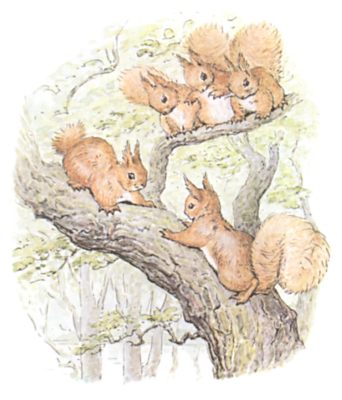
She drew the squirrels' journey across the water with feeling. They paddle on little rafts made of twigs, holding their tails up as sails. The illustration of the flotilla leaving the shore is one of the gentlest pictures she ever produced — warm autumn light, a calm lake, small animals absorbed in their work.
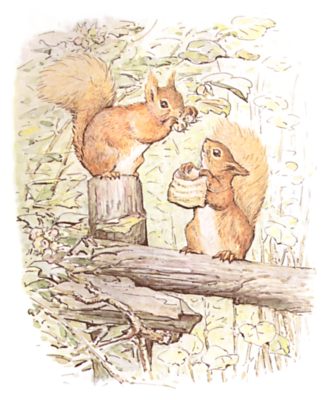
The contrast between that image and what follows is part of what makes the book work. The setting is beautiful. The squirrels' ritual is almost ceremonious. And Nutkin disrupts it all.
The Live Models
Beatrix kept squirrels to draw from while she worked on the book. The squirrels were difficult.
According to Leslie Linder's account, they fought each other. They would not stay still. They were more aggressive and less willing than the rabbits and hedgehogs she had worked with before. The drawings she produced despite this were exceptionally precise — the angle of the head, the curl of the tail, the grip of the small claws on bark — but the process had not been easy.
That difficulty may have sharpened her sympathy for Old Brown. A creature pushed too far will react.
The Riddles and What They Mean
The riddles are real riddles, and Beatrix took care with them. They have traditional roots in English folk verse. Some are easy. Some are hard. A few are quite old.
Nutkin does not present the riddles politely. He throws them at Old Brown as provocations, not as questions. He dances while he asks. He makes a nuisance of himself. Old Brown refuses to answer any of them, which is his prerogative — he is, after all, the owner of the island and the recipient of squirrel tribute. He ignores Nutkin as long as he can.
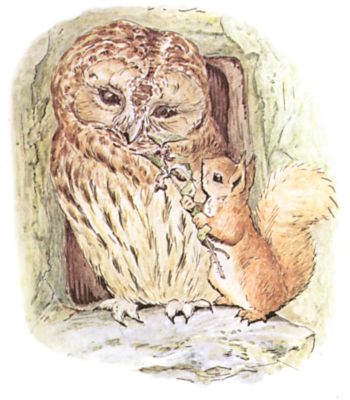
What the riddles tell us about Nutkin is something Beatrix seems to have intended carefully. He is not stupid. The riddles require intelligence and memory. His problem is not that he cannot think — it is that he will not conform. He knows the rules and chooses to mock them. The other squirrels know this. They are embarrassed by him. They bring their offerings and try to make up for his behaviour.
She had written a character who was clever, disruptive, and entirely unwilling to learn.
The offerings the squirrels bring are themselves carefully chosen. Old Brown receives moles, and fat minnows, and a new-laid egg. These gifts have weight and specificity. They are not invented tribute — they are the kinds of things an owl actually values, and the kind of detail Beatrix always got right. The contrast between the squirrels' careful giving and Nutkin's dancing dismissal of the whole ritual is part of what makes the sequence funny and also slightly awful.
The structure of the gifts — different each day, building through the week — gives the book a rhythm like a counting rhyme. Readers who know it well can follow the pattern the way they follow a familiar song. The riddles are embedded in that pattern, and the repetition makes Nutkin's persistence feel almost musical. He is not just rude. He is relentlessly, rhythmically rude.
→ Read The Tale of Squirrel Nutkin
A Tale of a Tail
Beatrix described the book herself, in a note she made, as "a tale of a tail." The phrase is a small joke, but it is also a true description of the plot. The story ends with Nutkin losing most of his tail. Old Brown eventually seizes him, and Nutkin barely escapes with his life — but leaves most of his tail behind.
There is no happy resolution. No lesson learned, no wisdom gained. Nutkin is left with half a tail and, by Beatrix's account, a lingering fury. When anyone asks him riddles, he stamps his feet and shouts.
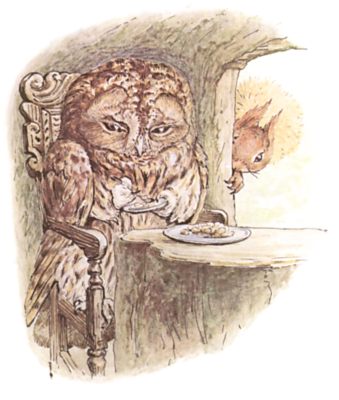
This ending troubled some readers when the book appeared in 1903. A character who suffers a real, permanent consequence — not a fright, not a near-miss, but an actual loss — was unusual in a picture book for young children. Beatrix had given Old Brown the right to punish insolence with real force, and she did not walk it back.
For Leslie Linder, writing decades later, this was evidence of Beatrix's willingness to follow her story wherever it led, without smoothing the ending to reassure adults. The punishment fitted the provocation. Nutkin had pushed too far, too many times, and the owl had reacted. Beatrix trusted young readers to take that in.
The Letters After the Book
Beatrix Potter did not leave Nutkin's situation unexamined. After the book was published she created a whole miniature postal correspondence in which Nutkin tries to recover his tail.
He writes to Old Brown. Politely, formally, with a return address. He offers three bags of nuts. He explains that he misses his tail very much. He notes he would pay postage. He signs the letter "yrs truly, Squirrel Nutkin."
Old Brown does not reply. Nutkin writes again, noting that he may not have given his address clearly — it is Derwent Bay Wood — and that he wrote twice before. He will pay postage. He remains "yrs respectifully."
His brother Twinkleberry intervenes diplomatically. He writes to Old Brown on Nutkin's behalf, noting that Nutkin never asks riddles any more and is truly sorry that he was so rude.
Old Brown's secretary finally sends a reply. Mr Brown cannot reply to letters as he is asleep. Mr Brown cannot return the tail. He ate it some time ago. It nearly choked him. Mr Brown requests Nutkin not to write again, as his repeated letters are a nuisance.
Nutkin then consults a Dr Maggotty, who advertises blue beans for chilblains. Perhaps the beans could make a tail grow? He is worried, he writes, that they might make him grow a blue tail instead. It would spoil his appearance.
These tiny letters, each folded into its own miniature envelope, are among Beatrix's most purely comic writing. Judy Taylor collected them in Letters to Children from Beatrix Potter. The tail is gone. It nearly choked the owl. The polite, escalating, entirely futile campaign to recover it is exactly the kind of story Beatrix enjoyed. She gave Nutkin the full dignity of a formal correspondence, and then she gave him Old Brown's completely final answer.
What the Book Reveals
The Tale of Squirrel Nutkin sits a little apart from the other early books. It is the only one structured around a repeated form — the riddle, the snub, the next day's offering — rather than a linear chase or journey. The Lake District setting is used not as background but as a world with its own rules, presided over by a figure of genuine authority.
Old Brown is not a villain. He is the law of the island, and the island's law is that visitors must behave. Nutkin's refusal to accept that law is the engine of the entire story.
Beatrix seems to have found something worth exploring in that refusal. She gave Nutkin her best energy, her sharpest illustrations, her most playful text. And she gave him a punishment that lasted. He is her most vivid study in what happens when a creature trusts its own cleverness too completely, and finds too late that cleverness alone is not protection.
Read It in Full
That's how it was made. Now read The Tale of Squirrel Nutkin itself, in the Complete Tales. Open The Tale of Squirrel Nutkin →
Sources
The facts in this article are drawn chiefly from Leslie Linder, A History of the Writings of Beatrix Potter, and Linda Lear, Beatrix Potter: A Life in Nature, with the miniature letter texts drawn from Judy Taylor's Letters to Children from Beatrix Potter. The history is theirs to record; the words here are our own.
Leave a Visiting Card
Consulting the visiting cards...