
Three little mice sat in a window to spin. They were cousins. Said the First Cousin Mouse to the Second Cousin Mouse, "Tell us a story, to pass the time while we spin."
"What about?" said the Second Cousin Mouse.
"About cats," said the First Cousin Mouse.
"About a cupboard," said the Third Cousin Mouse.
This rhyme is a wink. Beatrix Potter first used it thirty years earlier, to open *The Tailor of Gloucester*. By starting Sister Anne with the same words, she's telling her long-time readers: this is still my world. And true to the mice's request, the story delivers exactly what they asked for — black cats prowl the battlements, and a forbidden cupboard sits at the heart of the castle. She just uses those familiar pieces to tell a much darker, much more chilling story than anything before.
The Strangest Book Beatrix Potter Ever Wrote
In 1932, eleven years before her death, Beatrix Potter published a book that doesn't look like the rest. It is not a Little Book. It is not for small children. There is no Peter Rabbit, no garden, no nursery comfort. Sister Anne is a gothic retelling of Bluebeard — the old fairy tale about a man who has murdered six of his wives and keeps their bodies in a locked room.
It is also the only book in Potter's entire career that her usual publisher refused to print.
Why Frederick Warne Said No
Beatrix Potter and Frederick Warne & Co. had been a near-perfect partnership for thirty years. Peter Rabbit, Mrs. Tiggy-Winkle, Jemima Puddle-Duck — all of them came through Warne's hands. They knew what their readers wanted: small books, kindly stories, gentle peril, warm endings.
Sister Anne was none of those things. The book opens on a bleak Northern English coast, with a castle that "lowered, darkly menacing, over the Sands before rain." The hero is a man whose six previous brides have all disappeared. The plot ends with a sword fight and a beheading. No animal narrators. No reassuring meadow.
Warne politely declined. They could not see how to sell it to the parents who bought Peter Rabbit.
So Potter took the manuscript to David McKay, a Philadelphia publisher she had worked with on the American editions of her earlier books. McKay agreed to print it — but only for the United States. Sister Anne never had a UK edition in Potter's lifetime.
The American edition was illustrated not by Potter herself but by Katherine Sturges, an American children's-book artist. Potter had grown too short-sighted by then to draw small detailed pictures, and the McKay deal came with Sturges already attached. The result is a book that looks unlike any other Potter wrote: the words are hers, but the pictures belong to a different hand entirely.
The Bluebeard Tradition
The Bluebeard story is one of the older fairy tales in the European tradition. The version most people know was written down by Charles Perrault in 1697 — the same Frenchman who gave us Cinderella and Sleeping Beauty. In Perrault's version, a wealthy nobleman with a strange blue beard marries a young wife, gives her the keys to his castle, and tells her she may open every door but one. She opens it anyway. Inside the forbidden room, she finds the bodies of his previous wives. Bluebeard discovers her disobedience and prepares to add her to the collection. Her sister, watching from the tower, calls out for the brothers to ride in and save her.
That sister is named Anne.
Potter takes the bones of Perrault's tale and moves them to the Lake District she knew by heart. Her Bluebeard is a Northern baron who rides out to "gather his rents and fines and extortions from trembling hamlets and farms." His castle stands on shifting quicksands above a bay. His seventh wife is Fatima — a "high-spirited girl, fat and merry, and fond of a frolic" — and her sister Anne arrives, alone and on foot, to check on her.
What follows is recognisably Bluebeard: the locked room, the keys, the discovery, the ride to the rescue. But the texture is entirely Potter. The castle has cats sleeping on the battlements. The local women in the town below mutter "more wives" as Anne walks past. A mad old woman wanders the courtyard calling out for Marion — one of the previous wives — and cursing the walls.
Three Small Excerpts
The Sands at low tide:
"It stretched for miles and miles, glittering like gold at sunset, shining like silver at moonrise, treacherous with shifting quicksands when the tide came up."
The first sight of the Baron:
"The master of this grim stronghold was a short, broad-shouldered man, with roving black eyes, a hawk-like nose, and up-turned mustaches. Not an ill made man, but thick set; he might even have been reckoned coarsely handsome but for one strange peculiarity — his beard was blue."
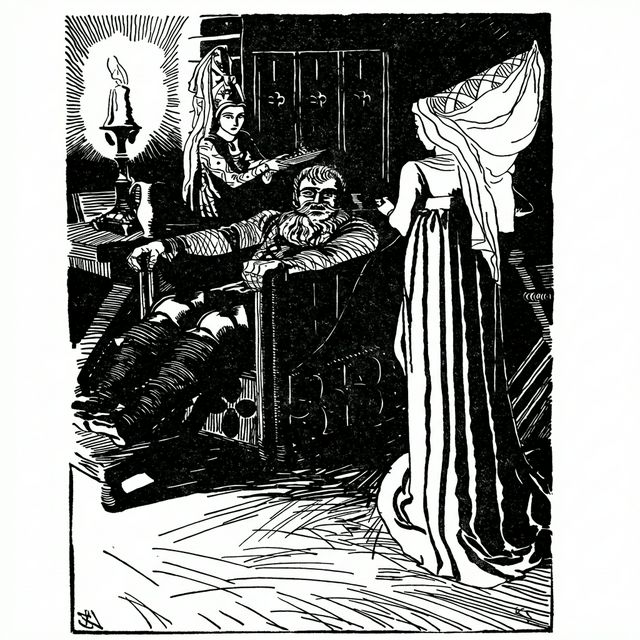
The mad woman in the courtyard:
"Where's Marion? Where's Marion? Come back to me, Marion! Cursed be the ditch and the cross-bolt and the walls!"
These three lines — the landscape, the introduction, and the wail — give the whole book in miniature. A beautiful and dangerous coast. A polite-looking monster. A previous wife whose name is still being called.
Where It Fits in Her Work
Sister Anne sits at the far edge of Beatrix Potter's writing — the one book her own publisher could not place, written for an older reader, set in a darker world. It is not the Potter most children meet first. It is the Potter who, late in life, wanted to try something stranger.
For now, the full text of this book is not available on the Sanctuary. Sister Anne is still under copyright in the United States until 2028, and we cannot host it freely. The book is in print and available through major booksellers — you can find it at Bea's Corner.
A Note for Parents
Guidance for the collector and the caretaker.
- A shift in tone. Beatrix Potter is best known for her Little Books for very young children. Sister Anne was written for an older audience. It is a gothic retelling of the Bluebeard story, with a far darker mood than her other work.
- Suggested reading age: 13+ (Young Adult). The book deals with the threatened murder of a young bride and the discovery of previous wives' bodies. We do not recommend it for small children, who may find the locked-room scene and the suggestion of past killings frightening.
Leave a Visiting Card
Consulting the visiting cards...