CHAPTER XVIII
THE WOODS BY MOONLIGHT
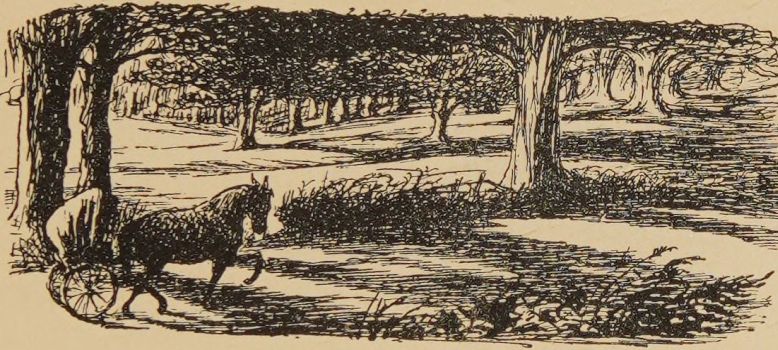
THE moon had risen by the time that Pony Billy—properly shod—trotted away from the village smithy to fetch Mary Ellen. The empty tilt-cart rattled at his heels; jumping forward into the harness like a live thing downhill; trundling gaily along the level.
The pebbles on the road sparkled in the dazzling moonlight. Pony Billy blew puffs of white breath from his nostrils, and he stepped high - tap-tap-tappitty! prancing to the tune of the smithy song.
He amused himself with step-dancing over the shadows of the hedgerow trees; black shadows flung across the silver road from hedge-bank to hedge. Down below in the reed beds a wild duck was quacking. A roe-deer barked far off in Gallop Wood. White mist covered the Dub; the woods lay twinkling in the moonlight.
Up hill and down hill, Pony Billy trotted on and on; and the woods stretched mile after mile. The tall, straight tree-trunks gleamed in white ranks; trees in hundreds of thousands.
Pony Billy glanced skeerily right and left. Almost he seemed to hear phantom galloping horseshoes, as his own shoes pattered on the road. Almost he seemed to see again the fairy dancers of Mettle’s story by the forge.
Shadows of a shadow! Was that the shadow of a little hooded figure, flitting across a forest ride? and a dark prowling shadow that followed her? Was the trotting shadow on the road beside him the shadow of himself? Or was it the shadow of another pony? A little bay pony in a pony trap, with an old woman and a bob-tailed dog, caught in a snowstorm in the woods?
But this white road was not white with snow; and they were real overtaking footsteps that caused Pony Billy to spring forward with a start of panic. Three roe-deer cantered up behind him. Their feet scarcely touched the ground, so lightly they bounded along. They made playful grunting noises, and dared Pony Billy to catch them.
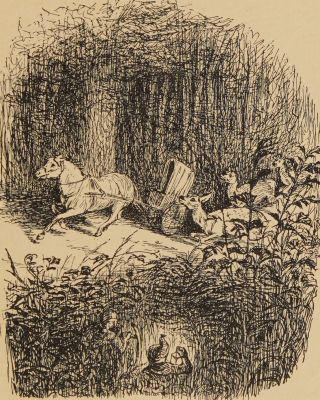
He arched his neck and trotted his best, while he “hinnied” in answer to the deer. They bore him merry company for longer than a mile; sometimes gambolling alongside; sometimes cantering on before.
On and on they travelled, through many miles of woods. Past the black firs; past the sele bushes in the swamp; past the grove of yew trees on the crags; past the big beech trees; uphill and down. Sometimes a rabbit darted across their path.
And once they saw two strange dwarfy figures crossing the road in front of them—stumpy, waddling figures, broad as they were long; running, running. The second trundled a handbarrow; the foremost pulled it with a rope—there go the Oakmen! Are those pissamoor hills in the glade? or are they tiny charcoal settings on the pit-steads?
The gamboiling roe-deer kick up their heels. They know the weight of Oakman Huddikin’s sledge in winter! But this is spring. The dwarfy red-capped figures, running like two little fat badgers, disappeared in the moonlight behind the Great Oak.
At length the woods grew thinner. There began to be moonlit clearings; small parrocks where the Big Folk last summer had hung white streamers on sticks, to scare the red stags from the potato drills. The friendly roe-deer turned aside and left him, leaping a roadside fence, with a flicker of white scuts.
Pony Billy by himself reached a lonely farm-steading; he was pleasantly warm after his long brisk trot. He turned up a narrow yard between manure heaps and a high stone building, that showed a white-washed front to the moon.
He passed the doors of byres. Sleepy cows mooed softly; their warm sweet breath smelled through the door-slats. A ring-widdie clinked, as a cow turned her head to listen to the wheels.
Pony Billy passed several more doors. Old Tiny, the sow, was snoring peacefully behind one of them. He drew the cart round the end of the shippon into a cobble-paved yard, where the wheels rumbled over the stones. He went up to the back door of the house.
There was no light upstairs; the window panes twinkled in the moonlight. A faint red glow showed through the kitchen window and under the back door.
Mary Ellen, the farm cat, sat within; purring gently, and staring at the hot white ashes on the open hearth; wood ash that burns low, but never dies for years. She sat on a dun-coloured deer-skin, spread on the kitchen flags.
Pots and pans, buckets, firewood, coppy stools, cumbered the floor; and a great brown cream mug was set to warm before the hearth against the morrow’s churning. The half-stone weight belonging to the butter scales was on the board that covered the mug; Mary Ellen had not been sampling the cream. She sat before the hot wood ash and purred. Crickets were chirping. All else was asleep in the silent house.
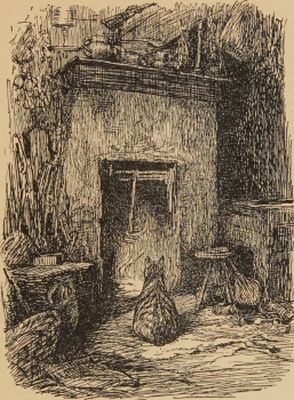
Mary Ellen listened to the sounds of wheels and horseshoes, which came right up to the porch. Pony Billy’s soft nose snuffled about the latch. He struck a light knock on the door with a forward swing of his forefoot.
Mary Ellen arose from the hearth. She went towards the door, and looked through a crack between the door and the door-jamb.
“Good-evening, good Pony; good-evening to you, Sir! I would bid you come in by, only the door is locked. Snecks I can lift; but the key is upstairs.”
Pony Billy explained his errand through the crack.
“Dear, dearie me! poor, poor young pig!” purred Mary Ellen, “and me shut up here, accidental-like, with the cream! Dearie, dearie me, now! to think of that! Asleep in the clothes-swill, I was, when the door got locked. Yes! indeed, I do understand pig powders and herbs and clisters and cataplasms and nutritions and triapharmaeons etcy teera, etcy teera!” purred Mary Ellen, “but pray, how am I to be got out, without the door key?”
Pony Billy pawed the cobblestones with an impatient hoof.
“Let me see, good Mr. Pony, do you think that you could push away that block of wood that is set against a broken pane in the pantry window? Yes? Now I will put on my shawly shawl; so,” purred Mary Ellen, “so! I am stout, and the hole is small. Dearie, dearie me! what a squeeze! I am afraid of broken glass. But there is nothing like trying!” purred Mary Ellen, safely outside upon the pantry window-sill. “Now I can jump down into your cart, if you will back, under the windy pindy.”
“First rate! Are you ready, M’mam?” said Pony Billy, backing against the wall with a bump.
“Oh, dearie me! I have clean forgotten the herbs; I must climb in again! Bunches and bunches of herbs!” purred Mary Ellen, pausing on the window-sill, above the cart. “My Mistress Scales grows a plant of rue on purpose for poor sick piggy-wiggies. Herb of Grace!” purred Mary Ellen, “what says old Gerard in the big calfskin book? ‘St. Anthony’s fire is quenched therewith; it killeth the shingles. Twelve pennyweight of rue is a counter-poison to the poison of wolfs-bane; and mushrooms, and TOADSTOOLS; and the bite of serpents; and the sting of scorpions, and hornets, and bees, and wasps; in-so-much that if the weasel is to fight the serpent, she armeth herself by eating rue.’ Toadstools! it says so in the big-book! the very thing!” purred Mary Ellen, squeezing inside, and disappearing into the pantry.
“Bunches and bunches of herbs,” she purred, struggling out again through the broken window; “bunches and bunches hanging from the kitchen ceiling! And a pot of goose-grease on the jam board; and a gun. And onions. And a lambing crook. And a fishing rod. And a brass meat-jack that winds up.”
“Am I to take all these things, M’mam?” inquired Pony Billy.
“Bless me no! only the herbs,” purred Mary Ellen, seating herself in the cart. But no sooner had Pony Billy turned it in the yard, preparing to start homewards: “Oh, dearie, dearie me! I’ve forgot my fur-lined boots! No, not through the window this time. I keep my wardrobe in the stick-house. And I would like an armful of brackens in the cart-kist, to keep my footsies warm, please Mr. Pony Billy.”
“We shall get away sometime!” thought Pony William.
Once set off, Mary Ellen sat quietly enough; never moving anything excepting her head, which she turned sharply from side to side, at the slightest rustle in the woods, hoping to see rabbits. The roe-deer did not show themselves again. The journey back to Codlin Croft Farm was uneventful. Mary Ellen was set down safely at the stable door. Cheesebox welcomed her effusively.
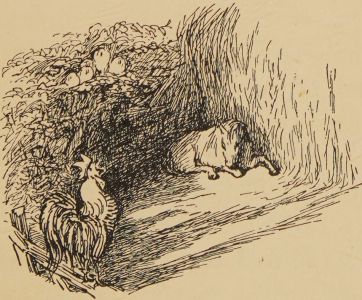
After assuring himself that Paddy Pig was still alive and kicking, Pony Billy dragged the tilt-cart into the orchard, and tipped it up beside the caravan. Himself he went up to the hay-stack for a well-earned bite of supper. Afterwards he lay down on the west side of the stack; and slept there, sheltered from the wind.
Leave a Visiting Card
Consulting the visiting cards...