CHAPTER IX
BY WILFIN BECK
ALL upon a day in the month of April, the circus company crept slowly through soft green meadows.
It was early morning. Long shadows from the woods lay across the grass. Birds sang to greet the rising sun. Iky Shepster, the starling whistled, and fluttered his wings on the roof of the caravan.
Pony Billy bent to the collar. The dew splashed from his shaggy fetlocks as he lifted his feet amongst the wet grass. Paddy Pig toiled between the shafts of the tilt-cart, assisted by the panting Sandy, harnessed tandem.
“We shall stick fast, Sandy! Let us go back to Pool Bridge.”
“Yap! yap! we will try the next ford higher up.”
“Get out of my way,” said Pony Billy, coming up behind them, steadily pulling the caravan.
They were trying to cross a stream that ran through the middle of the valley. In summer it was a little brook, but spring rains had filled it to the brim. The forget-me-nots waved to and fro, up to the waist in water; the primroses on the banks drew up their toes; the violets took a bath. Wilfin Beck was in high flood.
Paddy Pig disliked water. The ford which they should have crossed, had proved to be a swirling stream, instead of a broad rippling shallow. He wished to turn back and go round by the bridge.
The proprietors of the circus refused.
“If we cross the stream as far down as Pool Bridge, there will be two days’ toilsome march through the woods. We broke a spring of the caravan last time we went by the drift road; and the wagoners have been snigging timber since then,” objected Sandy.
“Go on to the Ellers ford,” said Pony Billy.
So Paddy Pig pulled, grunting, through the fast-asleep buttercups and daisies.
Xarifa and Tuppenny, in the cart, were fast asleep too. Jenny Ferret was awake inside the caravan. A pot had hit her on the head, when the wheel sank into a drain and caused the caravan to lurch.
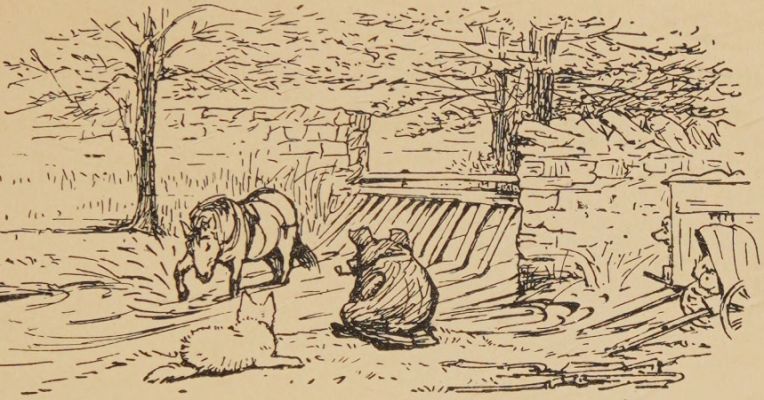
When Tuppenny woke up and peeped out, the procession had halted, and unharnessed, beside the beck.
Sandy was rolling on the grass. Paddy Pig was smoking a pipe and looking pigheaded, which means obstinate.
“You will be drowned,” said he to Pony Billy.
The pony was pawing the water with his forefeet, enjoying the splashes, and wading cautiously step by step further across.
“Drowned? Poof!” yapped Sandy, taking a flying leap splash into the middle; he was carried down several yards by the current before he scrambled out on the further bank. Then he swam back.
“It’s going down,” said Sandy, sniffing at a line of dead leaves and sticks which had been left stranded by the receding flood.
Pony Billy nodded. “Let us pull round under the alder bushes and wait.”
“Then you will not go back by Pool Bridge?”
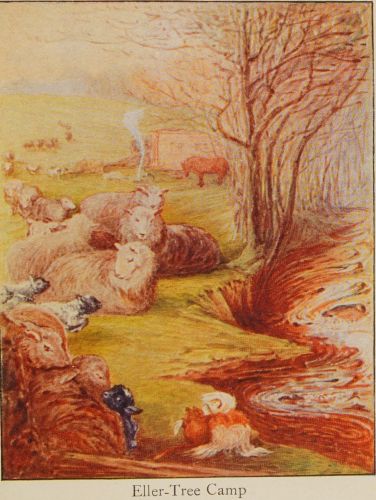
“What! all across those soft meadows again? No. We will lie in the sun behind this wall, and talk to the sheep while we rest.”
So they pitched their camp by the wall, where there is a Watergate across the stream, and a drinking place for cattle. Pony Billy’s collar had rubbed his neck; Sandy was dog tired; Jenny Ferret was eager for firewood; everyone was content except Paddy Pig.
He did his share of camp work; but he wandered away after dinner, and he was not to be found at tea time.
“Let him alone, and he’ll come home,” said Sandy.
“Baa baa!” laughed some lambs, “let us alone and we’ll come home, and bring our tails behind us!”
They frisked and kicked up their heels. Their mothers had come down to Wilfin Beck to drink. When their lambs went too near to Sandy, the ewes stamped their feet. They disapproved of strange dogs—even a very tired little dog, curled up asleep in the sun.
The sheep watched Jenny Ferret curiously. She was collecting sticks and piling them in little heaps to dry; short, shiny sticks that had been left by the water.
Xarifa and Tuppenny were at their usual occupation, giving Tuppenny’s hair a good hard brushing. Xarifa was finding difficulty in keeping awake. The pleasant murmur of the water, the drowsiness of the other animals, the placid company of the gentle sheep, all combined to make her sleepy.
Therefore, it fell to Tuppenny to converse with the sheep. They had lain down where the wall sheltered them from the wind. They chewed their cud.
“Very fine wool,” said the eldest ewe, Tibbie Woolstockit, after contemplating the brushing silently for several minutes.
“It’s coming out a little,” said Tuppenny, holding up some fluff.
“Bring it over here, bird!” said Tibbie to the starling, who was flitting from sheep to sheep, and running up and down on their backs.
“Wonderfully fine; it is finer than your Scotch wool, Maggie Dinmont,” said Tibbie Woolstockit to a black-faced ewe with curly horns, who lay beside her.
“Aye, it’s varra fine. And its lang,” said Maggie Dinmont, approvingly.
“It would make lovely yarn for mittens; do you keep the combings?” asked another ewe, named Habbitrot.
“I have a little bag, there is only a little in it, yes please, I put it in a little bag,” twittered Tuppenny, much flattered by their approbation.
“Baa! baa! black sheep! Three bags full!” sang the lambs, kicking up their heels.
“Now, now! young lambs should be seen, not heard. Take care, you will fall in!” said Tibbie Woolstockit, severely.
Three more ewes hurried up, and gave their lambs a good hard bat with their heads; but the lambs minded nothing.
The ewes, whose names were Ruth Twinter, Hannah Brighteyes, and Belle Lingcropper, stepped down to the water side to drink. Then they lay down by the others, and considered Tuppenny.
“His hair is as fine as rabbit wool, and longer. Rabbit wool is sadly short to spin,” said Habbitrot. “Save all the combings in your little bag, in case you pass this way again.”
“You were not with the circus last time they camped by the Ellers?” said Tibbie Woolstockit. “What may your name be, little guinea-pig man?”
“Tuppenny.”
“Tuppenny? a very good name,” said the sheep.
At this moment a bunch of lambs galloped across the meadow with such a rush that they nearly overran the bank into the water. Their mothers were quite angry.
“A perfect plague they are! But never-the-less we would be sad without the little dears! Now lie down and be quiet, or you will get into the same scrape as Daisy and Double!”
But the lambs only raced away faster. Xarifa had been awakened by the disturbance.
“Who were Daisy and Double? We love hearing stories, Tibbie Woolstockit; do tell us!”
Tibbie Woolstockit turned her mild bright eye on the little dormouse.
“Willingly I will tell you. There is not much to tell. Every spring for four and twenty years we have told that story to our lambs; but they take little heed.
Daisy and Double were the twin lambs of my great grandmother, Dinah Woolstockit of Brackenthwaite, who grazed in these pastures, even where we now are feeding. The coppice has been cut thrice since then; but still the green shoots grow again from the stools, and the bluebells ring in the wood. And Wilfin Beck sings over the pebbles, year in and year out, and swirls in spring flood after the melting snow.
That April when Daisy and Double played in this meadow, Wilfin was full to overflowing, as high as it is now. Take care! you thoughtless lambs, take care!
But little heed will you take; no more than Daisy and Double, who made of the flood a playmate. For it was carrying down sticks and brown leaves and snow-broth—as the trout-fishers call the cakes of white fairy foam that float upon the flood water in early spring.
Daisy and Double saw the white foam; and they thought it was fun to race with the snow-broth; they on the meadowbank and the foam upon the water; until it rushed out of sight behind this wall. Then back they raced upstream till they met more snow-broth coming down; then turned and raced back with it.
But they watched the water instead of their own footsteps—splash! in tumbled Daisy. And before he could stop himself—splash! in tumbled Double; and they were whirled away in the icy cold water of Wilfin Beck.
‘Baa! baa!’ cried Daisy and Double, bobbing along amongst the snow-broth. Very sadly they bleated for their mother; but she had not seen them fall in. She was feeding quietly, by herself. Presently she missed them; and she commenced to run up and down, bleating. They had been carried far away out of sight, beyond the wall; beyond another meadow.
Wilfin Beck grew tired of racing; the water eddied round and round in a deep pool, and laid the lambs down gently on a shore of smooth sand. They staggered onto their feet and shook their curly coats—‘I want my mammy! baa, baa!’ sobbed Daisy. ‘I’m very cold, I want my mammy,’ bleated Double. But bleat as they might, their mother Dinah Woolstockit could not hear them.
The bank above their heads was steep and crumbly. Green fronds of oak-fern were uncurling; primroses and wood anemones grew amongst the moss, and yellow catkins swung on the hazels. When the lambs tried to scramble up the bank—they rolled back, in danger of falling into the water. They bleated piteously.
After a time there was a rustling amongst the nut bushes; someone was watching them. This person came walking slowly along the top of the bank. It wore a woolly shawl, pulled forward over its ears, and it leaned upon a stick. It seemed to be looking straight in front of it as it walked along; at least its nose did; but its eyes took such a sharp squint sideways as it passed above the lambs.
‘Burrh! burrh!’ said this seeming woolly person with a deep-voiced bleat.
‘Baa! baa! We want our mammy!’ cried Daisy and Double down below.
‘My little dears come up! burrh! burrh! come up to me!’
‘Go away!’ cried Daisy, backing to the water’s edge. ‘You are not our mammy! Go away!’ cried Double. ‘Oh, real mammy, come to us!’
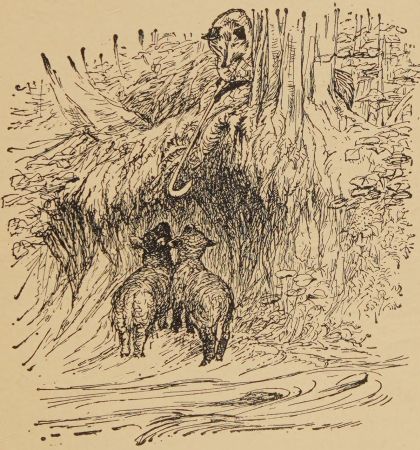
Then the woolly person reached out a skinny black arm from under the shawl, and tried to claw hold of Daisy with the handle of its stick. Its eyes were sharp and yellow, and its nose was shiny black.
‘Baa, baa!’ screamed Daisy, struggling, and rolling down the bank, away from the crook. ‘Burrh! burrh! bad lambs; I’ll have you yet!’
But what was that noise?
A welcome whistle and shout—‘Hey, Jack, good dog! go seek them out, lad!’
The wily one threw off the shawl and ran, with a long bushy tail behind him; and a big strong wall-eyed collie came bounding through the coppice, on the track of the fox. When he came to the top of the bank, he stopped and looked over at Daisy and Double with friendly barks. Then John Shepherd arrived, and came slithering down the bank between the nut bushes.
He lifted up Daisy and Double, and carried them to their mother. But it is in vain that we tell this tale to our lambs from generation to generation; they are thoughtless and giddy as of old. Well for us sheep that—
‘There’s sturdy Kent and Collie true, They will defend the tarrie woo’!’
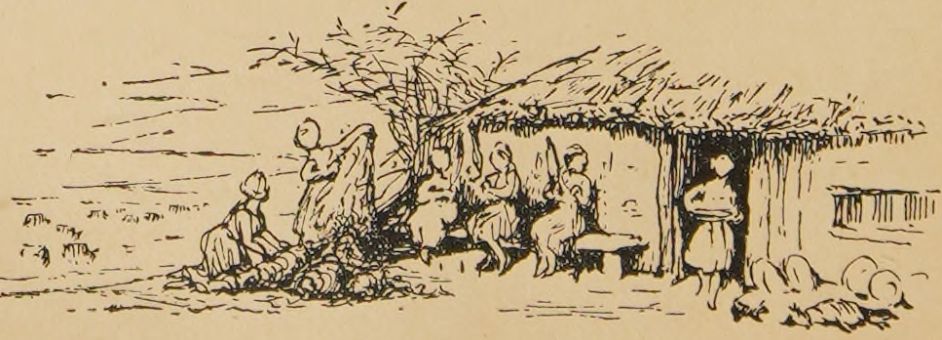
Sing us the spinning song that the shepherd lasses sang, when they sat in the sun before the shieling, while they cleaned the tarry fleeces; carding and spinning—
‘Tarrie woo’, oh tarrie woo’—tarrie woo’ is ill to spin, Card it wool, oh card it weel! Card it weel ere you begin. When it’s carded, rolled, and spun, then your work is but half done, When it’s woven, dressed, and clean, it is clothing for a queen.
It’s up you shepherds! dance and skip! O’er the hills and valley trip! The king that royal sceptre sways, has no sweeter holy days.
Sing to the praise of tarrie woo’! Sing to the sheep that bare it too! Who’d be king? None here can tell, When a shepherd lives so well; Lives so well and pays his due, With an honest heart and tarrie woo’!’ ”
Leave a Visiting Card
Consulting the visiting cards...