
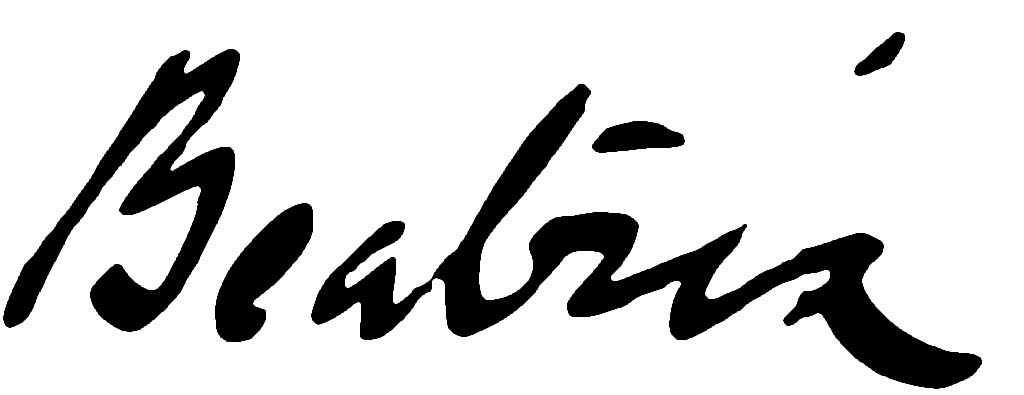
Beatrix Potter arrived at Hill Top Farm in November 1905 knowing almost nothing about farming. She had bought the place — thirty-four acres in the village of Sawrey — with money she had earned from her books. It was hers, and she was proud of it. But she had spent her whole life in a London nursery and a London drawing room. She had never kept a farm. What followed was a long, patient, and sometimes humbling education.
This is the story of that learning. Not the land she eventually saved, or the prizes she won — those come later. This is the earlier and quieter thing: how a children's author in her late thirties walked into an entirely foreign world and learned, slowly and seriously, to belong to it.
The Farm She Bought
The farmhouse was already occupied when she arrived. John Cannon, the tenant manager, lived there with his wife and two children. Beatrix took lodgings at the top of the village street. She was up at dawn every morning, studying her property inside and out.
Her first lesson came quickly. Cannon drove her out in a trap to look over the fields and pastures. She had expected to learn about sheep. What she found first was pigs. Pigs, it turned out, were a significant part of what the farm earned. Cannon bought them only with pedigree papers, and they were sold in the surrounding villages. "The whole district is planted out with my pigs," Beatrix wrote to her friend Millie Warne, a fortnight after arriving. They went at what she described, with dry humour, as "what the drapers call a 'sacrifice.'" But the plan was to build the farm a name for quality. "Such is fame!" she wrote.
She also discovered that the farm's butter scales were out of register. The farm had been undercharging for butter for years without anyone noticing. Beatrix went with Cannon to the police station — a legal requirement for any farmer who traded — to have the scales certified. She checked them herself.
These small things taught her the essential rule of a working farm. It was a business. Every detail of it mattered.
What the Cannons Taught Her
The farmhouse offered its own education. Exploring it from top to bottom, Beatrix found a staircase hidden inside a four-foot-thick wall and "funny cupboards and closets" at every turn. "It really is delightful," she told Millie, "if the rats could be stopped out." The worst discovery was a serious infestation. Rats were in the walls, in the beds, and in the grain. The mattresses were pulled out for airing and the seams sewn shut. Every hole she could find was cemented.
Mrs Cannon was her closest teacher in those early months. Together they nursed a sick calf — Beatrix giving it medicine from a hollow horn inserted into its mouth, in the old country way. After an emergency dose of brandy, the calf recovered. The carthorse, meanwhile, had developed a toothache. There was always something. A farm was never still, and it waited for no one.
She photographed the lambs before they went to market. "It does not do to be sentimental on a farm," she told Millie. She was reminding herself. The animals she had drawn in her books were also part of the farm's income. When necessary, they were eaten. This was not pleasant. It was real, and she faced it clearly.
In the early days she made mistakes, too. A workman who was supposed to lay out garden beds misunderstood her instructions and built a large flat lawn instead. She did not pay him to undo it. Cannon planted the whole lawn in potatoes until there was time to plan it properly. It was the response of someone learning to be patient with imperfection.
Learning From a Distance
She could not farm continuously from the start. Her parents still expected her in London for most of the year, and she had to manage the farm by letter as much as by visit. "Will you ask Mr Cannon if I can have a few days' notice before dipping time?" is the kind of instruction she wrote. She had to trust people she barely knew to do work she did not yet fully understand.
This was harder than it sounds. Cannon was adequate, but not inspired. He was not from the local area, and Beatrix was uncertain about him from the start. She kept him on, and watched him carefully. She learned which questions to ask and what the answers should sound like. Year by year her letters grew more specific, more knowledgeable, more confident.
Her neighbours did not take her seriously at first. They saw a London lady with a tape measure, walking her fields, asking questions about pigs. Her biographer Linda Lear records that they treated the whole enterprise as a joke, and that she had paid too much for Hill Top besides. She found this out later. None of it discouraged her.
Growing Into the Work
Ten years after she bought Hill Top, she was a different farmer. By 1916 she had been farming for a full decade. She wrote to a woman asking about employment on the land: "I have farmed my own land for 10 years as a business, before & since marriage, and I have got it into such good order it would be a pity to let it go down."
That sentence says everything. "As a business." Not as a hobby, not as a gentleman's pleasure farm. She had learned to think of it in practical terms, and she was proud of what it had become.
Once she married William Heelis in 1913, she could spend more of the year in Sawrey. She worked alongside her farm men in the hayfield. She took a hand in all of it. The farm was no longer a place she visited between London seasons. It was her home and her work.
The New Scale: Troutbeck Park
In 1923 she bought Troutbeck Park Farm — nearly 2,000 acres in the upper Trout Beck valley, one of the largest farms in the Lake District. She paid £8,000 for it. The purchase was made to stop developers from building holiday houses on the valley floor. But it was also a new and much harder farming education.
Hill Top was small and lowland. Troutbeck Park was a great fell farm with grazing ground that stretched up to High Street. The challenges were proportionate. The flock was badly affected by liver fluke, and cleaning up the pastures took years. She had to learn fell farming at scale. She did.
The Teacher She Found
For a farm the size of Troutbeck Park she needed a skilled fell shepherd, someone who understood hefted Herdwicks on high ground. She was directed to Tom Storey, a young shepherd working in the Troutbeck valley. She went to see him, the conversation was short, and she doubled his wage.
Tom Storey worked for Beatrix Potter for eighteen years. In a Radio Cumbria broadcast years later, he recalled what she had been like as a learner: "She'd never done any farming. She learnt as she went on from her farm men and local farmers."
That is the whole story, in a sentence. She arrived knowing nothing. She watched. She asked. She paid attention to the people who knew more than she did. And she kept at it.
What She Learned
By the end of her farming life, Beatrix Potter was one of the most knowledgeable fell farmers in the Lake District. She could judge the quality of a Herdwick ewe at a glance. She kept careful notes at agricultural shows. She experimented with new cures for animal disease and shared her findings with other breeders. She knew the Lakeland customs: to keep crop ash and holly near the farmhouses for cutting and feeding to sheep in severe winters. She knew which land would carry a large flock and which would not.
She had learned it all the hard way — from her animals, from her farm men, and from a great many mistakes. The London daughter who had walked her fields with a tape measure and planted a garden lawn in potatoes had become a working fell farmer. Not because she was born to it, but because she paid attention, season after season, for nearly four decades.
Sources
The facts in this article are drawn from Linda Lear's biography Beatrix Potter: A Life in Nature, which covers her arrival at Hill Top and the development of her farming in detail, cross-checked against Beatrix Potter's Letters (edited by Judy Taylor) for her own words, and J. W. R. Mitchell's Beatrix Potter: Her Lakeland Years, which draws on Tom Storey's account of working for her. The history is theirs to record; the words here are our own.
Leave a Visiting Card
Consulting the visiting cards...