
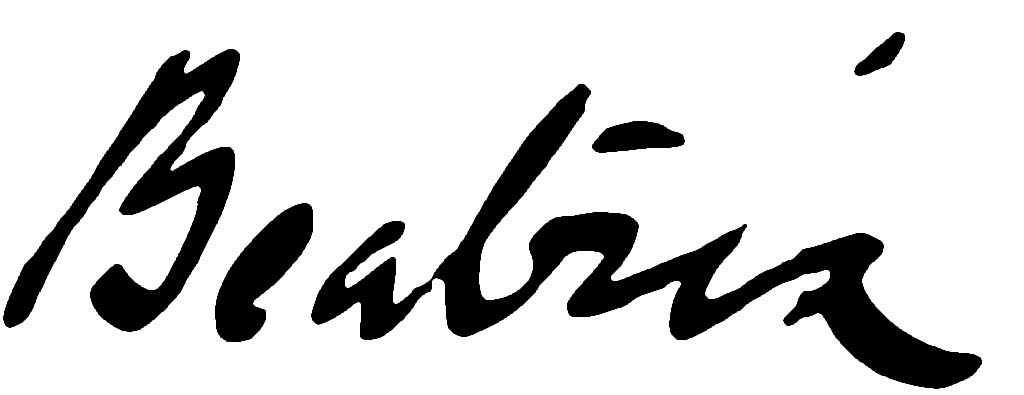
The name Tom Storey appears in almost every account of Beatrix Potter the farmer. He was her shepherd for eighteen years. He knew her sheep better than anyone. He knew her own mind, her stubbornness, and her deep love of the Herdwick breed. And when she died, in December 1943, he was there.
This is his story — who he was, what he did, and what their long working partnership looked like from his side of the fence.
The Man She Needed
By 1923 Beatrix had taken on Troutbeck Park, a great fell farm above the valley — nearly two thousand acres of high grazing ground. For a property that size, running a hefted flock of Herdwicks on open fell, she needed a skilled shepherd — someone who understood high-ground sheep from the inside. She asked around. Several farmers directed her to a young man working at Townend Farm in the Troutbeck valley.
Tom Storey was, by his own description, "pigeon-chested" — he had come out to the Lake District from Barrow-in-Furness to escape the town air, which troubled his lungs. But Linda Lear describes him as physically powerful, not slight at all: ruggedly handsome, with bright blue eyes, dimples, and a cleft chin. He was a north-country stockman by temperament and said plainly what he thought. He was married, with two young children.
Beatrix drove out to see him while he was finishing the milking. He remembered it clearly:
"My boss came into the shippon and said, 'There's a lady wants to see you.' Mrs Heelis. She was quite smart for her age... 'You're Tom Storey,' she said. 'Yes.' 'Well, I've come to see you about working for me. Will you go to Troutbeck Park to be my shepherd?' I said, 'Yes, I'll go if the money's right.'"
She asked what he was earning. When he told her, she doubled it. Tom Storey went to Troutbeck Park.
At Troutbeck Park
The fell farm had been in poor condition when Beatrix bought it. The flock had been badly affected by liver fluke — a parasite that spread through the wet valley ground and infected an entire herd if left untreated. There was no reliable cure at the time.
Tom had barely arrived when a new remedy appeared: a capsule from a veterinary firm in Newcastle that had shown early results against fluke. He brought the news to Beatrix, who ordered it immediately. He recalled: "By jove, we used it that back-end and it was a life-saver." In the spring of 1927, three years after his arrival, Tom lambed a thousand sheep at Troutbeck. After that, Beatrix was, as he put it, "set up."
Her willingness to try new remedies impressed him from the start. She was interested in scientific farming: new castrating knives, new sheep dips, new injections against grass staggers. As Storey put it, "she was very good at sending for new cures, nothing was too good for the sheep."
Moving to Hill Top
In June 1927 Beatrix drove to the Park for another conversation. "I want to ask you something Storey." "Oh, aye?" "Will you come and work for me and manage Hill Top at Sawrey? I want to show Herdwick sheep, and I've heard you've done a bit."
After consulting his wife, Tom agreed. He and his family moved to Near Sawrey.
He arrived at Castle Farm and looked over her sheep there. He was surprised to find a ram he recognised — a prize animal called "Cowie" that he had first picked out at the Eskdale show when it was a lamb. He had not known where the ram had gone. Now here it was, in Beatrix Potter's flock, having taken first prize at Eskdale in each of the four years since. He was "enormously pleased," Lear records, with his luck in finding it again. It was typical of his gift for remembering individual animals.
That same season, with Beatrix alongside him, Tom picked out a few lambs for the Hawkshead show. Two won first prizes. Lear records Tom's account of Beatrix's reaction: "She was as proud as a dog with two tails, as the saying goes. It was the first time she'd won a first prize. I said I was glad for that and I hoped we'd win a few more."
By 1930 his breeding work at Hill Top had produced one of the most successful show flocks in the region.
The Argument
Their partnership was not always smooth. Tom liked to tell the story of an early falling-out. He had been sorting sheep for a Keswick show. He noticed that some had already been ruddled — marked with iron-based red powder to identify them as show animals. He did not think highly of them. He was planning to put them back in the pasture when Beatrix came in and asked why he was removing her show sheep.
He told her plainly: they were no good to show. She was, as he put it, "quite cut up about it." He held firm. "If you want these sheep showing, Mrs Heelis, you'd better have Mackereth back. I won't show them, they're not fit to show."
At that, according to Tom, Beatrix stomped off to his wife in the kitchen and announced: "I'll tell you what it is, Mrs Storey — your husband's a bad tempered little devil."
Shortly after that, Tom started winning prizes with her sheep. Lear records that Beatrix "apparently never intervened again."
A Daily Partnership
Over the years their working relationship settled into a steady routine. Every morning, Tom brought fresh milk across from Hill Top to Castle Cottage. Beatrix was always up and ready. If anything special was needed, they discussed it then, at the door. She rarely gave him direct orders. She trusted his knowledge of the sheep, and he knew it.
He was careful about the knowledge he held. He remembered individual animals by sight. He could tell a good Herdwick by bone, line, head, and wool. Beatrix understood this and respected it. Lear notes that when she did work alongside the farm hands — in the harvest, or in the field — she took orders from Tom, not the other way round.
His opinion of her was consistent and precise. He described her to a Radio Cumbria interviewer with simple directness: "She was rather quiet, reserved, but good to work for if you went the right way about it. She was a good farmer. She took notice of her men."
There was one particular request she made at lambing time that he never forgot. She came to him and said: "Storey, the next lamb that dies — could you cut its head off for me and skin it back to the shoulder?" He obliged. The next morning the head was up — fixed to the meadow wall — and Beatrix was on a stone in front of it, painting. "It was really a grand job when she finished it," he said.
What He Thought of Her Work
Tom had his own professional opinion of her farming decisions, and he did not hide it. He was quite clear, for example, that Hill Top Farm was the wrong ground for Herdwick sheep. The country was too soft — too low, too lush — for the wiry, small-hoofed fell breed that thrived on open high ground. Crossbred sheep would have earned more. He said so.
But he understood why she disagreed. "It was her love was Herdwick sheep," he said. That settled it. There were no more arguments on the point.
He also received the first copy of The Fairy Caravan, her 1929 novel that drew on farm life in the Lakes. He kept it for the rest of his life. "It had that much handling," he told Bill Mitchell, "it had to have a new back put on."
The End and After
Tom was at Hill Top on the day Beatrix Potter died in December 1943. She had been ill for some time, and they had all known it was coming. William Heelis told him, in the days after: "You'll know where these have to go, Storey." He meant the sheep — the hefted Herdwick flocks she had spent two decades building. Tom knew.
He went on to work for William for another two years, until William died in 1945. By then he had served the Heelis farms for eighteen years. In old age he lived in a small terraced cottage in Near Sawrey. For forty years he served as a warden at the village church.
Bill Mitchell, who interviewed Tom in his later years, describes a man still completely himself. He was small, spare, quiet-spoken, with a wry sense of humour. He sat by his fire in an uncluttered room. He waved when he saw Mitchell through the window. "I'd enter to a warm welcome," Mitchell wrote, "and often a nip o' summat strong."
He respected his famous employer. He was not above a quiet laugh at her expense. And he had known, better than almost anyone, what she was really like on a farm — not the author, not the conservationist, but the farmer. He had seen that version of her every morning, at the door, in the cold.
Sources
The facts in this article are drawn from Linda Lear's biography Beatrix Potter: A Life in Nature and J. W. R. Mitchell's Beatrix Potter: Her Lakeland Years, which draws extensively on conversations Mitchell had with Tom Storey in his later years. Storey's direct quotes are taken from both Lear (who cites his recorded recollections) and Mitchell's interviews. The history is theirs to record; the words here are our own.
Leave a Visiting Card
Consulting the visiting cards...