In the last twenty years of her life, Beatrix Potter and the Herdwick sheep became almost inseparable. She did not just keep the breed. She bred prize-winning flocks. She fought to protect the pure strain. And she won the respect of the practical, no-nonsense farmers of the fells who had done it all their lives. In 1943 they paid her the highest compliment they could: they made her the first woman ever to lead their breeders' association.
The Herdwick is the tough little grey sheep of the high Lake District fells. (For the breed's long history, see the story of the Herdwick; this article is about Beatrix Potter's own part in it.) What follows is how a famous author became, in her own right, one of the most respected Herdwick breeders of her day.
A Latecomer to an Old World
She came to it late, and from the outside.
The breeders had organised themselves back in 1899. Canon Rawnsley, his son Noel, and a Cockermouth stockman named Stanley Dodgson set up an association to protect the Herdwick as a pure breed. By 1916 it had grown into the Herdwick Sheep Breeders' Association. In 1920 it published its first Flock Book — the official register of pedigree animals.
Beatrix joined in 1924, a year after buying the great sheep farm at Troutbeck Park. She was one of only a handful of women in the whole association. She was also an "off-comer" — not born to the fells, and known to the wider world as the author of *The Tale of Peter Rabbit*, not as a farmer. None of that was an easy start in so settled and so male a world. She earned her standing in it the only way that mattered there: with good sheep.
A Woman in a Man's World
The world she walked into was rough, close-knit, and entirely run by men.
The breeders met twice a year at the great tup fairs — a tup is a ram. They met at the local shows and auctions too. And most of their real business was done afterwards, in the pub. Beatrix was a lifelong teetotaller. She went to the tavern meetings anyway and sat them out without a drink, often slipping off to a tearoom instead. She wore her favourite Herdwick tweed suit and a brown felt hat, clamped on with elastic under her chin. Her short, round figure soon became a familiar sight around the judging pens.
She enjoyed the oddity of her position, and wrote about it with dry delight. "You would laugh to see me," she told an American friend, "amongst the other old farmers — usually in a tavern! after a sheep fair. We are serious enough; about the future." The farmers, for their part, warmed to her. At one show where she presided, an old farmer raised a toast that likened her to the first-prize cow — "a lady-like animal," he said, with "neat legs," who "walked well." Beatrix accepted it cheerfully: the neat legs, she noted, were surely the cow's, "not me, being slightly lame."
The Prize Pens
What won her real standing was not her name, but her flock.
Beatrix set out to breed the best Herdwicks in the country, and she very nearly did. Her ewes from Hill Top went unbeaten at the shows for the best part of nine years. (Her shepherd, Tom Storey, did the hands-on work of breeding and showing them — his story is told separately.) Her most famous ewe, Water Lily, founded a prize-winning line. In a single autumn she took sixteen first prizes, and won the silver challenge cup awarded to the finest ewe in all the Lakes. She registered her own smit mark — the coloured ownership mark daubed on a fleece — in the Flock Book: the letter "H," for Heelis.
The prizes were not vanity. In the breeders' world, the show pen was where reputations were made, and a wall of rosettes was proof that you knew what you were doing. Each cup Beatrix won bought her a little more authority among men who would never have taken her seriously on her name alone.
Pure Herdwick, No Compromise
Her deepest mark on the breed was a matter of principle: she would not dilute it.
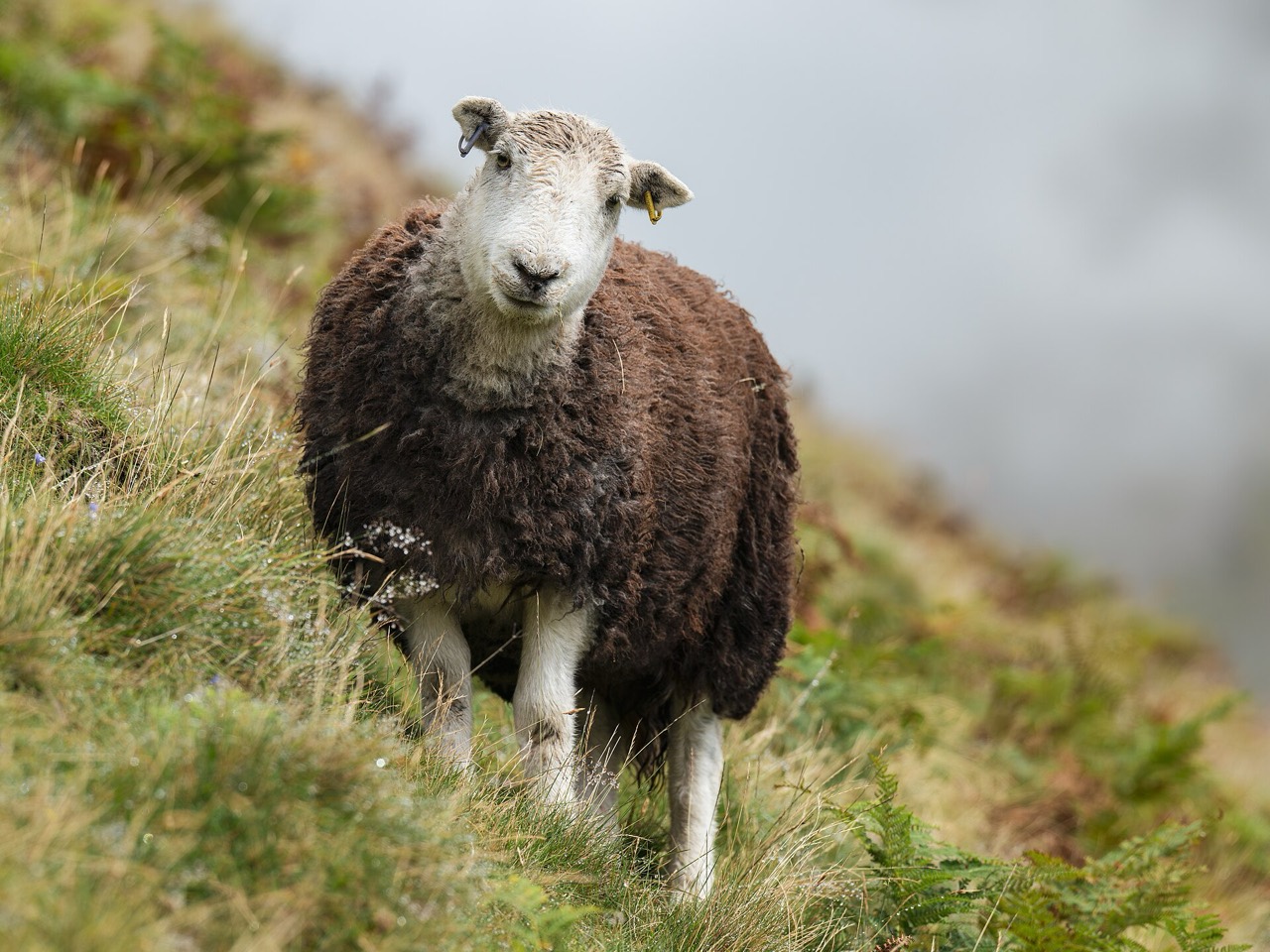
A Herdwick on the High Fells
The hardy grey breed Beatrix Potter fought to keep pure — here on Kirk Fell in the Lake District.

There was always a temptation to cross Herdwicks with other breeds for fatter lambs and softer, more saleable wool. It made plain financial sense — even her own shepherd thought her farms would earn more with crossbred sheep. Beatrix refused. As Tom Storey put it, "it was her love was Herdwick sheep." She kept her landlord flocks pure-bred — and hefted too. A hefted flock has learned to stay on its own patch of open fell, without fences. The knowledge is passed down from ewe to lamb. Lose the pure hefted flock, she believed, and you lost the fell farm itself.
She was clear-eyed about the danger. The Herdwick's coarse wool had no luxury market, and she feared for the breed's future. "It's doubtful if Herdwick sheep farms can survive another slump," she wrote during the war, "unless a fresh market can be found for the harsh, hard-wearing wool." During the war the government bought up all the coarse Herdwick wool for soldiers' uniforms. That propped prices up for a time. But Beatrix knew the prop would not last, and worried what peace would bring. She took a grim pride in that hard wool all the same: "Herdwick cloth never wears out!" The point, for her, was never profit. It was keeping a living breed alive on the fells where it belonged.
The First Woman President
Recognition came slowly, and then all at once.
In 1935 she was made president of the Keswick Agricultural Show — a real honour, and one she met with her usual dry modesty. "I guess they think it's time I should give some prizes as well as take some," she wrote, "so long as I am not expected to make a speech." The cup that year was handed to her by Stanley Dodgson's son — the son of one of the men who had founded the breeders' association back in 1899.
Then, in March 1943, came the greatest mark of respect of all. The Herdwick Sheep Breeders' Association elected Beatrix Potter its president for the coming year — the first woman ever chosen to lead it. She was already standing in at meetings, in the chair among the old farmers, "serious enough, about the future." It was a remarkable thing. The shy London author had risen to the head of the most male world in fell farming. She did it on merit — by the judgement of men who did not give such things away.
She never took up the office. Beatrix Potter died in December 1943, a few months before her presidency would have begun.
Beatrix Potter's Lasting Mark on the Herdwick
Her influence did not die with her.
Soon after her death, the National Trust's own land agent paid her a plain tribute. "No other woman," he said, "was so knowledgeable about the local breed and method of farming." And she had made sure her beliefs would outlast her. In her will, she ordered that the flocks on her fell farms be kept pure Herdwick, for good. It turned her lifelong preference into a binding rule, on thousands of acres. (More on the will and its conditions.)
Today the Herdwick still grazes the high Lakeland fells, still hefted, still grey. It survives for many reasons. But one of them is a children's author who refused to let it fade. She won the cups. She chaired the meetings. She wrote the breed into her will. And she earned, on merit, the respect of the wariest farmers in England. Whether her successors could keep that promise on the ground, in the hard decades that followed, is the last part of the story.
Sources
This account of Beatrix Potter and the Herdwick sheep is drawn from Linda Lear's biography Beatrix Potter: A Life in Nature and Susan Denyer's At Home with Beatrix Potter (written for the National Trust), with her own words taken from her published correspondence — Beatrix Potter's Americans, edited by Jane Crowell Morse, and Beatrix Potter's Letters, edited by Judy Taylor. The history is theirs to record; the words here are our own.
Leave a Visiting Card
Consulting the visiting cards...