
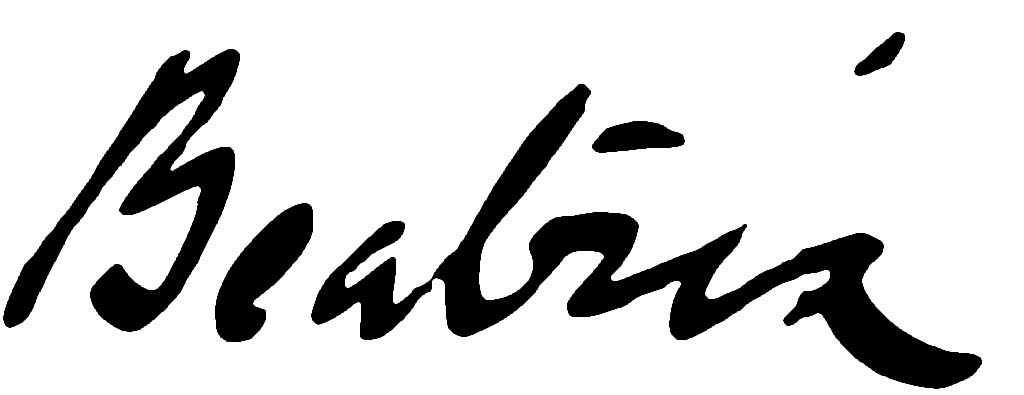
Beatrix Potter and the National Trust spent the last twenty years of her life working closely together. She bought land and passed it to the Trust. She managed its farms for nothing. She wrote it a stream of letters, full of advice it had not asked for. And when she thought it was getting things wrong, she said so — bluntly, often, and in writing.
It was a partnership, but not always an easy one. She believed in the Trust completely. She also believed she usually knew better than the people who ran it. Both things were true at once — and the result was one of the most fruitful, and most prickly, relationships in British conservation. This is what it looked like, day to day, while she was alive.
An Ally at the Top: Samuel Hamer
For years, her main link to the Trust was its secretary, Samuel Hamer.
From the mid-1920s, Beatrix wrote to Hamer constantly — at times almost weekly. The letters were not small talk. She used them to teach him about the Lake District: which places were under threat, which farms might come up for sale, which corners were worth saving and why. When she worried that a stretch of Langdale might be sold for holiday huts, or that an old house in Ambleside might be lost, she told Hamer, and pressed him to act.
Her advice was shrewd, not just heartfelt. She urged the Trust to save the Old Bridge House at Ambleside. Not because the building was fine — she thought it plain. She wanted it saved because it would preserve a little of old Ambleside, and, just as usefully, "endear the Trust to the townspeople." She thought like a campaigner: which saves would win hearts, which money was wasted. "Small purchases are a wasteful way of buying land," she warned him, weighing every move against the next.
There was caution in it, too. In those early years she was quietly assessing Hamer's character before she let him know her own plans for the land she would one day leave. In the end she did trust him. He listened, valued her local knowledge, and gave her room — and that trust was the foundation of everything that followed. When the great chance came at Monk Coniston, it was Hamer she took into her confidence, and Hamer who, once the deal was done, asked her to keep managing the estate.
The Unpaid Land Agent
That request turned her into something unusual: the Trust's own land agent, working for free.
After she sold the Trust half of Monk Coniston in 1930, it asked her to go on running the whole estate on its behalf. She agreed, and did it for the best part of ten years, drawing no salary. What delighted her was that the costs fell elsewhere: the repairs and replanting came out of the estate's rents and the Trust's funds, not her own purse. "Interesting work," she wrote, "at other people's expense!"
But there was nothing amateur about the work itself. She was no distant manager signing off papers from afar. She chose the tenants. She organised repairs, put up fences, planted trees, mended walls, and argued over rents. She knew every field and every flock. Even in the dead of winter the work never quite stopped. "One cottage after another forwards complaints of roofs raining in," she wrote one December, "so this amateur land agent is still trotting around." For a decade, much of the Trust's land in that part of the Lakes was looked after, in effect, by Beatrix Potter herself. And she took not a penny in wages for it.
The Standards She Set
Her help came with conditions, and she defended them hard.
"It's disagreeable to seem to be wiser than other people," she once admitted, "but I cannot help saying what I think." From the Trust she expected high standards, and had no patience for decisions she judged foolish — least of all about how land should be kept. When it fenced off a piece of Holme Fell, she objected at once. It was "exactly the sort of wild open fell ground that ought and could be left open to the public," she wrote. "I can't imagine why you fenced it?" Open fells, working farms, proper repairs, the right tenants — these were not vague preferences. They were the terms on which she gave her time, and she held the Trust to them.
The Clash With Bruce Thompson
The partnership had one real fault line: the Trust's land agent, Bruce Thompson.
As its holdings grew, the Trust needed a professional agent for the north — and Beatrix had firm views on who it should be. The Trust was outgrowing the idea of a cheap, part-time local man, she told Hamer. "I think you need a better class of man," she wrote. Its first agent should be "a superior man with more than a merely local outlook, a clear head, a good presence, presentable in London; honourably independent above local politics and squabbles." She judged people by one measure: "a man's attitude towards his subordinates, and their opinion of him, is an acid test of character." She trusted her own eye, formed at the village smithy and the joiner's shop, over the good opinion of the Windermere golf-and-tennis set. Perhaps her lobbying told: no northern agent was appointed until 1932, and for years she went on dealing directly with head office in London, exactly as she preferred.
The man the Trust eventually settled on was Bruce Thompson — and at first she had hopes for him. In 1929 she had even urged Hamer to "take good young material and mould it, as I hope you find successful with Bruce Thompson." But once Thompson actually took over the Monk Coniston management from her, her hopes for him faded. She had wanted an educated man who understood fell farming, and she decided Thompson was not it.
She did not hide her opinion. She found him stiff and slow, and said so without mercy: "A man cannot help having been born dull," she wrote, "Thompson is supercilious as well." The typical agent, she complained, "has the faults of the idle rich, with bumptiousness added." When the Trust gently invited her suggestions, she answered sharply that "a man must have judgement to sift the value of advice and advisors." Otherwise, she meant, he pleased nobody — like the old man in the fable.
The Trust's officials handled her with weary tact. Privately, one committee called her complaints "a rather exaggerated outpouring of an injured lady's mind." The secretary wrote soothingly to the wounded Thompson that "none of us are much good in Mrs Heelis' eyes." They needed her goodwill too badly to push back.
Thompson, for his part, was no lightweight. He was a capable man, Lakeland born and bred, who would later write the standard book on the Trust's properties in the district. By Lear's account, he stayed unfailingly courteous, however crusty Beatrix was. Both her biographers suggest that little he did was ever likely to please her. The coolness between them was a loss — a warmer alliance, Lear notes, would have served the Trust's work better. Her own letters hint at the standards behind the friction. She had wanted "a gentleman" for the post — and part of her objection to Thompson seems to have been that he did not quite fit the word.
The Power She Held
The Trust tolerated all of it — the harangues, even her hardness on its own man — for one plain reason. It needed her, and she held something it could not ignore.
The most valuable half of Monk Coniston was still hers, promised to the Trust only in her will. That promise was not yet binding. As long as it remained a promise, the Trust had to keep her content, and it knew it. Officials trod carefully, anxious that nothing might change her mind. She was aware of the power this gave her, and not above hinting that her gift might be withdrawn.
Yet she never used it to wound the Trust itself. Her quarrels were with particular people and particular fences, never with the cause. Through every row, her loyalty held. She went on giving the Trust money as well as land — often anonymously, so the full scale of her help was never widely known.
"A Noble Thing": Beatrix Potter and the National Trust
Why put up with an organisation that so often exasperated her? Because she believed in what it was for.
Beatrix took the long view of the Trust. Its officials might frustrate her, but the institution itself would outlast them all. "The Trust is a noble thing, and humanly speaking immortal," she wrote. "There are some silly mortals connected with it; but they will pass." She had long agreed with Canon Rawnsley, who first set her on this path, that the Trust was "the only salvation for the Lake District."
So she gave it her land, her labour, her money, and her sharp opinions — all at once, and all in earnest. The silly mortals would pass. The fells would remain. That was the bargain she had made, and she kept her side of it to the end.
The greatest proof of that faith was still to come — in the will she had been quietly preparing for years.
Sources
This account of Beatrix Potter's working relationship with the National Trust is drawn from Linda Lear's biography Beatrix Potter: A Life in Nature and Susan Denyer's At Home with Beatrix Potter (written for the National Trust). Her quoted words have been checked against her own published correspondence — Beatrix Potter's Letters, edited by Judy Taylor, which preserves her letters to the Trust's secretary, and Beatrix Potter's Americans, edited by Jane Crowell Morse. The history is theirs to record; the words here are our own.
Leave a Visiting Card
Consulting the visiting cards...