Between a letter written in 1893 and the book published by Frederick Warne & Co in 1902, The Tale of Peter Rabbit passed through at least five distinct forms. A picture letter. A prose manuscript. A rival verse version by someone trying to help. Two private printings with small but specific changes between them. And finally the coloured Warne edition. Each stage left marks on the story that survived into the next.
The Letter Becomes a Book
Beatrix wrote the original story in September 1893, in a picture letter to a sick child named Noel Moore. The letter had the bare bones: four young rabbits, a kitchen garden, a farmer who gave chase, and one small animal finding his way home. It was written to entertain a child she knew, and it worked for that purpose.
Years later she borrowed it back. She wanted to turn it into a proper book.
The expansion was substantial. She rewrote rather than copied. Mrs Rabbit gained a stronger presence. Mr McGregor's garden became more fully realised — the cold frames, the cucumber frames, the watering can, the squeeze under the gate. The story grew from a warm sketch into something with real momentum.
The name McGregor was not invented. Beatrix had noted in her journal that a tenant of a farm she knew was actually called McGregor. That detail had stayed in her mind and found its way into the story.
The Verse Version
The manuscript was sent to six publishers between 1900 and 1901. All six declined.
A family friend, Canon Rawnsley — vicar, poet, and one of the founders of the National Trust — was trying to help. In September 1901, still convinced the book deserved to exist, he sent his own version of the story to Frederick Warne & Co. He had rewritten it in verse.
The title page of Rawnsley's version read: The Tale of Peter Rabbit, written and illustrated by Beatrix Potter, done into rhyme by Canon Rawnsley. The story began:
There were four little bunnies
—no bunnies were sweeter
Mopsy and Cotton-tail,
Flopsy and Peter.
It ran to forty-one pages and ended with a moral: the good bunnies ate their tea and did what their mother told them.
Warne replied on September 18th 1901. They were polite but clear. They preferred the prose. "We think there is a great deal to be said for the simple narration," they wrote to Rawnsley, "though there are many good ideas in your verses which might be introduced with advantage." They added that they still could not accept the book that year, as it needed to be illustrated throughout in colour.
They wrote later, directly to Beatrix, with equal clarity: "We very much prefer your own letterpress to the verses by Canon Rawnsley."
The verse version was a detour that proved something useful. Warne had now seen both approaches side by side. They had chosen hers. The prose she had written — plain, direct, unhurried — was exactly right. Rawnsley's cheerful rhymes were not.
The Private Edition
While all this was happening, Beatrix had already decided to print the book herself. She contacted a London printer called Strangeways & Sons, and on December 16th 1901, the first privately printed edition of 250 copies was ready.
It was black and white throughout. She had forty-one line drawings made for it — careful and precise, the bean poles, the cold frames, the garden tools all exactly observed — but without colour. The cover was grey-green, with the binding cut flush and a flat back. She priced each copy at one shilling and twopence, a sum she had thought about carefully. "Little rabbits," she had written to a young reader, "cannot afford to spend six shillings."
On that same day — December 16th — a letter arrived from Frederick Warne & Co. They had reconsidered. Since Beatrix was willing to prepare coloured illustrations throughout, they now wanted to publish it.
She wrote back two days later: "I was on the point of posting the book, when I received your letter of December 16th."
Between the Two Printings
The private edition sold immediately. Within a week or two, Beatrix ordered a second impression of 200 more copies. It appeared in February 1902 with a slightly better binding, a rounded back, and an olive-green cover.
There were also small but specific changes to the text.
Beatrix changed "She shook her head at him" to "She only shook her head at him." She reworked the hoe scene — where Peter hears the gardener approaching — tightening the description of the scratching sound and restructuring the Three Blind Mice passage so that Peter's response came more naturally from the sequence. The changes were small. But each one shows the story still under revision, each word being considered.
→ Read The Tale of Peter Rabbit
She was already preparing a working copy of the first edition, marking it up for the Warne version. The private edition had served its purpose — it had proved the book worked, found its first readers, and got to Warne at precisely the right moment.
What Warne Changed
For the Warne edition, published in October 1902, Warne required colour throughout. Beatrix had resisted this initially — she had thought rabbit-brown and garden-green might look dull in colour printing. She was wrong, and she knew it once she began.
She did not simply paint over the black and white originals. She rethought many of the illustrations. The number of pictures went down — Warne had marked ten drawings for elimination in their detailed editorial review, bringing the total to thirty-two full-colour plates. Each image now carried a quality that the line-drawn edition had not had. The palette she settled on — dusty greens of the kitchen garden, ochre tones of the soil, the warm interior of the burrow, the faded blue of Peter's jacket — has barely dated in over a century.
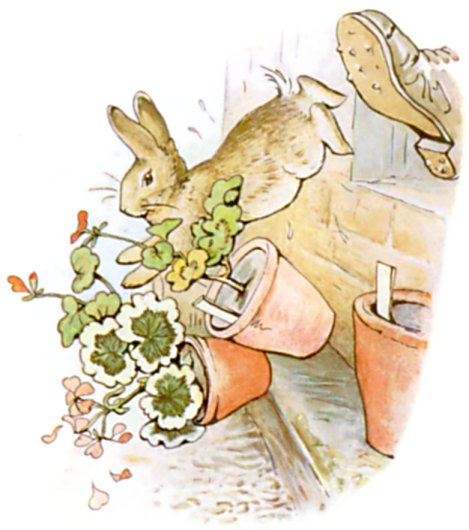
The text was edited further. Some descriptive passages were cut. The sentences were tightened. The result moved faster.
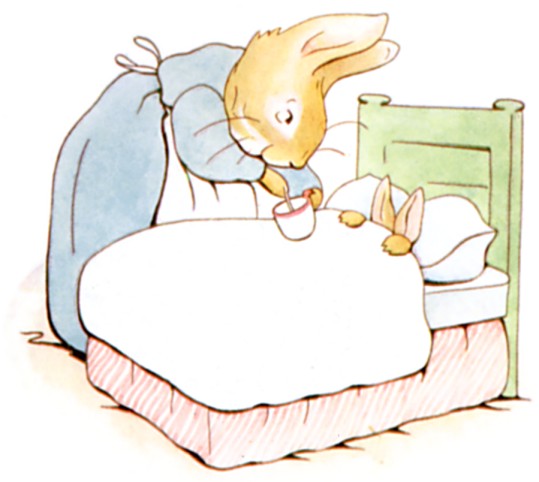
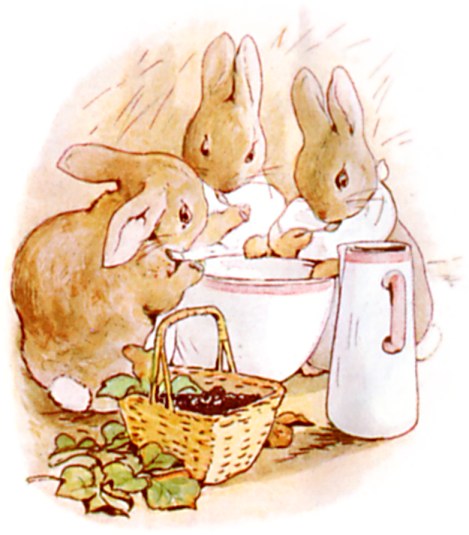
One thing was kept exactly as it had been. Peter lies in bed with chamomile tea while his well-behaved sisters eat bread, milk, and blackberries. That contrast — punishment light but present — had been there since the picture letter, and it survived everything.
The Garden Behind the Story
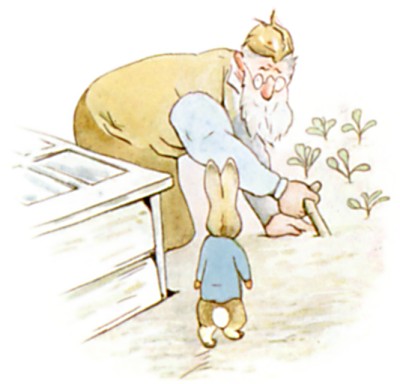
The garden in the book has the look of a real place. The lettuces, the cold frames, the tool shed, the wheelbarrow — none of these were put in for atmosphere. Beatrix drew from the kitchen garden at Lingholm, the estate on Derwentwater where the Potter family had taken summer holidays. She had sketched that garden in the 1890s and knew it well.
There is also a detail from another garden. The door in the wall beside which Peter asks the mouse the way to the gate was drawn from a door at Camfield Place in Hertfordshire, where Beatrix had spent time as a child. Real places accumulated in her drawings. She used what she had observed, from wherever she had observed it, and it all went into a single coherent world.
Her models for the rabbits were equally real. She kept pet rabbits and drew from them throughout. The weight of the ears, the way a small animal crouches when uncertain — these were observed from life, over and over, before they became pictures.
The Characters Carry On
After the Warne edition appeared, Peter Rabbit did not stay inside the book.
Beatrix wrote tiny letters in character — from the book's animals to each other, each folded into its own miniature envelope, some with a stamp drawn in red crayon. Judy Taylor collected these in Letters to Children from Beatrix Potter.
Peter's letter to Mr McGregor is a small masterpiece of nerve. He writes to ask whether the spring cabbages are ready. He signs off "yrs truly, Peter Rabbit" and adds: "Kindly reply by return & oblige." Not a word of apology. He is simply checking on the garden.
Mrs McGregor replies on behalf of her husband, who is in bed with a cold. The spelling is her own: "I rite by desir of my Husband Mr. McGregor who is in Bedd with a Cauld to say if you Comes heer agane we will inform the Polisse." And then a postscript: "I have bort a new py-Dish, itt is vary Large."
Peter passes the news to his cousin Benjamin: shall they meet at the corner of the wood at six that evening?
The chamomile tea and the warm bed changed nothing about him. He is still Peter.
Her Own Uncertainty
Late in her life, Beatrix reflected on why the story had lasted. Her answer was honest. "I have never quite understood," she wrote, "the secret of Peter's perennial charm."
She did not offer a theory. She had made the book through picture letter, prose manuscript, verse detour, two private printings, and a coloured edition. She knew every word of it. And yet its reach exceeded her understanding. That seems right. The book that works is often the book whose maker cannot fully explain it — built from specific observed details, shaped by patient revision, and finally open to a world of readers who find in it something true.
Read It in Full
That's how it was made. Now read The Tale of Peter Rabbit itself, in the Complete Tales. Open The Tale of Peter Rabbit →
Sources
The facts in this article are drawn chiefly from Leslie Linder, A History of the Writings of Beatrix Potter, and Linda Lear, Beatrix Potter: A Life in Nature, with miniature letter texts drawn from Judy Taylor's Letters to Children from Beatrix Potter. The history is theirs to record; the words here are our own.
Leave a Visiting Card
Consulting the visiting cards...