
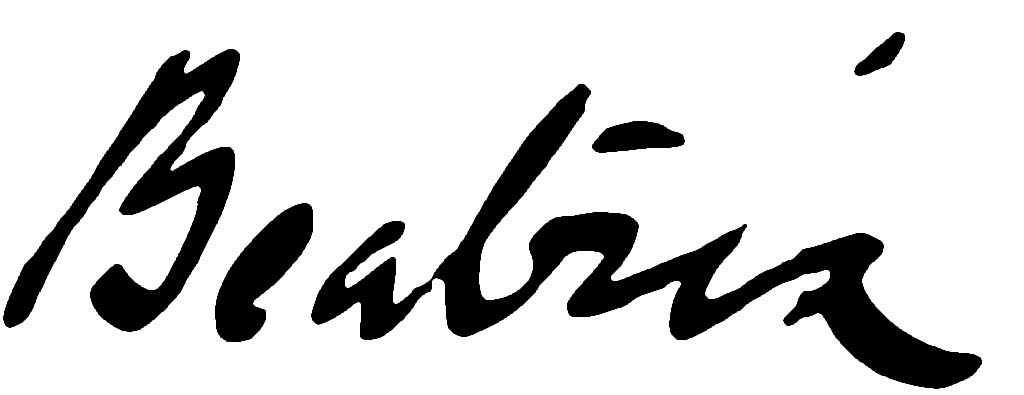
For more than forty years, one London firm sat at the centre of Beatrix Potter's working life. Frederick Warne & Co. published nearly every little book she made. Frederick Warne was the Beatrix Potter publisher who printed Peter Rabbit in colour and sold him by the hundred thousand, turning a picture-letter written to cheer a sick child into a household name. But the relationship was never simple. It began as a business deal. It became a friendship. And, for a few short years, it became a love story — because the man she dealt with was the man she came to love.
This is the story of that working partnership, from 1901 to her death in 1943: the three brothers who ran the firm, the terms she agreed to, how much say she really had over her own books, and the strange knot that formed when love and business grew from the same root.
The Frederick Warne firm and the three brothers
Frederick Warne & Co. had been founded in 1865. The elder Frederick Warne had started out in partnership with Routledge, and brought some good titles with him when he set up on his own. By the time Beatrix knocked on the door, the firm had a real list: world literature, and picture books by Kate Greenaway, Randolph Caldecott and Leslie Brooke. It also had a name for fine natural-history books — which mattered to a woman who had spent years drawing fungi and beetles.
In 1894 the old man retired and handed the business to his three sons. Then he died in 1901, the very year Beatrix came to them. So the firm she joined was run by the brothers, not the founder.
The three did different jobs. Harold Warne, the eldest, was the managing partner — he held the purse and the power. Fruing Warne looked after sales. Norman, the youngest, handled the making of the books: the printing, the proofs, the production. He was thirty-three when he met Beatrix in 1901. He still lived at the family house in Bedford Square with his widowed mother and his unmarried sister, Millie.
In all the back-and-forth over The Tale of Peter Rabbit, it was Norman she dealt with. The letters started stiff and formal — "Madam" and "Sir," all about terms and copyright. By the time the deal was done, they had warmed to "Miss Potter" and "Mr Warne." The firm had its three brothers. For Beatrix, the door into it was the youngest.
(Norman as a man, and what grew between them, belong to their own story. You can read it in our piece on Norman Warne.)
The terms she agreed to
Beatrix knew what she wanted, and it was not mainly the money. She wanted the book cheap. A few pennies, so an ordinary child could own one. On that she would not bend.
The first contract was a small one. She agreed to a run of 5,000 copies, fully coloured, to sell at one shilling and sixpence — about 36 US cents at the day's exchange rate, when the pound stood near $4.87. Her royalty was threepence a copy. By her own sum, that came to about £20 in all (roughly $95 at the time). She did not think much of it, and said so plainly: "no one is likely to offer me better," she wrote, "and I am aware that these little books don't last long, even if they are a success." She was wrong about the lasting. But the modest deal is telling — she went in expecting a small thing, not a fortune.
What she cared about more was control. She pressed the firm hard on copyright: who would own it, and what her rights were if Warne ever chose not to reprint. In the end it was settled that the printing blocks would pass to her if there were no later editions. A safeguard, in case the firm walked away. The contract was signed in early June 1902.
There was one quiet, awkward fact running underneath all of it. Beatrix was thirty-five, but she was an unmarried daughter still living in her parents' house — and in her world, a daughter did not settle a business agreement without her father looking it over. Rupert Potter, a trained barrister, expected to vet the contract. She warned the publishers ahead of time, half-apologising for him: "if he is fidgetty about things," she wrote, would they please "not mind him very much."
She was careful, though, to mark where she stood. "I can of course do what I like about the book being 36," she told them. At thirty-five she was of full age and free to sign for herself; the deference she showed her father was a matter of family, not of law. She humoured him — she did not ask his permission.
How much control did she really have?
Here is the surprise. For all that, she ended up with a remarkable grip on her own work — not at first, but more and more as the years went on.
Early on, she bent to the firm's suggestions and enjoyed the bending. She redrew, she trimmed, she took advice on covers and dialogue. But she was never a passive supplier of pictures. She fought for the price. She watched the proofs like a hawk. And from 1907 she became the real driving force behind the side business — the dolls, the games, the china, the slippers, all the "side-shows" built on her characters. She judged each new product for quality, asked for changes, and turned down what she did not like. A German firm's china tea set she had "never liked"; she had it dropped. She designed a Peter Rabbit board game herself.
The firm needed her more than she needed any single contract. She knew it. Her books were Warne's most valuable property, and after a while she negotiated as someone who understood that. By 1916 she was unhappy that the firm "had never yet produced any satisfactory accounts." She used a price rise as her opening. She changed the open-ended copyright assignment, so she would not be tied to Warne forever "in view of the uncertain future for all trade." She told Harold the old agreements had become "virtually a dead letter."
So the answer is not simple. On paper, the firm held her copyrights. In practice, the woman whose father once fussed over her first contract ended up the one creditor and creator the whole house depended on.
When the editor became the love
The entanglement is the part that makes this firm's story unlike any other publisher's.
Norman was her editor. The work threw them together — letters, parcels, proofs, a doll's house he built that became the one in The Tale of Two Bad Mice. The professional and the personal grew from the same soil. In 1905 he asked her to marry him, and she said yes, against her parents' wishes. Within weeks he was dead, of leukaemia, at thirty-seven.
We will not retell the romance here; that is its own piece. What matters for the firm is what the loss did to the working relationship. Beatrix did not leave. She could have. Instead she stayed with Warne for the rest of her life — and a good part of why was Norman. She kept working, she later said, partly out of loyalty to his memory, partly out of affection for the Warne family. And partly out of gratitude to the firm "which had taken a risk on an unknown woman writer and made her famous."
The man was gone. The firm, and the family, she held on to. From then on her editor was Harold. The easy warmth of the early letters was never quite there again.
The scandal that nearly sank the firm
In the spring of 1917, the whole thing almost ended.
Harold Warne and Fruing were walking near the office one day when the police arrested Harold. He was charged with passing a forged bill of exchange — for £988, knowing it to be false. The Times printed the charge. The forgeries, it turned out, ran to some £20,000. Harold had been quietly draining the publishing company to prop up a failing fishing business in Jersey that he had inherited from his mother. Both were now in ruin.
Beatrix was the firm's largest creditor. She was owed a great deal, and she had not even been told of the emergency meeting of creditors. She was stunned. But, she admitted, not entirely surprised — "I have felt for a long time there was a great risk of ending in a smash." Her first instinct was kindness. "I don't bear him the least grudge," she wrote to Millie, even as the betrayal cut deep. "I would thankfully have sunk my share of the debt to have hushed the matter up."
There was no hushing it. On 26 April 1917 Harold pleaded guilty and was sentenced to eighteen months' hard labour at Wormwood Scrubs. Fruing was cleared of any part in it. He was left holding a company on the edge of bankruptcy. Its one great asset was the published and future work of Beatrix Potter.
Saving the firm — and the terms of staying
What Beatrix did next shows the businesswoman she had become.
First she protected herself. Days before Harold's sentencing, she had her solicitors fetch back the original drawings for all nineteen little books and both painting books. She went up to London herself to see her copyrights kept safe.
Then she helped. Fruing had sold his house, his things, everything he had, to keep the creditors at bay. He sent her at last the proper accounts she had been denied for years, and asked for her aid. She gave it. There was no new book ready for 1917. So she rummaged through her old portfolios and pasted together Appley Dapply's Nursery Rhymes from drawings she already had. Some went back to 1893. It sold well. As Lear puts it, it is too much to say Beatrix saved the firm that year, but without her it could not have risen from the ruins.
She gave her help on one hard condition. Harold must never come back. "One thing I am firm about," she told Fruing, "if I am to go on working for the firm, he must not come back." She bore him no grudge, she said again — "but I know & remember what a trial he has been, even to me, for many years." She agreed to take part of what she was owed in shares rather than royalties. She let her solicitors steer the restructuring. In May 1919 a new company, Frederick Warne & Company Limited, was registered, with Fruing as managing director.
She had thought she might finally be free to live her country life. Instead the rescue tied her tighter — committed, as she saw it, "in ways she had not been previously." She stayed for a plain reason. Leaving would have meant pulling out all her printing blocks, finding a new publisher, and renegotiating everything — at a moment when she was barely making new work. And leaving would have ruined the family she had stood by since Norman.
A forty-year fixture
For the rest of her life the firm stayed close. The work went on — the books, the merchandise, the long, frank, detailed letters in which she judged every game and tea set and slipper.
Then the partnership thinned out by death. Fruing died in February 1928, of a heart attack, worn down by the years of strain. For Beatrix, Taylor writes, his death closed almost three decades of friendship and good business with the Warne family. Fruing's son did not go into the business. The new managing director was his brother-in-law, Arthur Stephens — and for Beatrix it would be "almost like starting again."
She kept on with the firm through the 1930s and into the war, more slowly now, her eyes failing, her heart more in her sheep than her stories. Frederick Warne outlived her. It had published her first book and it published her last. For over forty years it was the one fixed business in her life. It had made her famous, and it broke her heart through the man she met there. It nearly collapsed under one brother's crime. And it was held up, in part, by her own stubborn loyalty.
The deeper, stranger story of what happened to those copyrights after she died — the long afterlife of the Warne relationship — belongs to our piece on her estate after death. This one ends where her working life did: with the firm still standing, and Beatrix Heelis still, to the last, its most valuable name.
Sources
The facts in this article are drawn chiefly from Linda Lear's biography Beatrix Potter: A Life in Nature and Judy Taylor's *Beatrix Potter: Artist, Storyteller, Countrywoman*, with her own words taken from Judy Taylor's edition of Beatrix Potter's Letters. The history is theirs to record; the words here are our own.
Leave a Visiting Card
Consulting the visiting cards...