Everyone knows Peter Rabbit. The little books with the blue covers sold by the million, and Peter was the face on all of them. But if you had asked Beatrix Potter which of her own books she liked best, she would not have said Peter Rabbit.
She would have said the Tailor.
In May 1905 she wrote to her publisher: "I am glad that the old books continue to sell, especially my favourite the Tailor." She said it again and again over the years. On a copy she gave away in 1916: "This is my own favourite amongst my little books." Years later she put it most plainly: "The Tailor never caught on like the others, but he is far the best." It never sold like Peter. The critics never made much of it. She loved it anyway.
What is it about this book? And why did she feel she had to print it herself before she would hand it to her publisher?
A Christmas Present for a Sick Child
The Tailor of Gloucester began as a present. At Christmas 1901, Beatrix made it by hand for a little girl named Winifrede Moore — known as Freda. She was one of the children Beatrix had been writing picture letters to for years. Freda had been ill. Beatrix wrote the story out neatly in a plain exercise book and added twelve little watercolours to go with it.
She tucked a letter in the front, and it tells you how much the story already meant to her: "My dear Freda, Because you are fond of fairy-tales and have been ill, I have made you a story all for yourself—a new one that nobody has read before. And the queerest thing about it—is that I heard it in Gloucestershire, and it is true! at least about the tailor, the waistcoat, and the 'No more twist'."
So the very first Tailor of Gloucester was a one-off, made for a sick child at Christmas. The printed book grew out of that handmade gift.
The True Story Behind It
The "true" part was real. Beatrix had heard the tale at Harescombe Grange, near Stroud in Gloucestershire, the home of a distant cousin, Caroline Hutton. She traced exactly how it reached her: "from Miss Caroline Hutton, who had it of Miss Lucy, of Gloucester, who had it of the tailor."
The tailor was a real Gloucester man named John Prichard. He had been given a grand commission — a fine waistcoat for the new mayor to wear at a civic occasion — and he was overwhelmed by the work. One Saturday he left the pieces cut out on his workbench and went home. When he came back, the waistcoat was made up, beautifully, all but one buttonhole. Pinned to it was a scrap of paper: "No more twist."
The truth, told later by the tailor's own wife, is gentler than magic. His two workmen had let themselves in with skeleton keys over the weekend and finished the waistcoat to do their master a good turn. They left the last buttonhole undone only because they had run out of thread. Prichard, no fool, saw an opportunity. He put the waistcoat in his window with a sign: "Come to Prichard where the waistcoats are made at night by the fairies." The story went round the city as a wonder. He is buried in Gloucester under a stone that reads, simply, "The Tailor of Gloucester."
Beatrix kept the bones of it — the unfinished work, the helping hands, the note — and gave it mice, snow, and the eighteenth century.
What the Book Is About
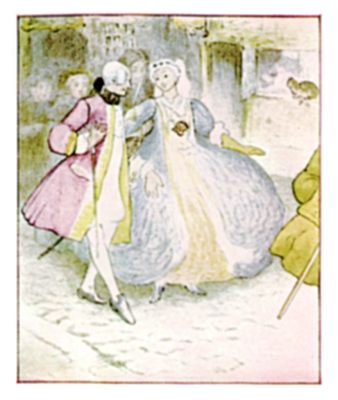
The Tailor of Gloucester is not quite like her other tales. There are no rabbits or ducks, no Lake District field or kitchen garden. The story is set in the city of Gloucester, in the depth of winter, in the age of periwigs and full-skirted coats. The tailor is old and poor. He has been asked to make a splendid coat — cherry-coloured silk, lined with yellow — for the Mayor of Gloucester, who is "to be married on Christmas Day in the Morning." (The Christmas wedding is Beatrix's own invention; the real commission was the mayor's everyday civic waistcoat.)
The tailor cuts out every piece. Then he falls ill with a fever, and the work lies unfinished on the bench. He is short of just one thing: a last skein of cherry-coloured twist to finish the buttonholes.
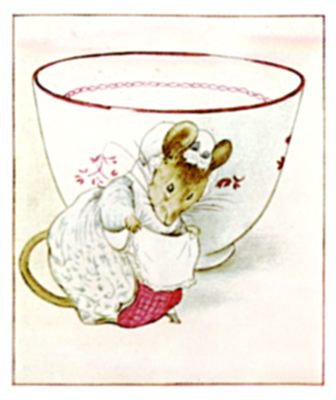
His cat, Simpkin, is sent out for food and that last skein of silk. While the cat is gone, the tailor finds that Simpkin has trapped live mice under the upturned teacups on his dresser. He lifts the cups and sets them free. Simpkin comes home, finds his mice gone, and takes revenge: he hides the precious twist in the teapot.
But the mice remember the kindness. Through the long Christmas Eve night they come out and sew. By morning the coat is finished — every seam made, every button on — except for one buttonhole, where a tiny note is pinned: "No more twist." Simpkin, ashamed at last, gives back the hidden silk. The tailor recovers, finds his coat made, and his fortune is made with it. "He grew quite stout, and he grew quite rich."
→ Read The Tailor of Gloucester
That is the story. It is simple. But it carries a hush the other books do not — the feel of Christmas Eve, of cold streets, of small magic working quietly in the dark.
The Research She Did
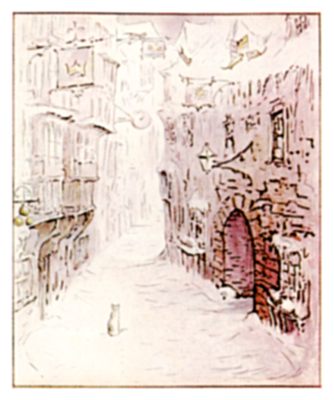
For all its fairy-tale air, the book is built from careful looking. Beatrix went to Gloucester and sketched the real streets — drawing the snow scenes, oddly enough, in summer. As Linder records it: "We are told how she sat on a doorstep in one of the streets of Gloucester in the hot, summer sunshine, sketching a snow-scene for her story." The real house she drew as the tailor's, at 9 College Court, still stands; it is now a little shop and museum to the book.
She studied the trade itself. To get the inside of a tailor's shop right, she went into one in Chelsea on the pretext of having a button mended, so she could look around while she waited.
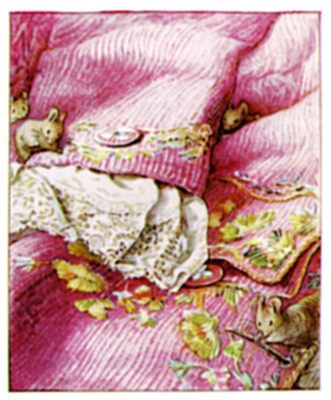
The clothes were drawn from the real thing. She found a collection of eighteenth-century costumes at the South Kensington Museum — now the Victoria and Albert — and was delighted: "I have been delighted to find I may draw some most beautiful 18th. century clothes at the South Kensington Museum. I had been looking at them... but had no idea they could be taken out of the case." The embroidered waistcoat she drew for the book has since been identified, and it is still in the museum's collection today.
Why She Printed It Herself
By 1902 Beatrix had agreed to publish Peter Rabbit with Frederick Warne. The relationship was a good one. But she did not give the Tailor to Warne first. She printed it herself.
In December 1902 she had a private edition made — five hundred copies, printed by Strangeways, bound in pink paper boards — before her publisher had a real say in it. The reason is plain from her own letter to Warne, written that same month: "you have paid it the compliment of taking the plot very seriously; and I perceive that your criticisms are just: because I was quite sure in advance that you would cut out the tailor and all my favourite rhymes! Which was one of the reasons why I printed it myself."
She knew what would happen. A commercial publisher needed a book that would sell to children — short, direct, a picture on every page. The old nursery rhymes she had woven through the story would look like clutter. The slow, wintry passages would look like delay. Warne would take a pen to them, with the best of intentions, and the thing she loved most would be gone.
So she made her own copy first, exactly as she wanted it, and gave it to the people she chose. Whatever came next, the whole book existed.
What Warne Changed
The trade edition came out in October 1903, in good time for Christmas, and it was indeed cut. Not carelessly — but the text came down. The long passage of Simpkin wandering the Christmas-Eve streets, which carried most of her rhymes, was taken out; only six of the old rhymes survived. A picture she loved went too, and she never quite forgave it: "In the privately printed edition of the Tailor there was a picture of the rats carousing in the cellar under the Mayor of Gloucester's shop—one of them drinking out of a black bottle—For the life of me I could not see why Mr. Warne insisted on cutting it out."
It was not all loss. Warne actually gave the trade edition more pictures, not fewer — twenty-eight against the private edition's sixteen. The art grew richer; only the words were trimmed. The trade Tailor is the finer-looking, better-known book. But the private edition, fat with rhymes, is the one she had made for herself.
The Book She Kept Coming Back To
Leslie Linder, who spent years tracing her manuscripts, found that she returned to the Tailor in her letters more than to any other book. It held a place that had nothing to do with sales or reviews. It came from somewhere private.
It was the book she had written for herself, and for a sick child one Christmas, out of a story she had heard and loved. The wintry setting, the quiet magic, the old verses she had known since she was small — none of it was shaped for a market. And because she knew a publisher's pencil might thin it out, she printed it whole, herself, before anyone could improve it. That choice is the whole of her in miniature. She did not argue. She just kept the book the way she loved it best.
Read It in Full
That's how it was made. Now read The Tailor of Gloucester itself, in the Complete Tales. Open The Tailor of Gloucester →
Sources
The facts in this article are drawn chiefly from Leslie Linder, A History of the Writings of Beatrix Potter, and Linda Lear, Beatrix Potter: A Life in Nature, cross-checked against Judy Taylor's editions of Beatrix Potter's Letters and Letters to Children. The Freda Moore dedication, the Caroline Hutton story, and the publishing history are recorded there in Beatrix Potter's own words. The history is theirs to record; the words here are our own.
Leave a Visiting Card
Consulting the visiting cards...