
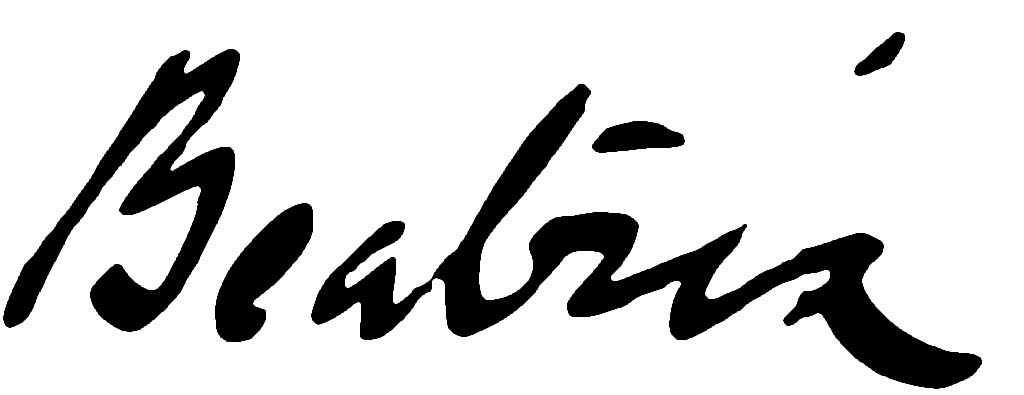
In 1897, the men who ran British science looked at Beatrix Potter's work on fungi and decided it did not matter. Her paper was read at the Linnean Society and quietly set aside. She was an amateur, and a woman. As far as the establishment was concerned, that settled it.
It did not settle it.
Over the next hundred years, the mycologists came back. They untied her portfolios, read her notes, and looked again at what she had actually done. One by one, they reached the same verdict. On the questions that mattered, Beatrix Potter had been right. This is the story of that recognition — slow, posthumous, and in the end complete.
The Paintings Found Their Book
The first person to bring her science back into the open was a working mycologist.
In 1967, W. P. K. Findlay published a book on fungi in the well-known "Wayside and Woodland" series of nature guides. To illustrate it, he chose fifty-nine of Beatrix Potter's watercolours. It was the exact fate she had once imagined for them. Back in 1897 she had written to a small boy that her funguses might one day be put in a book — "but it will be a dull one to read." Seventy years later, that book existed.
Findlay was a past president of the British Mycological Society. He did not treat the paintings as charming curiosities. He treated them as data.
And he said something about their maker that set the course for everyone who followed. Beatrix Potter, he wrote, "was more than an enthusiastic amateur collector and artist. She had the mind of a professional scientist and biologist."
That sentence was a challenge to the next generation. Was Findlay right?
The Mycologists Who Came Back
The answer came from people willing to do the work he had started.
Mary Noble, a mycologist, spent years studying Potter's fungi and her working methods. She traced the link between Beatrix and Charles McIntosh, the Scottish postman-naturalist who had taught her to paint fungi with scientific accuracy. From the late 1970s, Noble's research put Beatrix back on the record as a real naturalist — not a children's author who had dabbled in mushrooms.
Then came Roy Watling. Watling was a mycologist at the Royal Botanic Garden Edinburgh, and he became her most thorough champion.
In April 1997 — almost exactly a hundred years after her paper was shelved — the Linnean Society and the British Mycological Society joined forces. They presented her work at the Edinburgh Science Festival. Mary Noble spoke on Beatrix as a woman and on her bond with McIntosh. Other scientists showed how the fungi she had studied now sit at the centre of industry, medicine, and modern biology. Watling laid out how far her own enquiry had gone.
He did not dress it up. In her day, he wrote, the study of fungi was a "cinderella" subject — and for a woman to take it on was stranger still. Much of her work, he added, had been "overshadowed for centuries" by the study of plants and larger animals. She had chosen a hard, unfashionable corner of science, and worked it seriously.
"Treated Scurvily"
1997 was also the year the establishment said sorry.
That April, the Linnean Society publicly acknowledged that Beatrix Potter had been "treated scurvily" by its members a century before. The press reported it plainly. "Apology to end tale of Beatrix botanist," ran the headline in The Times. A few weeks earlier another paper had put it even more simply: "We were wrong about Beatrix."
It was a symbolic act. Beatrix had been dead for more than fifty years, and an apology could not reach back to 1897. But it set the record straight in public, where the original slight had happened. She had been shut out for being a woman and an amateur — not for doing poor science.
What They Found When They Looked Again
The apology was the easy part. The hard part was the evidence, and the evidence held.
Scientists went back to her actual paintings and tested them against what is known now. They kept finding things she had recorded correctly, long before anyone else.
One painting carried tiny details she had drawn without knowing what they were. Decades later, two mycologists looked again — Peter Roberts at Kew, and Jim Ginns of the Canadian Agricultural Services. They identified those details as Tremella simplex, a fungus that lives as a parasite on other fungi. Her picture turned out to be the first British record of the species. She had documented it without a name, simply because it was there.
She had also argued, against the British consensus of her day, that a lichen is not one organism but two living together — a fungus and an alga in partnership. The men at the British Museum had no patience for the idea. One of them, George Murray, is said to have fled rather than answer her questions about it. Today the idea is settled fact. Science calls these things lichenized fungi, reasoning exactly as she had.
And the watercolours themselves never stopped earning their keep. Linda Lear notes that modern mycologists still reach for them to identify fungi. The paintings are simply that accurate.
The Mushroom on the Supermarket Shelf
There is one vindication she would have enjoyed most of all.
The fungus she worked on hardest was a small tawny mushroom, Flammulina velutipes. She grew it in her London kitchen, on glass and on bits of broom, and watched its spores develop. Once, a piece left forgotten in a tin canister in a warm room sprouted pale, stretched, ghostly growths — she counted nearly a hundred of them, grown entirely in the dark.
She did not quite grasp what she was looking at. Watling did. That same fungus, grown in the dark in exactly that way, is now sold around the world as food. We know it as enoki — the pale clustered mushroom on the supermarket shelf.
The fungus Beatrix Potter studied by accident in a Victorian kitchen turned out to be a future food crop. She had been a lifetime early.
The Record She Left
Linda Lear, her biographer, weighs the whole episode plainly. Time, she writes, "has been far kinder to Beatrix's scientific efforts than her contemporaries were."
The bare facts bear her out. On the evidence of her journal and her drawings, Beatrix Potter was the first person in Britain to germinate the spores of basidiomycetes — the large fungi, the mushrooms and toadstools. She was the first in Britain to argue that a lichen is two organisms in partnership, ahead of everyone but the Swiss botanist who first proposed it. "Not a bad record," as Lear puts it, "for an amateur."
Much of that record survives because institutions kept it safe. The bulk of her fungi work is held by the Armitt Trust in Ambleside, with more at the Victoria and Albert Museum and at Perth. These are the collections the modern mycologists came back to read.
The honours have kept arriving. In December 2023, more than a century after her paper was shelved, a team naming a newly found fossil fungus chose to call it Potteromyces — after her. Her name now sits in the permanent catalogue of life on Earth.
She never wanted to be a professional scientist. Lear is clear about that. Beatrix wanted to look hard at something and get it right. On that count the verdict is no longer in doubt. The mycologists came back — and found that the amateur had seen further than the experts who turned her away.
Sources
The facts here are drawn chiefly from Linda Lear's Beatrix Potter: A Life in Nature and from Roy Watling's own appreciation, Helen Beatrix Potter (The Linnean, 2000), cross-checked against contemporary press reports of the 1997 Linnean Society apology. The naming of Potteromyces (2023) postdates these books. The history is theirs to record; the words here are our own.
Leave a Visiting Card
Consulting the visiting cards...