
Among all of Beatrix Potter's animal characters, Mrs Tiggy-Winkle stands closest to her maker. Beatrix said so herself. She described the little hedgehog washerwoman as a portrait of her own nature, and the character she drew — tidy, hard-working, private, and skilled with her hands — has enough truth in it to make the comment feel more than modest.
Lucie Carr of Newlands
The child in the story is real. Her name was Lucie Carr, and she was the daughter of the vicar of the Newlands Valley, a hidden fold of fell country south-west of Keswick. The valley is steep-sided, very quiet, and little visited. Beatrix knew it from the years she had spent in the Lake District, and she used it as the setting for the book with care.
She had been thinking about a story with Lucie in it for some time. As early as 1901 she wrote, in an inscription, that she "should like to put Lucie into a little book." The plan sat for a few years while she worked through other projects. When she returned to it, the story came together quickly.
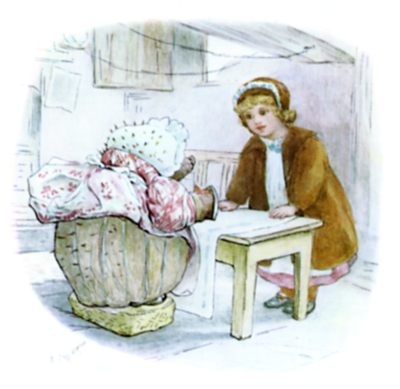
The Lucie in the book is a small girl who loses her handkerchiefs and her mittens and follows a hedgehog up the hillside to find them. It is a gentle premise. The danger is minimal. The emotional weight of the story is not in tension but in warmth — the warm kitchen, the smell of clean linen, the small acts of domestic care carried out by a figure who is very good at her work.
The Newlands Valley Setting
Beatrix drew the Newlands Valley landscapes with exceptional care. The fell slopes behind the washhouse, the winding paths, the scale of the hills against the small figure of a child — all of these were observed rather than invented.
For a book with so little plot in the conventional sense, the setting carries a great deal. The valley is a world that feels complete and private. It exists beyond the edge of ordinary life. When Lucie arrives at Mrs Tiggy-Winkle's door, she enters a space that is domestic and safe, but also quite separate from the everyday world she came from.
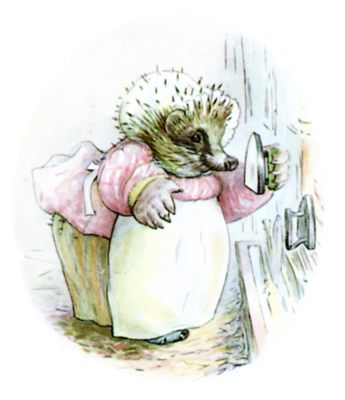
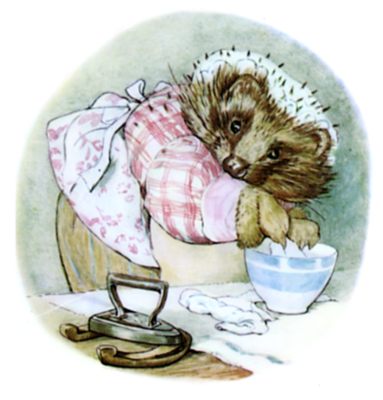
Beatrix drew the washerwoman's small house and its interior — the ironing table, the starch, the line of clothes — with the same precision she brought to the kitchen garden in Peter Rabbit. You can smell the hot iron and the clean linen. The illustrations are among the most interior and detailed she ever produced.
The Self-Portrait
Beatrix was direct about the connection between herself and the character. Mrs Tiggy-Winkle is a worker. She is expert in her work. She takes pride in what she produces and does not make a fuss about it. She is warm with Lucie but does not talk much. She just gets on.
For Leslie Linder, this self-identification was not simply a passing remark. It reflected something genuine. Beatrix had always associated her own value with what she could make with her hands — her paintings, her needlework, her later management of the farm. The washerwoman who knew her craft and exercised it without complaint was a version of who she wanted to be.
She also used the book to pay a quiet tribute to the women she had known in the Lake District — the farm wives and housekeepers whose domestic competence she had observed and respected over many years of holidays and, later, of living at Hill Top. Mrs Tiggy-Winkle is drawn from a type Beatrix had seen clearly.
Drawing the Model
The hedgehog model was difficult.
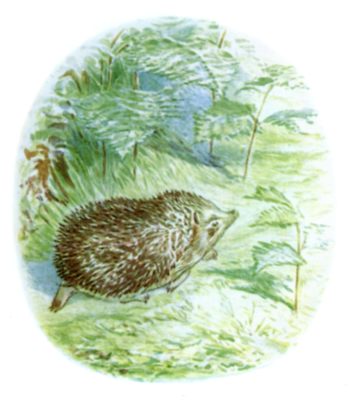
Beatrix had a pet hedgehog named Mrs Tiggy, who had provided the character's name and some of her physical habits. But hedgehogs do not naturally pose. They curl up when they feel uncertain, they are prickly to handle, and they have a strong instinct to move rather than sit still.
Beatrix discovered that if she tried to prop the hedgehog up in a sitting position for the more domestic illustrations, the animal would bite. She noted this with a kind of resigned admiration. Mrs Tiggy had strong opinions about being arranged.
The drawings she produced despite this are remarkably convincing. The hedgehog in the book looks both entirely like a hedgehog and entirely like a woman absorbed in her work. The trick of making an animal serve double duty — wild creature and human type simultaneously — was one of Beatrix's great skills, and she used it nowhere better than here.
→ Read The Tale of Mrs. Tiggy-Winkle
The Route Up the Hill
Part of the book's quiet pleasure comes from the walk itself. Lucie follows the hedgehog up into the fells and finds the washhouse in a hollow of the hill. Beatrix drew this route with care.
The ascent from the valley floor to the washhouse works as a kind of threshold crossing. The lower valley is the ordinary world — the farm, the lane, the ordinary morning. The hillside and the hollow above it are something else: domestic, warm, and entirely separate from the life Lucie came from.
Beatrix had walked hillsides like this all her life. She had sketched in the Newlands Valley specifically, and she knew how the fells above the valley floor looked in morning light and how they felt underfoot. The route Lucie takes is not a dramatic climb. It is the gentle, unhurried ascent of a child following something that has caught her attention.
That unhurried quality sets the tone for the whole book. Nothing in Mrs. Tiggy-Winkle is rushed. The story moves at a pace suited to its subject: an afternoon's walk, a warm kitchen, a pile of clean linen, a long walk home.
A Girl's Book
Beatrix described The Tale of Mrs. Tiggy-Winkle as "a girl's book." By this she meant something specific. It was not an adventure story. It did not have a chase or a rescue or a near-miss. It was a story about a girl finding her things and meeting someone who cared for small objects and kept them safe.
She was right that it was different from the rabbit books. But it found its readers quickly. The dedication — "For the real little Lucie of Newlands" — made it something a specific child could hold in her hands and recognize as hers. That personalness, that sense that the book was written for someone real, gives it a warmth that is still present when you read it now.
The book was ready in 1905, but Norman Warne — her editor and fiancé — died before he could see it published. He died in August 1905 of sudden illness. The book appeared that October. It was dedicated in his absence to the real Lucie, in the valley he had never visited.
The Dedication and Norman Warne
The book was dedicated "For the real little Lucie of Newlands." The dedication was personal in a way that mattered. Lucie Carr was a real person who had waited years to be the subject of a book. When the book finally appeared in October 1905, she was old enough to hold it and read her own name.
What she could not know was the context of that publication. Norman Warne — Beatrix's editor, and the man she had agreed to marry earlier that year — had died in August 1905. He died of sudden illness less than three months after the engagement. The book he had worked on with her appeared in October, two months after his death.
Beatrix continued. She revised, she corresponded, she prepared the book for publication without him. The dedication to the real little Lucie was in place, just as planned. Nothing in the book itself marks the change in her circumstances. The illustrations are warm. The washhouse is warm. Mrs Tiggy-Winkle goes about her work as she always had.
What Katie Macdonald Added
There was a second source for the character that is less often noted. Beatrix knew a woman called Katie Macdonald — a woman she had observed and liked, whose manner in the house was steady and capable. According to Linder's account, something of Katie Macdonald's way of working found its way into the final character.
This layering — the real hedgehog, the self-portrait, the farm women Beatrix admired, the specific person Katie Macdonald — is typical of how she built her characters. They were composites of observation, drawn from life at several removes, assembled until they felt true rather than invented.
Mrs Tiggy-Winkle's pet hedgehog was buried at Bolton Gardens in February 1906. The book she had inspired was already in print and already loved. She had done her work.
Read It in Full
That's how it was made. Now read The Tale of Mrs. Tiggy-Winkle itself, in the Complete Tales. Open The Tale of Mrs. Tiggy-Winkle →
Sources
The facts in this article are drawn chiefly from Leslie Linder, A History of the Writings of Beatrix Potter, and Linda Lear, Beatrix Potter: A Life in Nature, cross-checked against Judy Taylor's edition of Beatrix Potter's Letters. The history is theirs to record; the words here are our own.
Leave a Visiting Card
Consulting the visiting cards...