
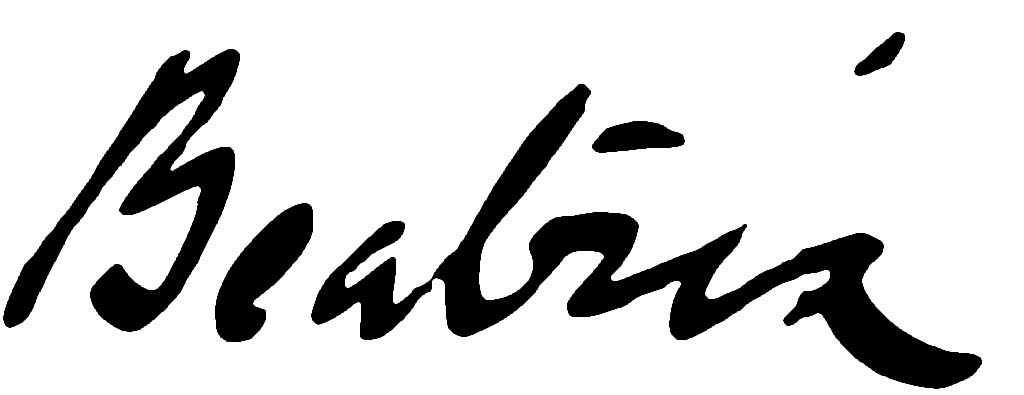
For sixteen years, Beatrix Potter's journal was written in a secret code that she invented herself. She began at fifteen and stopped at thirty. Into it went art, politics, holidays, and the people who passed through her days. No one was meant to read a word.
One entry tells you everything. She was eighteen, standing in front of the old Italian masters at a London gallery. She wrote four words first: "No one will read this." Then she wrote what she really thought: "I say fearlessly that the Michelangelo is hideous and badly drawn; I wouldn't give tuppence for it except as a curiosity."
That one entry shows what Beatrix Potter's journal is like. The code let her say exactly what she thought. Decoded and published long after her death, it held more than 200,000 words. They are not the words of a quiet, passive woman. They are quick, watchful, and very funny.
The journal has a reputation for a cold eye. Read in full, it is sharper than that — and warmer too.
Beatrix Potter's Journal and the Art World
Through her father, Beatrix saw the London art world up close. Rupert Potter was a keen amateur photographer. He took photographs that famous painters used as models — people, landscapes, studies of light. That work brought his daughter into their studios and exhibitions, usually to a quiet corner of the room. She used the chance to form her own opinions.
She judged the great names by one test: was the drawing any good? Michelangelo failed it. Turner, on the other hand, she called "the greatest landscape painter that ever has lived." She was not following the fashion. She was looking.
She went to the Royal Academy year after year and filled pages with her opinions. Most of the paintings she thought poor, and said so. The foreign painters, she decided one summer, were "in a better style than the English."
Her closest study was of John Everett Millais. He was one of the most celebrated painters in England, and a friend of the family. He came to the house often, and she watched him work for years.
People assume she liked to point out his mistakes. The journal shows something gentler. One evening Millais came to ask Rupert to photograph a small boy with a bowl of soap suds — the picture later called Bubbles. Millais was cheerful, and laughed at himself: "I can't paint you know, not a bit." He held a photograph of his own painting, he said, and compared it with the real thing, "and I can see where the drawing's wrong." So the famous line is his, not hers. She wrote it down because she liked him.
She said so herself. "I shall always have a most affectionate remembrance of Sir John Millais," she wrote. He once praised her at a small country exhibition in Perth: "plenty of people can draw, but you and my son John have observation." She knew exactly what he meant, and kept the words. "He was an honest fine man."
She was not so gentle with everyone. She saw the critic John Ruskin at the Royal Academy and found him "one of the most ridiculous figures I have seen." He wore an old hat, a buttoned-up coat, and one trouser leg tucked up. He noticed it half way round the room, stood on one leg to fix it, and pulled the other leg up worse than the first. She wrote the whole funny scene down, just as it happened.
Politics as a Show
Politics was a normal part of life at home. Rupert belonged to the Reform Club and the Athenaeum, and political talk filled the rooms. Beatrix listened, then went upstairs and wrote it down. She did not care much for parties or sides. She cared about the men themselves — the gap between how they looked and what they really were.
Her portrait of William Gladstone is the most famous example. He was Prime Minister four times. In 1890 he came into a show at the Royal Academy, and she looked at him long and hard. The entry is addressed to "my dear Esther" — an imaginary friend she wrote to, because she had few real ones.
"He really looks as if he had been put in a clothes-bag and sat upon," she wrote. "I never saw a person so creased. He was dressed entirely in rusty black... gray wisps of hair straggled from under his old hat. But very waken, not to say foxy the old fellow looked, what there is of him."
Hardly anyone in the room went near them. He was famous, yet people kept their distance. She also saw how carefully he was looked after. One evening his doctors said he was too ill for dinner. But that same night he went to the theatre and sat through a whole opera, Carmen. The Tory newspapers noticed it, and so did she. She just wrote it down.
The People She Watched
She turned the same eye on everyone, high or low. She wrote a small, perfect portrait of a Perthshire postmaster. He was "a fat, hunched old fellow, with little piggy eyes," in "a smoking-cap with a yellow tassel," with "immense hands" that fumbled slowly for the stamps. He put on the wrong postage and worked out change on his fingers. "He wants reporting," she decided.
Her own family was not spared. Her Uncle Fred she set down as "deaf, placid, rather dateless, excessively obstinate, very mean as to ha'pence... and sublimely unconscious of the fact that he cannot drive." The family's old horse was worn out. Her father sent a man to the London Zoo to ask what it was worth. The zoo bought old horses for meat, to feed its big cats. A fat one was worth two pounds, a middling one thirty shillings. Thin horses they would not take, she noted, because "the lions are particular."
By the 1890s the journal was filling with fungi, and she turned the same eye on the scientists. She visited Kew Gardens to see its plant collection. There she met a shy librarian. She summed him up in one line: he had "an appearance of having been dried in blotting paper under a press." The director talked on and on with a cigarette. Of him she noted only that she "shot in one remark which made him jump, as if they had forgotten my presence."
This is where the reputation for a cold eye comes from. But the journal keeps correcting it. Her last governess, Miss Carter, is a good example. She taught Beatrix German for two years. The line people always quote says only that she had "her faults" and was "one of the youngest people I have ever seen." But read the whole entry, and it is warm. "I have liked my last governess best on the whole," it begins — and ends, "but she was very good-tempered and intelligent." A sentence later she adds, "I regret German very much," and German was Miss Carter's subject. The cold dismissal everyone repeats is, in her own words, a warm goodbye.
The warmth turned out to matter. Miss Carter became Mrs. Annie Moore. Years later, when she had no news to send, Beatrix wrote picture letters to the Moore children. One, to a boy called Noel Moore, told a story about four little rabbits. It grew into Peter Rabbit. The governess she is said to have dismissed had given her the readers for everything that came next.
The Same Eye, Turned on a Rabbit
She watched her own pets as closely as she watched Gladstone. She studied her rabbit Benjamin with real delight, but no soft feeling. Rabbits, she wrote, were "creatures of warm volatile temperament but shallow and absurdly transparent." Benjamin was "amiably sentimental to the verge of silliness" one minute, a spitting demon the next, and "an abject coward" who believed in bluster. He could "stare our old dog out of countenance," she wrote, and chase a cat that had turned tail.
Once he fell head first into an aquarium. He sat in the water he could not climb out of, pretending to eat a piece of string. "Nothing like putting a face upon circumstances," she wrote.
That is where the tales come from. Not from softness — and not from a cold heart either, but from both at once. Watch closely. Record exactly. Let the truth be funny. The journal ran for sixteen years, and every page of it was practice.
Sources
The facts and quotations here are drawn from The Journal of Beatrix Potter, 1881–1897, cross-checked against Linda Lear's *Beatrix Potter: A Life in Nature* and Judy Taylor's *Beatrix Potter's Letters to Children*. The history is theirs to record; the words here are our own.
Leave a Visiting Card
Consulting the visiting cards...