
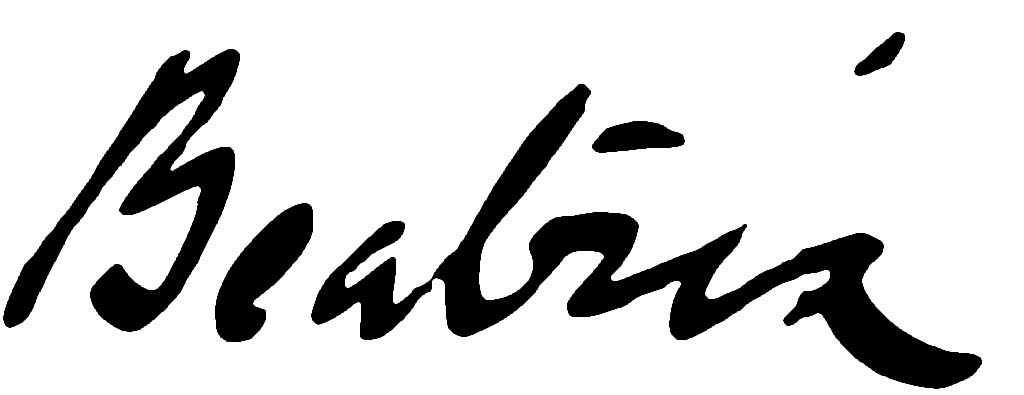
Beatrix Potter's later years were not a slow fade in a quiet room. She was a working farmer almost to the end. She still ran her sheep farms, still walked her garden, still wrote sharp letters to friends across the Atlantic. But her body was giving way. Her eyes failed. Her chest filled with bronchitis most winters. Her heart, weak since a fever in her twenties, beat too fast and would not settle. This is the story of those last winters — what she could still do, what she had to give up, and the husband who quietly held the whole thing together.
To the outside world she was a famous author growing old. To herself she was Mrs. Heelis, with lambs to see to and a garden full of rabbits. The decline was real. So was the stubbornness.
The eyes went first
The trouble with her sight started early, well before old age. During the First World War she noticed her eyes changing. She needed glasses, but glasses had to be fitted in London, and London was a place she no longer wished to go.
It cost her the work she was famous for. Pulling a new book together meant fine drawing, and the fine drawing was getting hard. Now and then she still dug through old folders of her drawings, looking for something she could turn into a book. But the effort only made her sad. She wondered, in one letter, "how I ever drew so much and well, while I could see."
She was honest about the rest of it, too. The eyesight was not the whole reason the books slowed. The passion had gone. "Somehow since the war I have never felt as if I could concentrate my attention on drawing," she wrote to an old friend. "It is much easier for me to attend to real live pigs & rabbits; and after all I have done about 30 books, so I have earned a holiday."
So the drawing stopped, and she let it. She did not mourn it the way her readers did.
The 1939 operation
The hardest blow came in the spring of 1939.
For six months she had not been well. There had been bleeding, and a first small operation the previous November had not put it right. She worked out for herself what it probably meant. "Anything in the womb is apt to be the beginning of the end," she wrote. To another friend she put it plainer still: "I have felt very tired and aged the last two years. Maybe the surgeon will put me right — but he cannot put me young again."
On 29 March she went into the Women's Hospital in Liverpool. She told almost no one. Before she went, she did the practical things a careful woman does. She dictated her will to William, who wrote it down in pencil in his small, fine hand. She asked whether Liverpool had a crematorium. She wrote to the National Trust about her farms, in case William was too upset to manage it himself.
The surgery, on 1 April, was a hysterectomy. It was dangerous work for 1939, and her recovery was worse than the operation. About a week after, severe vomiting burst the stitches and she needed more surgery. She was very ill. "I do not think it is merciful to put an old woman through such an experience," she wrote.
She came home in May, weaker but alive. A later scare that summer sent her back to Liverpool by ambulance with violent stomach pains. The doctors gave her, in her words, a "thorough overhaul." Lear notes that the doctors told her she might be "good for 10 years" if the operation held. She would have four.
The stoop, and the elastic that held her together
The operation left a mark she carried for the rest of her life.
The vertical cut had never properly healed, and it weakened the muscles of her stomach. To hold herself in, she wore a wide band of elastic, like a girdle. As the years went on she grew more and more stooped. Neighbours thought it was arthritis or a bent spine. Lear records that it was mostly the failed incision — and it caused her real pain and real bother whenever she tried to do anything outdoors.
She rarely complained. When she did, it was usually about the elastic. In wartime, new elastic was almost impossible to find. By 1943 she told a doctor friend she could not move about without the belt, and got cold underneath it. At 77, she wrote, it was "hardly worth while to experiment" with sewing the old scar up. Even then she added: "I can still work in the garden & grow vegetables. We are bothered with rabbits."
What she could still do
She was no invalid sitting by the fire. Through the war years she ran a real farm and ran it hard.
There were sheep at Troutbeck Park, cattle to buy, wool to sell — more than three tons of it one year. She grew vegetables and potatoes. She kept hutch rabbits to make the meatless wartime days easier. She once saved up enough sugar to make marmalade from oranges going spare at a port. She fussed over her shepherds' welfare and over the dogs at Troutbeck that were taking sick for want of minerals.
In March 1943 the Herdwick Sheep Breeders' Association voted her president-elect for 1944. She would have been the first woman ever to lead that very male world of fell farmers. She found it funny and was plainly proud. "You would laugh to see me," she wrote, "amongst the other old farmers — usually in a tavern! after a sheep fair. We are serious enough; about the future."
There were small joys, too. A troop of Girl Guides camped each summer in a wood she had planted in 1906, on land everyone had said was too poor to grow trees. For her seventy-seventh birthday they dressed as characters from her books and sang to her. She was delighted. "I never had such a birthday before!"
The writing that came in old age
The drawing had stopped, but the writing had not, quite.
Late in life her audience was American. She wrote warm, frank letters to friends in New England — librarians and families who, she felt, understood something in her books that "the British shop keeper" missed. In 1942 an American magazine, The Horn Book, printed an essay of hers called "The Lonely Hills," stitched together from her Fairy Caravan stories. It is a reverie about walking the fells alone, "in company of gentle sheep, and wild flowers and singing waters." It reads like a farewell to the high country she could no longer reach.
Around the same time she wrote a stranger sort of note in an old book. The newspapers were full of penicillin and its power against disease. Beatrix had studied moulds herself in the 1890s, and her note shows she had guessed at such things long before. The scientist she had once been was surfacing one last time.
When a child asked after the Fairy Caravan in 1940, Beatrix answered in her own voice as much as her characters'. "When we grow old and wear spectacles," she wrote, "our eyes are not bright, like children's eyes, nor our ears so quick, to see and hear the fairies."
William, the carer
Through all of it there was William Heelis.
He had married a famous woman with a will of her own, and in her last years he became, quietly, the person who looked after her. He kept vigil at a hotel in Liverpool while she lay in the hospital after surgery. He took down her will in pencil. When she worried about her farms before going under the anaesthetic, it was William she trusted to remember the letters she could not write herself — and he did remember.
By her own account she was the stronger of the two. "You might have noticed I am the stronger minded of the pair," she told an American friend, "also the money is mine." She fretted about what would become of him. She even left her spinster friends a half-serious instruction that William should remarry if she died, "provided he did not make a fool of himself."
By the war years the worry ran both ways. William was overworked — on the farm committee, clerking for the magistrate, out late on cold nights as a reserve policeman in a tin hat. He took ill more than once. "I am not very comfortable about my husband — we are getting old!" she wrote. Two people minding each other, neither quite strong, neither willing to stop.
By the last winter they had brought in help. A Nurse Edwards came to stay through the New Year to look after them both. The household was shrinking down to its essentials: two old people, an elderly housekeeper, a nurse, and the farms still to be thought about every single day.
The last winter
The winter of 1943 was wet and cold, and she felt it more than ever.
In the early autumn she went to bed with another bronchial cough. Coughing kept her from sleep, and her pulse raced. "My heart has been too quick since I had rheumatic fever at 20," she explained to a tenant in October, half apologising for not coming to see the farms herself. She still got to her desk when she could, doing farm paperwork and writing letters. She still went over to her beloved Hill Top to dust it and arrange her china exactly as she wanted it. She was laying out, in effect, the museum she hoped to leave behind.
In her Christmas letters to American friends, she admitted the truth she made light of at home. Lear records that she wrote to each of "the continued weakness of her heart." She was grateful, too, that she and William had come through the bombing so lightly. "I may pick up in spring," she wrote to one. "I was pretty bad."
She did not pick up. But that is the story of how she died, and of the will and the land she left, and those belong to other pages. See The Death and the Ashes for the end itself, and Beatrix Potter's Will for what she gave away. This page is about the living years — and she carried on farming the fells until almost the last week, with her husband at her side.
She had once written, sorting old family letters, that records of illness give a false picture. "The milestones are all tombstones! But the record of the cheerful jog trot round of life between them is not kept." Her own last years were that jog trot to the end — stooped, short of breath, and still bothered about the rabbits in the garden.
Sources
The facts in this article are drawn chiefly from Linda Lear's *Beatrix Potter: A Life in Nature*, cross-checked against Beatrix Potter's Americans: Selected Letters (ed. Jane Crowell Morse) for her own late-life words, and Judy Taylor's *Beatrix Potter's Letters*. The history is theirs to record; the words here are our own.
Leave a Visiting Card
Consulting the visiting cards...