Canon Rawnsley could compose a sonnet for any occasion, fight a railway company to a standstill, and talk a room full of strangers into caring about a stretch of fell they had never seen.
Hardwicke Drummond Rawnsley was a priest by trade and an agitator by temperament. By the time Beatrix Potter met him, he had already published books, poured out essays and verse, and made himself the most determined defender the Lake District had. Linda Lear describes him plainly: a man of "high confidence and tremendous vitality," the sort you could not help but be caught up by.
He caught up Beatrix. And forty years later, when he was gone, she would spend the rest of her life finishing the work he started.
The Vicar Who Said Publish
They met in the summer of 1882, at Wray Castle on Lake Windermere, where the Potters were renting for the season and Rawnsley was the local vicar. He was thirty-one. Beatrix was sixteen.
A word on the title, since it runs through his whole story: in 1882 he was simply a parish vicar. "Canon" came later. In 1893 Carlisle Cathedral made him an honorary canon — a churchman's honour given for service to the diocese and the wider community, not for any grand position — and the name stuck. He was Canon Rawnsley ever after.
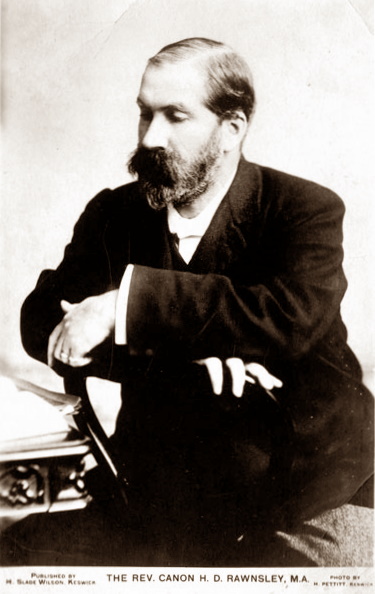

Most adults, shown a teenage girl's nature drawings, said something kind and changed the subject. Rawnsley didn't. He had been a student of John Ruskin at Oxford and had worked beside the housing reformer Octavia Hill in the London slums — he took ideas seriously, and he took her seriously. He told her the work was good. He told her she should publish.
Her father liked him too. Rupert Potter and Rawnsley shared a passion for photography and for collecting literary autographs, and the friendship gave Beatrix something rare: a grown man with publishing connections who treated her ambition as real.
He would remain her ally for the next four decades — first as the man who believed in her books, and later as the man who taught her what land was for.
The Dreadful Verse
When Beatrix could not find a publisher for *The Tale of Peter Rabbit*, Rawnsley tried to help. He had, around 1897, brought out a collection called Moral Rhymes for the Young, and he fancied he could do the same for her rabbit.
So he turned her plain story into verse — rhyming, improving, moralising verse — and submitted it to Frederick Warne & Co. alongside her drawings.
It was terrible. Lear puts it best:
"It may well be that Rawnsley's rhyming version was so bad that it made Beatrix's straightforward narrative look even better."
Warne's asked to see the rest of her manuscript. They wanted her words, not his rhymes. And here something quietly important happened: Beatrix took the negotiations into her own hands. When Warne's wrote to Rawnsley, she told the publisher exactly where she stood.
"I do not know if it is necessary to consult Canon Rawnsley; I should think not. Speaking for myself I consider your terms very liberal as regards royalty."
The mentor had opened the door. She walked through it alone.
A Sort of National Property
What made Rawnsley more than a kind vicar was his conviction that beautiful country belonged to everyone — and that the only sure way to protect it was to own it.
He had arrived in the Lakes to find them under siege: mines, quarries, and above all railways, pushing into the valleys to haul out slate and haul in trippers. In 1883, when a line was proposed through Borrowdale, Rawnsley founded the Lake District Defence Society at Wray and fought it with a new kind of weapon — national public opinion, mobilised against local money.
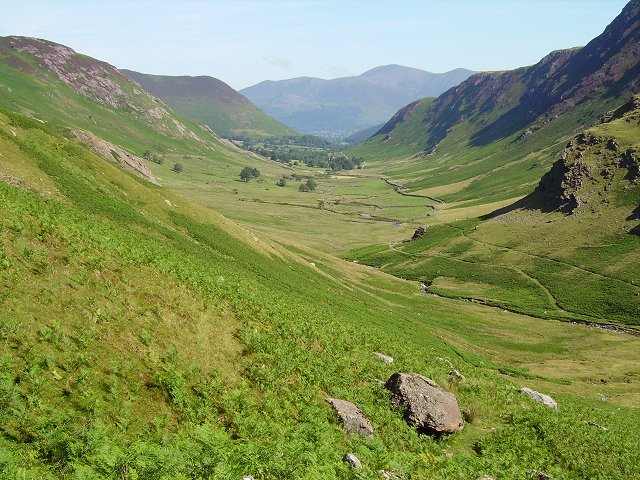
The Newlands Valley
The 1883 railway would have run from the Honister quarries here, through Borrowdale along Derwentwater — Rawnsley's campaign killed it.

He won. And he learned the lesson that he would hand to Beatrix: idealism was not enough. You needed land, held forever, in safe hands.
In 1895, with the jurist Sir Robert Hunter and his old friend Octavia Hill, Canon Rawnsley founded the National Trust for Places of Historic Interest or Natural Beauty. He served as its secretary for the rest of his life — still firing letters to The Times, in his later years, against a plan to put a seaplane factory on Windermere. The shores of the lake, he warned, were "seriously imperilled."
The Death of Canon Rawnsley
The losses came close together. Early in 1916, Rawnsley's wife of thirty-eight years, Edith, died after a long illness. He could not go on as Vicar of Crosthwaite without her, and retired to Allan Bank in Grasmere — the house where Wordsworth had once lived. Barely eighteen months later he married his secretary, Eleanor Simpson, whom Beatrix already knew and liked.
Then, in May 1920, Hardwicke Rawnsley died.
Beatrix had married William Heelis by then and was settling into the Lakes for good. The death of her oldest mentor did not close a chapter for her. It opened one. As Lear writes, his death "pushed her to take a more public role in carrying on his legacy and making it her own."
For nearly forty years he had been the one buying land, fighting developers, speaking for the fells. Now the work was hers.
Troutbeck Park
In the summer of 1923, Beatrix Potter made a decision that startled everyone who knew her as the author of small books about rabbits. She bought Troutbeck Park — a vast, run-down sheep farm of nearly two thousand acres at the head of the Trout Beck valley, under the highest road in the Lake District.
She did not do it alone. William, a country solicitor with a long reach into Westmorland families and their properties, had heard that developers were circling, ready to carve the bottom land into holiday houses. With his help she outbid them. The deed ran to twenty-five separate parcels; she paid £8,000, and the farm was conveyed to her on 28 August 1923.
It was a magical place to her — once a Norman deer park, full of old forest, ruined walls, and ancient stone huts. She had walked its great Tongue of high ground since 1895, calling it "uncanny; a place of silences and whispering echoes." Now she owned it, and the rescue of it became her absorbing passion, all but replacing her writing.
"Let Him Fish for Life"
The largest test came at Monk Coniston — a sprawling estate of nearly four thousand acres straddling two valleys, the kind of land that, sold off piecemeal, would mean the end of its hill farms and the scattering of its hefted flocks. Neither the National Trust nor the Forestry Commission could move fast enough to buy the whole. Beatrix could.
So she bought all of it, with the Trust as her silent partner: she would hold the estate, the Trust would raise an appeal for half, and she would manage the rest as its unpaid agent. The seller, Jimmy Marshall, cared mostly about keeping his fishing rights, and never knew the Trust was involved.
Her letters to the Trust's secretary during the negotiations are pure Beatrix — sharp, funny, entirely in command:
"Mr JM does not know it is the Trust… Let him fish for life!"
When it nearly fell apart: "We may all end in a lunatic asylum." When Marshall arrived with new conditions: "I was listening behind the dining room door."
She got it done. She had become exactly what Rawnsley had been — the businesslike hand that turned a wish to save the land into the deed that saved it.
The Enactor of His Ambitions
When Beatrix died, she left fifteen farms and more than four thousand acres to the National Trust — the body Rawnsley had helped found the year she made her first solo journey to Sawrey. She also left careful instructions: that her farms keep their Herdwick flocks, and that a "sufficient representative number of the old farms" stay in the Trust's hands.
A biographer called her the "enactor of the ambitions of Canon Rawnsley." It is exactly right. He supplied the vision — that the Lakes were a sort of national property, to be kept whole and handed on. She supplied what his idealism had always lacked: the money, the deeds, and the stubborn patience to actually buy the land, farm by farm, wall by wall.
The thread runs from a dinner at Wray Castle in 1882, where a young vicar looked at a girl's drawings and said publish, to the four thousand acres of protected fell that still carry the shape of his idea and the work of her hands.
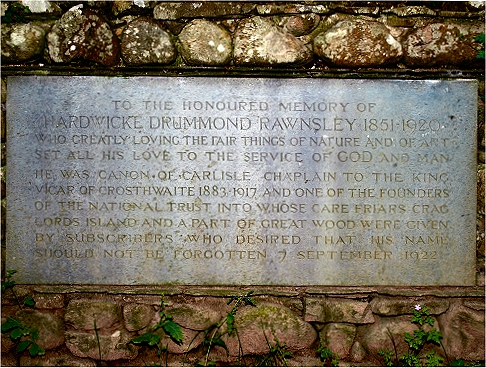
Rawnsley's Memorial, Friar's Crag
Overlooking Derwentwater — among the land he helped save.

Plaque inscription:
TO THE HONOURED MEMORY OF
HARDWICKE DRUMMOND RAWNSLEY 1851–1920
WHO GREATLY LOVING THE FAIR THINGS OF NATURE AND OF ART
SET ALL HIS LOVE TO THE SERVICE OF GOD AND MAN
HE WAS CANON OF CARLISLE CHAPLAIN TO THE KING
VICAR OF CROSTHWAITE 1883–1917 AND ONE OF THE FOUNDERS
OF THE NATIONAL TRUST INTO WHOSE CARE FRIARS CRAG
LORDS ISLAND AND A PART OF GREAT WOOD WERE GIVEN
BY SUBSCRIBERS WHO DESIRED THAT HIS NAME
SHOULD NOT BE FORGOTTEN 7 SEPTEMBER 1922
Leave a Visiting Card
Consulting the visiting cards...