The Tale of Pigling Bland ends with two pigs running away. They cross a bridge, reach open country, and dance off over the hills. It is one of the happiest endings Beatrix Potter ever drew. She published it in October 1913, only days before she married William Heelis. The timing was not planned. But it is hard to read the escape now without thinking of her own.
This was a book about getting free. Two young pigs are sent off to market. One of them, Pigling Bland, takes a wrong turn into trouble, then finds a way out — and a companion to share it with. For a woman of forty-seven who was about to leave her parents' house for a home of her own, the story carried more than it said.
The Real Pigs at Hill Top
The book began, as so many of hers did, with real animals.
Beatrix kept pigs at Hill Top. Two of them she named Alexander and Pigling Bland. They were sold because food was short and their appetites were enormous. She had written about a pig sale years before, writing to Millie Warne in November 1909: "The two biggest little pigs have been sold, which takes away from the completeness of the family group. But they have fetched a good price, and their appetites were fearful—five meals a day and not satisfied."
Then there was Pig-wig. The black pig in the story had a living model. Beatrix bought a small jet-black pig from a neighbouring farmer, Mr Townley, against the wishes of her farm manager John Cannon. She bottle-fed it by her own bedside and it became a pet. That is the pig Pigling Bland rescues in the book.
To draw the pigs, she went into the sty and sat with them. "I spent a very wet hour inside the pig sty drawing the pig," she wrote. "It tries to nibble my boots, which is interrupting." Another day: "Have spent some hours inside the pig sty to-day, drawing the little pigs before they cease to be interesting."
The Story
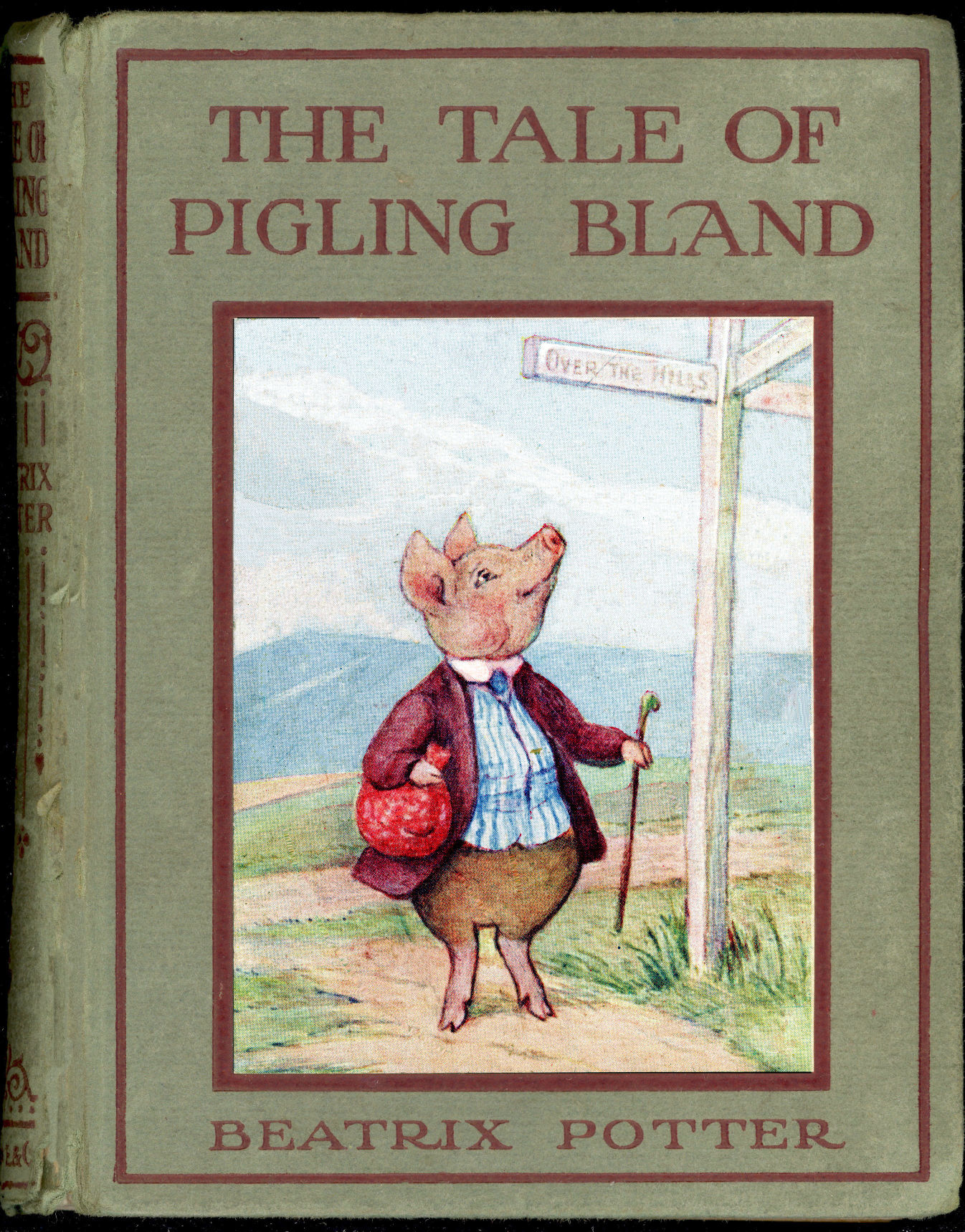
Aunt Pettitoes has too many piglets and cannot manage them. The two biggest, Alexander and Pigling Bland, are sent off to market with their licences to travel. Alexander loses his papers and is taken back. Pigling Bland goes on alone.
Night falls and he shelters in the house of a man called Mr Piperson. There he discovers a little black pig held captive — Pig-wig. Mr Piperson means to keep her, and the reader understands what keeping a pig usually leads to. Pigling Bland decides to free her.
At dawn the two of them slip away. They fool a grocer who recognises Pig-wig. Pigling fakes a limp to seem harmless. Then they reach a bridge, cross it, and the country opens out in front of them. Pig-wig drops Pigling's hand and begins to dance.
The last line of that escape stayed in Beatrix's mind to the end. She added it almost at the last minute, pencilling it into the proofs: "Take that peppermint out of your mouth, Pig-wig, we may have to run."
The Places She Drew
As ever, the landscape was real. The crossroads and signpost in the frontispiece stood just behind Hill Top. Mr Piperson's fireplace was drawn from the fireplace at Spout House in Far Sawrey. The bridge the pigs cross was Colwith Bridge, and the open country beyond it was Little Langdale, over the county line into Westmorland.
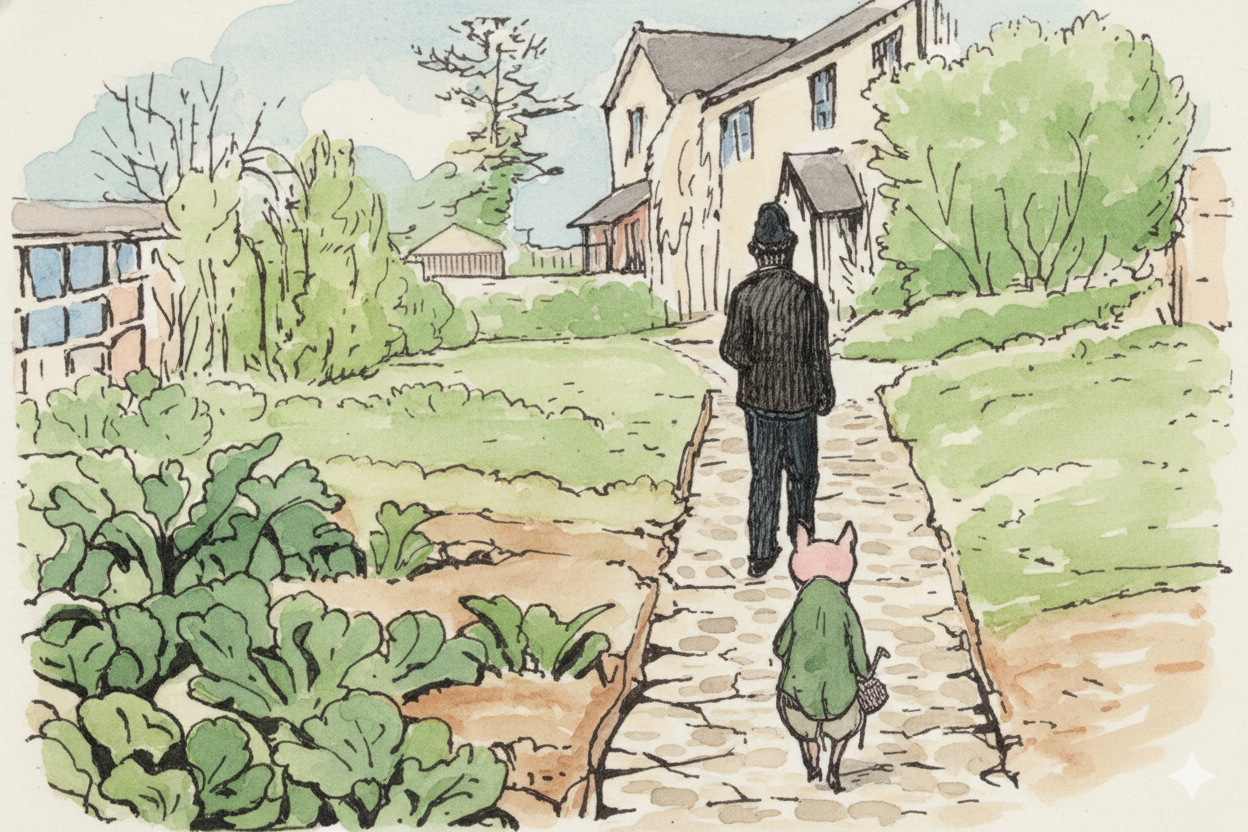
In the book, Pig-wig names it as they cross: "That's Westmorland." Then she lets go and dances.
Beatrix also put herself into the book. In one picture she stands handing travel papers to Alexander. It is one of only two of her books in which she drew her own figure. She had wanted to do it. "I think I shall put myself in the next book," she had written, "it will be about pigs; I shall put in me walking about with my old 'Goosey' sow, she is such a pet."
A Book Made in Difficulty
Pigling Bland was not an easy book to finish. Beatrix was ill through much of the year she made it. Her heart troubled her for weeks. She told the printer, Wilfred Evans, in June 1913: "I took so very long to get over my illness. I had my heart bad for weeks and could do nothing. I am all right now but it might have been wiser to give up the book, before they took orders for it."
→ Read The Tale of Pigling Bland
She worked on it through the summer and got the proofs cleared only in September. "I only got rid of the revised proofs last week," she wrote; "it is disgracefully late. It has been such a nuisance all summer." For a woman who was also planning a wedding and running a farm, the book came together in a scramble.
She dedicated it "For Cecily and Charlie. A Tale of the Christmas Pig" — to the two children of Farmer Townley, the family who had sold her the real Pig-wig.
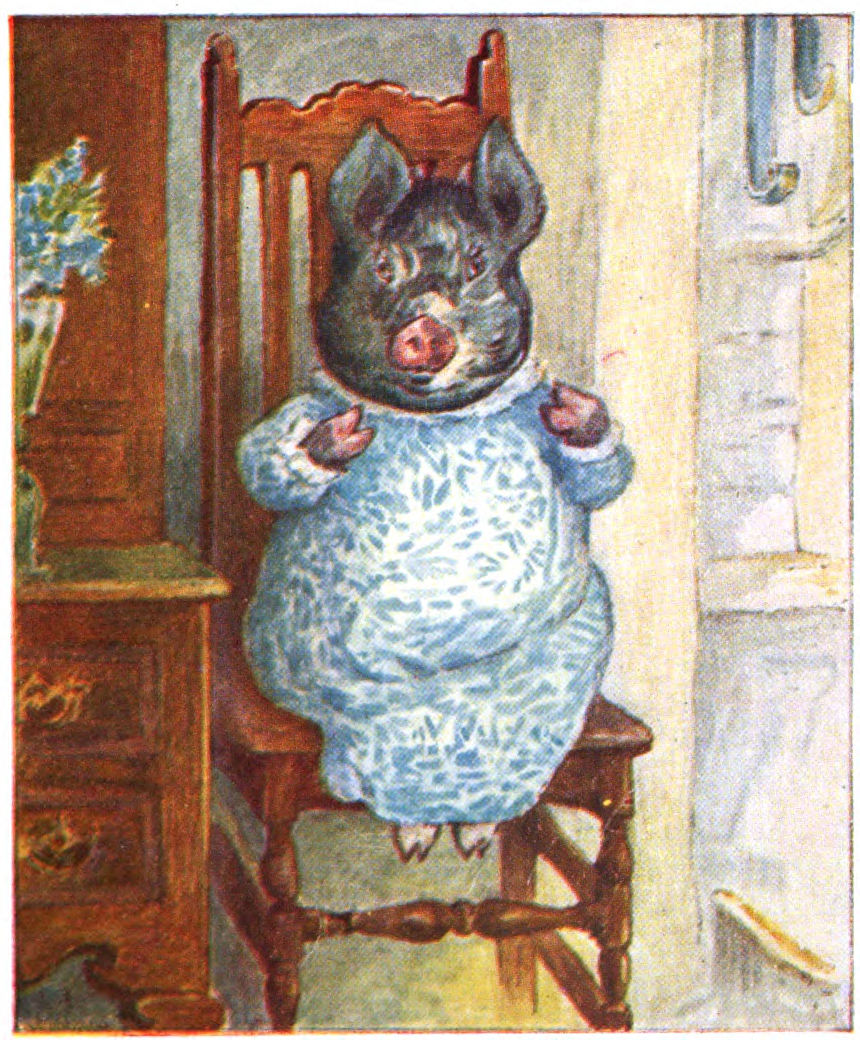
The Escape and the Marriage
This is where readers have long seen something more in the book.
Beatrix married William Heelis, a country solicitor, on 14 October 1913. Pigling Bland came out the same month, days before. The book she had been making all through that hard, hopeful year ends with two creatures escaping a narrow life and walking out into open country together. Her biographer Linda Lear reads the ending as a freedom story — the pigs going "over the hills and far away" as a quiet echo of Beatrix's own escape into marriage and the Lake District she loved.
Beatrix herself said no — at least to the literal version. When she sent out copies in November 1913, she wrote: "The portrait of two pigs arm in arm—looking at the sunrise—is not a portrait of me and Mr. Heelis, though it is a view of where we used to walk on Sunday afternoons! When I want to put William into a book—it will have to be some very tall thin animal."
So the denial is on record. The two pigs are not meant to be the couple. And yet she admitted the view was theirs — the very ground where she and William walked on Sundays. The reader is left with both facts and can weigh them. A woman who had spent her whole life under her parents' roof drew two small creatures walking free, on the land she was about to call home, in the month she finally married.
A Letter About the Pig Book
While she was making it, Beatrix kept up her habit of writing tiny letters to children in the voices of her characters. One of them announced this very book. Writing as Peter Rabbit to a small boy named Drew Fayle, she had him explain what his author was up to: "Miss Potter is drawing pigs & mice. She says she has drawn enough rabbits. But I am to be put into one picture at the end of the pig book."
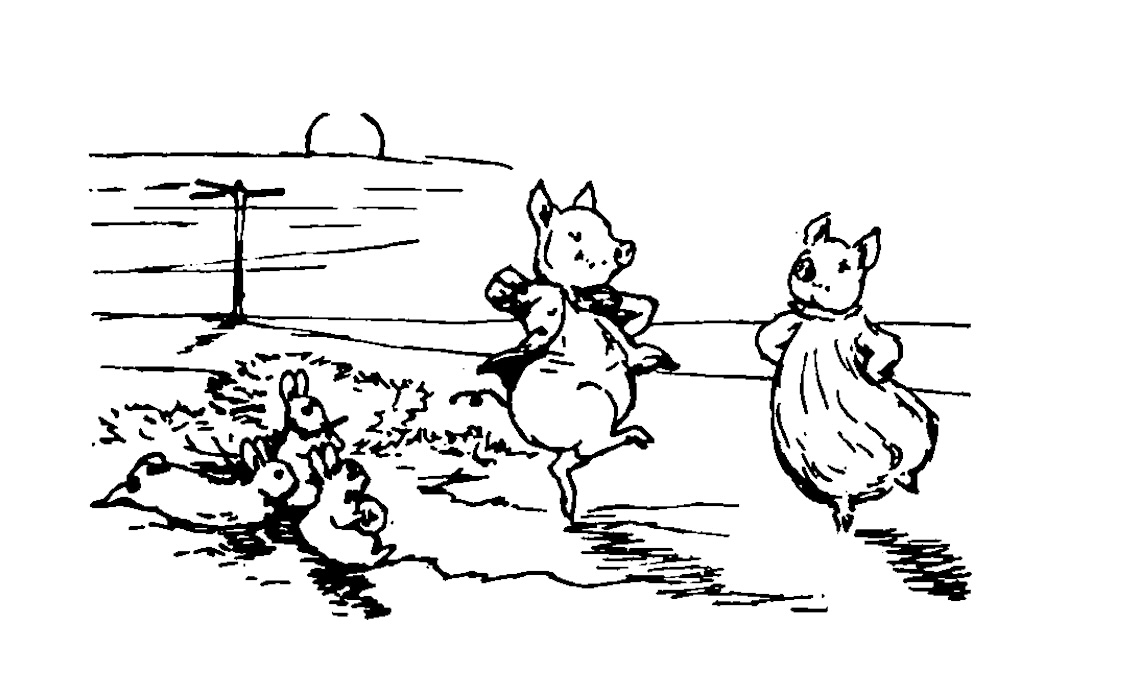
That is exactly what happened. Peter appears on the last page, watching the road as the two pigs make off. It was a small joke shared in advance with one child, then printed for all of them — Peter stepping aside, by his own account, to let the pigs have their book.
She had also planned, for a while, to put more of herself into it. "I think I shall put myself in the next book," she wrote; "it will be about pigs; I shall put in me walking about with my old 'Goosey' sow, she is such a pet." In the end she appears only once, handing over the travel papers. But the affection for her real animals runs through every page.
What the Book Holds
Pigling Bland is gentler than the book that came just before it, and warmer. It is a story about being sent away and finding, instead of danger, a friend and a way out. The pigs are not heroic. They simply walk, and trick a grocer, and keep going until the country opens up.
Peter Rabbit appears at the very end, watching the road — a small farewell wave from her best-known character, placed there because she said she had drawn enough rabbits and was moving on to pigs and mice.
It was the last full-length tale she would publish for years. After it came the wedding, the farm, and a different kind of life. The book stands at that hinge. Whatever she meant by the two pigs and their sunrise, she chose to end it with an escape into open country — and she did it in the same weeks she made her own.
Read It in Full
That's how it was made. Now read The Tale of Pigling Bland itself, in the Complete Tales. Open The Tale of Pigling Bland →
Sources
The facts in this article are drawn chiefly from Leslie Linder, A History of the Writings of Beatrix Potter, and Linda Lear, Beatrix Potter: A Life in Nature, cross-checked against Judy Taylor's edition of Beatrix Potter's Letters to Children. The freedom reading of the ending is Lear's; Beatrix Potter's own denial of the portrait is from her letters. The history is theirs to record; the words here are our own.
Leave a Visiting Card
Consulting the visiting cards...