
The Tale of the Pie and the Patty-Pan is Beatrix Potter's comedy of village manners. There is no chase in it and no real danger. The whole story turns on a tea party between two respectable pets — a cat and a dog — and on the small social anxieties that come with being invited somewhere and wanting to behave correctly.
It is set in the real village of Sawrey, the place Beatrix loved most. The cat, Ribby, invites the dog, Duchess, to tea. What follows is a gentle muddle over a pie. Underneath the muddle is a sharp, affectionate eye for how neighbours treat one another.
Two Houses, Two Pets
The shape of the book is a visit from one house to another. Ribby, a sensible cat whose full name is Mrs Ribstone Pippin, lives in one cottage. Duchess, a well-bred little dog, lives in another. Ribby writes a letter inviting Duchess to tea, and the story is the visit.
This two-house structure is what gives the book its flavour. It is a story about calling on a neighbour — about invitations, and good manners, and the worry of giving offence. Ribby plans her tea carefully. Duchess frets in advance about what she will be given to eat. Both of them are trying, in their small way, to do the thing properly.
Beatrix understood this world from the inside. The village she drew ran on exactly these courtesies: notes sent round, teas accepted, the careful management of who was asked and what was served. She made two pets act it all out, and the comedy comes from how seriously they take it.
The Pie Mix-Up
The plot is a misunderstanding. Ribby bakes a pie for the tea — a mouse pie. Duchess dreads the thought of eating mouse, so she secretly bakes her own pie, a veal-and-ham pie, in a dish exactly like Ribby's, meaning to swap it in.
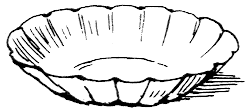
The trouble is Ribby's two ovens, and the small tin called a patty-pan that sits inside a pie to hold up the crust. The two pies and the two ovens get confused. At the tea, Duchess eats heartily, and then is seized by a terrible fear: she believes she has swallowed the patty-pan. There is great alarm. Dr Maggotty, a magpie doctor, is fetched. In the end Duchess discovers her own veal-and-ham pie still sitting in the top oven, and understands her mistake.
It is a slight plot, and Beatrix knew it. An earlier version had been "too thin," so she altered it and rewrote the whole thing. What carries the book is not the pie but the manners around it — the worry, the politeness, the wish to please that drives Duchess into the whole tangle.
The Real Village
Beatrix built the book out of Sawrey itself. She had been sketching the village for years — its cottage gardens, the post office door, the interior of one of the Lakefield cottages. Those sketches became the backdrops of the book.
Her biographer Margaret Lane described it well: the tale "roams about the village of Sawrey, lingering over the tiger-lilies and snapdragons in cottage gardens," and is, in the end, "Beatrix Potter's praise of Sawrey." The book is a walk through a place she loved, with two pets acting out a small drama in front of real cottages.
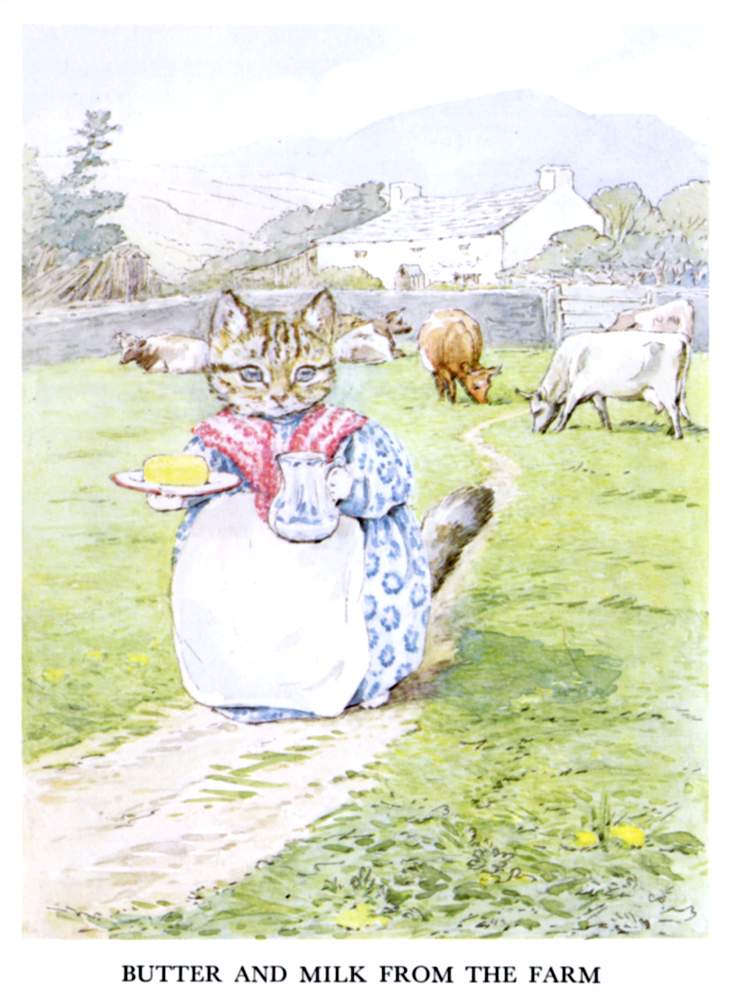
She moved things around for the picture's sake. In the book, Duchess reads her invitation in the garden of a cottage called Buckle Yeat, opposite the village shop — though the real dog lived elsewhere. Beatrix chose the prettier setting. The frontispiece shows Hill Top as it looked before she added rooms to it, with Ribby crossing the meadow by the post office.
→ Read The Tale of the Pie and the Patty-Pan
The Real Duchess
Duchess had a living model, and the truth of it is a little tangled. The real Duchess was a valuable Pomeranian belonging to Mrs Rogerson of Lakefield Cottage. By her owner's account, she was "a pedigree dog," and good show dogs were bred from her.
But she was not much to look at. So when Beatrix came to paint, she used a second, handsomer Pomeranian — a dog named Darkie, also Mrs Rogerson's — as the model for the pictures, while keeping the real Duchess's character in mind for the story. Beatrix said as much: "I enclose a photograph of the original Duchess (on a chair) in very bad coat... She was never much to look at herself, though a most valuable little dog."
There was even a small argument with the publisher about the breed. Pomeranians were not yet widely known. When the book went to Warne, the staff "did not think a Pom. could have such a mane," so Beatrix took the photograph in to prove it.
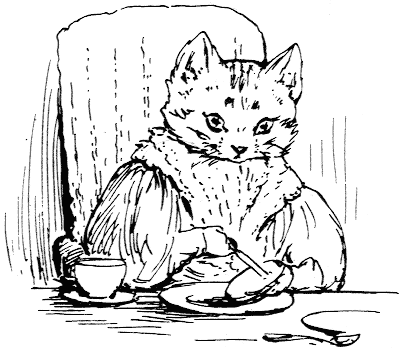
The magpie doctor was studied just as carefully. To draw Dr Maggotty, Beatrix went to the Zoological Gardens. "Perhaps I can get to-morrow to draw a magpie at the Zoological Gardens," she wrote, and her sketchbook note records exactly what she saw: "Brown black eye, nose a little hookier than jackdaw, less feathered."
The Tea Invitations, in Miniature
The manners at the heart of the book spilled over into Beatrix's letters. She wrote tiny notes to children in the characters' voices, and many of them are tea invitations — the very thing the story turns on. Ribby writes to Duchess: "If you are at home and not engaged will you come to tea tomorrow?... There will be a red herring, and muffins and crumpets. The patty pans are all locked up. Do come." Duchess, when she has missed the visit, sends a careful apology: "I am so sorry I was out... I had gone to a dog show. I enjoyed it very much but I am a little disappointed that I did not take a prize, and I missed the red herring."
When Duchess is away, Ribby falls back on her cousin Tabitha Twitchit, who accepts but cannot resist a small dig: "I am glad that Duchess is away from home, I do not care for dogs." Even Dr Maggotty the magpie carries on a correspondence of his own. The whole genteel social world of the book — invitations, regrets, polite snobbery between a cat and a dog — lived on in these letters as much as in the printed pages.
The story itself had a longer history than its 1905 date suggests. It began as a "cat story" Beatrix scribbled during a wet holiday week at Hastings in 1903 — the same rainy week that produced the doll's-house mice. She first called it "Something very very nice." She set it aside when another book was chosen, then came back to it, found the plot "too thin," and rewrote it around the Sawrey village she loved.
A Big Book, Then a Small One
The Pie and the Patty-Pan had an unusual life in print. It was first published in 1905 in a large format — deliberately bigger than the standard little books, to give Beatrix room for the village detail she wanted to show. The first edition even came out with plain mottled lavender end-papers, because she ran out of time to design proper ones. Only later, when it was rebound, did it gain end-papers showing a pie and a patty-pan.
In 1930, to match the rest of the series, it was reduced to the ordinary small size and given its longer title: The Tale of the Pie and the Patty-Pan. So, like a few of her books, it exists in both a big early form and a small later one.
Beatrix was fond of it. "If the book prints well," she wrote, "it will be my next favourite to the 'Tailor'." That is high praise — The Tailor of Gloucester was the book she loved best of all.
It carries a sadness too. This was the last of the seven books she had planned with Norman Warne, her publisher and, by the summer of 1905, the man she had agreed to marry. He saw the book through its final stages but died that August, at thirty-seven, before it was published. She kept its dedication simple and warm: "For Joan, to read to Baby," for two of the Moore children she wrote to. The lightness of the tea-party comedy sits, quietly, against the heaviest loss of her life.
Read It in Full
That's how it was made. Now read The Tale of the Pie and the Patty-Pan itself, in the Complete Tales. Open The Tale of the Pie and the Patty-Pan →
Sources
The facts in this article are drawn chiefly from Leslie Linder, A History of the Writings of Beatrix Potter, and Linda Lear, Beatrix Potter: A Life in Nature, cross-checked against Judy Taylor's edition of Beatrix Potter's Letters to Children. Margaret Lane's reading of the book as a praise of Sawrey is quoted from Linder. The history is theirs to record; the words here are our own.
Leave a Visiting Card
Consulting the visiting cards...