
The Tale of Mrs. Tittlemouse, published in 1910, is the quietest of Beatrix Potter's books. It has no chase and no real danger. Its central character is a wood mouse who lives alone in a burrow beneath a hedge and keeps it exactly as she likes it. The threat in the story is not violence but intrusion — the arrival of uninvited guests who track mud and leave mess and use her things without asking.
It is a book about tidiness, and what tidiness costs when the world outside will not cooperate.
Thomasina and Her Burrow
The mouse's full name, as Beatrix set it down, was Thomasina Tittlemouse. She lives in a long, intricate burrow with a larder, a kitchen, a parlour, and a series of passages and storerooms. The burrow is described in enough detail that a reader gets a clear sense of its shape and its order.
Mrs Tittlemouse has arranged her home to her own satisfaction. The larder contains what she has stored. The parlour is clean and dry. The passages are swept. She tends her house as a gardener tends a garden — with pleasure in the result and particular dislike of anything that disturbs it.
Beatrix built this character with affection. The detail she brought to the burrow — its rooms, its contents, its specific domestic atmosphere — suggests a world she had thought about at length. The burrow is both a fantasy and a recognizable space: tiny, cosy, and exactly as one person wants it.
The Uninvited Guests
The chaos that enters Mrs Tittlemouse's burrow comes in stages.
First there is a beetle, large and frightening, sheltering in her passage during rain. Then a spider. Then a whole family of beetles — Beatrix's first version of the text had them as "wood-lice," which she changed to "creepy crawly people" in revision. The original term was too specific. The revised phrase was more widely readable and funnier.
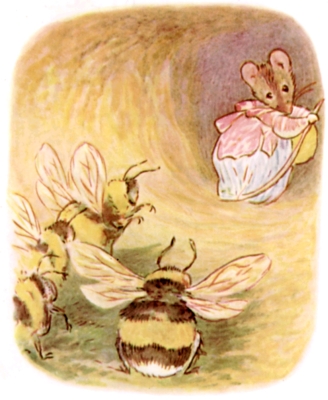
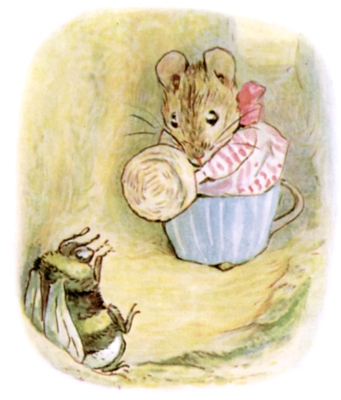
Then comes Babbitty Bumble, the bumblebee, who has taken up residence in one of the inner rooms and filled it with dry moss and honey. Babbitty is the most disruptive of the guests because she is the most settled. She has not merely wandered in — she has moved in. She has made herself comfortable in Mrs Tittlemouse's space as if she had a right to it.
The intrusion of Babbitty Bumble is the emotional centre of the book. Every other intruder can be dealt with by waiting or sweeping. Babbitty requires direct confrontation.
Mr Jackson and the Honey
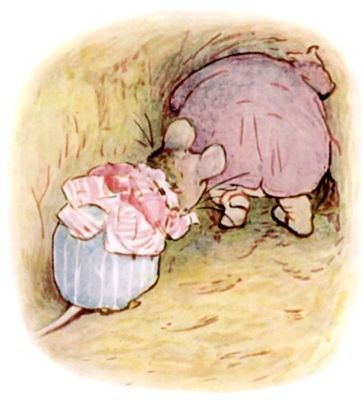
The largest intruder is Mr Jackson, a toad who visits uninvited and fills the passages with his damp, round body. He is not malicious. He is simply very large, very wet, and very much in the way. He does not fit in the passages. He leaves muddy marks on the clean floor. He sits in the parlour and asks for food.
Mr Jackson finds the honey. He eats it out of the moss while Mrs Tittlemouse looks on with a mixture of helplessness and horror. He thanks her cheerfully when he leaves.
Beatrix gave Mr Jackson some of the same quality she gave the fox in Jemima Puddle-Duck — an easy confidence, a lack of self-consciousness, a sense that the world exists for his comfort. He is not threatening. He is, in his own way, quite pleasant. But he is an absolute disaster for Mrs Tittlemouse's carefully maintained home.
She cleans up after him. And after all the other guests. And then she has a party of her own.
The Earwig Question
There is a small but characteristic editorial choice in the book. An early draft included an earwig — a specific insect — in one of the passages. Beatrix changed it to a beetle in the final version.
This kind of precision about the natural world ran through all her work. The difference between an earwig and a beetle is not large, but she thought about it. She made the change for reasons that she did not fully set out, but they probably had to do with which creature would be more immediately recognizable to a young reader and which would serve the illustration better.
The attention she brought to these small decisions is part of what makes the book feel solid. Every detail has been considered. The burrow has the right rooms. The insects are the right insects. The honey is real honey from a bumblebee's nest. Nothing has been put in simply because it was convenient.
→ Read The Tale of Mrs. Tittlemouse
The Burrow as Architecture
One of the pleasures of the book is the structure of the burrow itself.
Beatrix laid it out like a small house: a passage with a door, a kitchen, a parlour, a larder, a storeroom, and further passages leading to the rooms that have been invaded. The burrow is not simply "underground" — it has specific rooms with specific purposes, and Mrs Tittlemouse knows exactly what belongs in each one.
The attention to the architecture is characteristic. Beatrix had been drawing interiors since childhood, and she was interested in what rooms revealed about the people or animals who inhabited them. The burrow says everything about Mrs Tittlemouse before she appears. It is neat, it is organised, it has been arranged with purpose. The mouse who lives here is someone for whom disorder is not merely inconvenient but genuinely wrong.
When the beetles and the bumblebee and Mr Jackson disturb that order, the reader already understands why it matters.
A New Year Gift
Beatrix gave the manuscript of The Tale of Mrs. Tittlemouse to Nellie Warne as a New Year gift in January 1910. Nellie was the daughter of Frederick Warne, the publisher. The dedication — personal, affectionate, addressed to a specific child — was Beatrix's way of acknowledging the relationship between her family and the Warne family that had shaped her career.
The gift form suited the book. It is an intimate story about a private world. Giving it to a specific person felt right.
The Party on Her Own Terms
After all the intruders have gone, Mrs Tittlemouse cleans for two weeks. She sweeps and scrubs until the house smells of soap and hot candles. Then she has a party.
It is her party. She controls the guest list. Mr Jackson comes but finds the door too small for him — by design, or perhaps by good fortune. She passes food through a hole in the door. The other guests come inside and enjoy themselves properly.
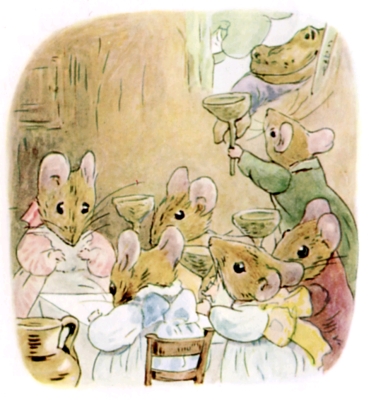
This ending is quietly triumphant. Mrs Tittlemouse has reasserted complete control over her own home. She is generous — she includes Mr Jackson, she feeds her friends — but she does so on her own terms and within her own order. The party does not happen until the house is right. The house is only right after two weeks of hard work.
Beatrix seems to have found the ending deeply satisfying, and so do readers. There is something very particular about a home restored to its right condition and then celebrated. The party earns its pleasure because the work before it was real.
What the Book Says
There is a reading of Mrs. Tittlemouse as a self-portrait — Beatrix as someone who values order and privacy and is frequently inconvenienced by the world's failure to respect either. The reading has something in it. She was, by most accounts, someone who did not enjoy uninvited company, who had strong feelings about how things should be done, and who took real satisfaction in the management of her own home.
But the book is not bitter. Mrs Tittlemouse deals with her intruders and then has a party. She makes the party on her own terms — she passes food through a small hole in the door to Mr Jackson, who is too large to come in, and the doors are kept just wide enough to admit the friends she has chosen.
It is a story about recovering your own space after it has been invaded, and then celebrating that recovery. Mrs Tittlemouse ends the book exactly as she began it: at home in her burrow, with everything in its right place and the doors secured.
Beatrix seems to have found that satisfying. So do the readers who return to it.
Read It in Full
That's how it was made. Now read The Tale of Mrs. Tittlemouse itself, in the Complete Tales. Open The Tale of Mrs. Tittlemouse →
Sources
The facts in this article are drawn chiefly from Leslie Linder, A History of the Writings of Beatrix Potter, and Linda Lear, Beatrix Potter: A Life in Nature, cross-checked against Judy Taylor's edition of Beatrix Potter's Letters. The history is theirs to record; the words here are our own.
Leave a Visiting Card
Consulting the visiting cards...