
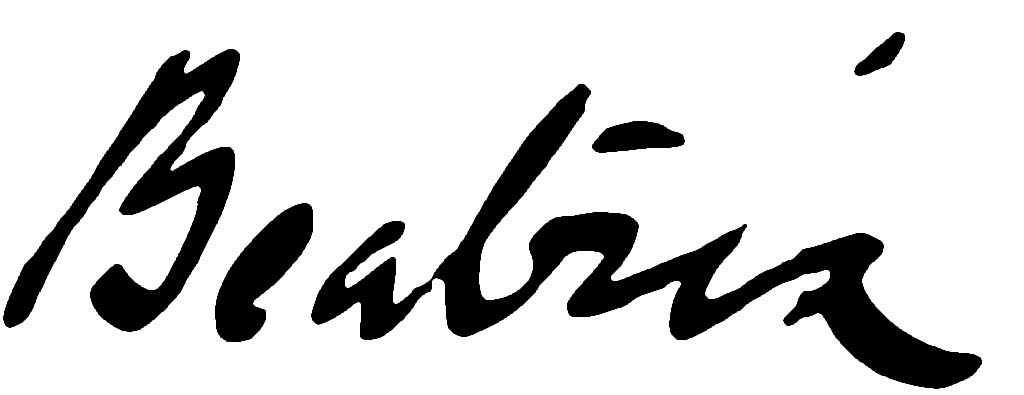
Beatrix Potter was thirty-nine years old when she bought Hill Top Farm. She used her own money — royalties from six bestselling books — to pay for it. She signed the deed herself. She was legally entitled to do all of this.
She still had to ask her parents' permission before she could visit.
The Legal Situation
Under Victorian law, an unmarried woman over twenty-one was a feme sole — a legal person in her own right. She could own property, sign contracts, keep her earnings. She could, in theory, do whatever she liked.
The social situation was different.
In Beatrix's world, a daughter of good family did not leave home until she married. It did not matter how old she was. It did not matter how much money she had. You stayed. You kept your parents company, went with them on holidays, poured tea when it was required. To simply leave on your own — without a husband to justify it — would have looked like something had broken down in the family.
Beatrix played the role for forty-seven years.
The Invisible Rules
Everything about her education pointed the same way. No school, no university, no qualifications that might lead anywhere on their own. A governess for lessons, a paintbox for accomplishments, a quiet third-floor nursery to keep her out of the way of the drawing room below.
Her parents were not unusual. They were doing what their world required. The Potters' wealth came from the Lancashire cotton mills, and they had spent decades trying to look as if it hadn't. A daughter who stayed home, who poured tea, who accompanied her mother on the afternoon rounds — she was evidence that the family had arrived. A daughter who went off and did something on her own was evidence that something had not gone according to plan.
When Beatrix began selling illustrations to a greeting card company in 1890, her parents were startled. Drawing was acceptable. Selling drawings was trade. They had spent thirty years putting distance between the Potters and trade.
She earned six pounds on that first cheque. She kept it.
The Escape Route Nobody Expected
In 1901, after several publishers declined to take on *The Tale of Peter Rabbit*, Beatrix published it herself. She used her own savings to fund a print run of 250 copies. As an unmarried woman over twenty-one, she was legally capable of entering a contract with a printer and managing her own capital. She did both.
The book sold. Frederick Warne & Co. reconsidered, and in 1902 published a full commercial edition. By 1905 she had released six titles, and the royalties were accumulating in a bank account of her own.
The Married Women's Property Act of 1882 had established that a woman's earnings belonged to her alone, not to her husband. Beatrix was not married, so the question of her husband had not arisen. But the principle held: what she earned was hers. Her father might disapprove of the source — trade — but he could not touch the money.
She discovered, as she later put it, that she liked having money.
Hill Top
In the summer of 1905, her aunt Harriet Leech died and left her a legacy. Combined with her royalties, Beatrix had enough for a working farm.
She already knew where she wanted it. The Potters had been summering in the Lake District for more than twenty years, and she had spent those summers studying every field and fell within walking distance of whatever house they had taken. Near Sawrey was the village she had first passed through in 1882, on the teenage walk to Hawkshead. In 1896 she had written in her journal that it was "as nearly perfect a little place as I ever lived in."
In November 1905, she signed the deed for Hill Top Farm. Thirty-four acres, a late-seventeenth-century farmhouse, outbuildings, orchard. Hers, in her name, paid for with her own money.
It was, as Lear records, her first independent business decision — paid for mostly with her own money. She later discovered she had paid nearly twice as much for the farm as the previous owner, a fact she would not learn until it was too late to renegotiate. It was an embarrassing lesson. In future purchases she would do her homework more carefully, and have a local solicitor — eventually William Heelis — to advise her. But nothing diminished the fact of ownership.
She could not live there. That would have been too much. But she could visit, and she did — staying as long as her parents would allow, then returning to Bolton Gardens to sit in the drawing room and count the days until she could go back.
The Two Engagements
She wanted to marry twice. Both times, her parents said no.
The first time was Norman Warne, her publisher. He proposed in July 1905, the same year she bought Hill Top. She accepted immediately. She was thirty-nine; he was thirty-seven; they had worked closely together for years and knew each other well. Her parents opposed it. The Warnes were in publishing, which was trade, and the fact that the Potters' own money had come from cotton mills did not, somehow, count.
Beatrix agreed to keep the engagement secret. She wore his ring in private.
Norman Warne died of leukaemia weeks later. The question was settled without her.
The second time was William Heelis, in 1912. He was a solicitor based in the Lake District — quiet, practical, with a thorough knowledge of Cumbrian land law. He had handled most of her property purchases. Her parents objected again: he was provincial, modestly placed, too far from London. By this point Beatrix was forty-six years old, owned several farms, and had stopped deferring. She secured what Lear calls a "reluctant consent."
They married in October 1913. The Married Women's Property Act meant she kept her land. Hill Top remained hers. They lived at Castle Cottage, across the road.
She never went back to Bolton Gardens to live.
The Account
The facts of Beatrix Potter's life are simple enough. She spent forty-seven years playing the role of the dutiful daughter — the one who stayed home, who accompanied her parents, who did not cause trouble. During those same forty-seven years, she taught herself natural history, wrote and illustrated twenty-three books, built a business, bought a farm, and laid the groundwork for one of the largest private gifts the National Trust has ever received.
Everything in it existed to keep her in place. She used it instead to build on.
When her father died in 1914, Beatrix was forty-eight, a farmer, and a married woman living in the Lake District. She had been the dutiful daughter for as long as it was asked of her.
Then she stopped.
Leave a Visiting Card
Consulting the visiting cards...