When Frederick Warne published The Tale of Peter Rabbit in 1902, readers wanted more. They wanted more of Peter, more of the garden, more of the world they had briefly entered. Beatrix gave them a sequel in 1904 — but she made it something more interesting than a simple return. She gave Peter a companion who was his opposite in almost every important way.
Benjamin as Foil
Peter Rabbit is frightened of the garden. That is the whole point of his story. He goes in because he is disobedient, suffers for it, and barely escapes. His fear is the source of the book's tension.
Benjamin Bunny is not frightened of the garden at all.
From his first appearance in the 1904 book, Benjamin is a different kind of animal. He walks across the top of a wall with the easy confidence of someone who lives in the neighborhood and knows it well. Where Peter had trembled behind a watering can, Benjamin strolls. Where Peter had lost his clothes in a panic, Benjamin goes looking for them in a calm and practical way.
Beatrix had described a real animal with this temperament. The rabbit whose character she drew on for Benjamin had a name: Bounce. She noted in her journal that he had a warm, volatile nature, and she described him with affection. But she also saw clearly that he was shallow. The journal line was measured: warm and volatile, but not deep. Benjamin's confidence in the story comes from that same quality — bold and capable, but without much beneath it.
The Fawe Park Garden
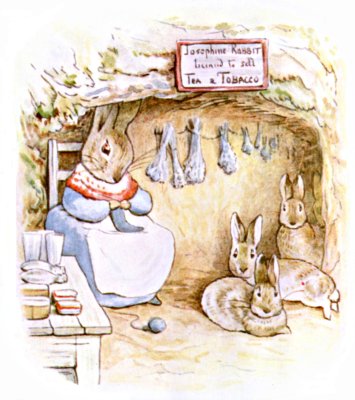
The setting for Benjamin Bunny is the garden at Fawe Park, on the western shore of Derwentwater. Beatrix's family rented the property for a summer in the 1890s, and she sketched it closely. The walled kitchen garden there was exactly the kind of enclosed, ordered space that she used throughout her work — a garden that looked safe from outside but had its own rules once you were in it.
She drew the garden walls, the flowerbeds, the vegetable rows, and the paths between them with the same attention she brought to any natural setting. The illustrations for Benjamin Bunny are among the most detailed garden scenes in all her books. You can feel the warmth of the walls in late summer. You can see the disorder of plants growing more freely than in the Peter Rabbit garden, and the different atmosphere that disorder creates.
The Fawe Park garden was not just a backdrop. It was the specific place that gave the book its visual character — different from Lingholm, different from Hill Top, recognizable to anyone who had spent time in a walled Lakeland garden of the period.
Getting the Clothes Back
The plot of Benjamin Bunny is built on a simple domestic concern. Peter left his clothes in Mr McGregor's garden — his blue jacket and his shoes — and they need to be retrieved. Benjamin leads the mission. He knows the way in and he is not afraid.
This is Beatrix working with the kind of practical, local knowledge that she gave her most capable animal characters. Benjamin knows the garden because he has been in gardens before. He knows where the cat is likely to be. He knows how long they have before the gardener returns. He plans, after a fashion.
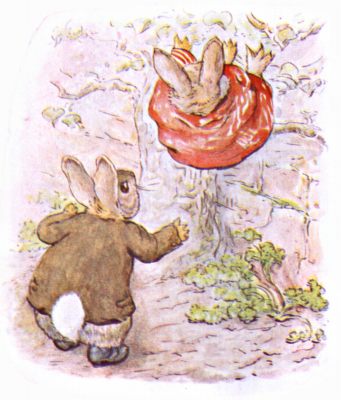
Peter, trailing behind him, is in exactly the position of a child who does not know a place as well as the person leading them. He is anxious. Benjamin is not. The roles are cleanly reversed from the earlier book.
When things go wrong — as they do — it is not because Benjamin fails to think. It is because an old cat discovers them under a basket and sits on it for five hours. The cat is the unmovable fact that no amount of confidence can negotiate around. They simply have to wait.
The Ending She Insisted On
The rescue comes from an unexpected direction. Benjamin's father appears, deals with the cat, and then deals with Benjamin and Peter. His response to finding them trapped under a basket is not gentle. Beatrix shows a father rabbit who uses a switch on both animals — on Peter for his disobedience in Mr McGregor's garden originally, and on Benjamin for leading him back.
→ Read The Tale of Benjamin Bunny
The ending that followed was one Beatrix was firm about. The rabbits encounter the "rabbit-tobacco" — the dried herbs and petals left in the garden — and Benjamin takes some home. She insisted on keeping this detail. It was a small, specific, country thing, and she would not let it be cut. She was right to keep it. It gives the ending a texture of ordinary life resumed after crisis, and it tells you something true about Benjamin: he is the type who, having survived a dangerous hour, walks home with his pockets full of something useful.
What Benjamin Knows That Peter Doesn't
Benjamin's confidence in the garden rests on something specific: he has been there before. He knows the layout. He knows where the things he needs are kept.
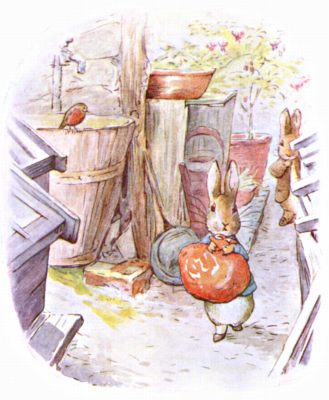
This kind of local knowledge is something Beatrix valued. Her animal characters are most alive when they are moving through environments they understand — the pond that Jeremy Fisher knows, the burrow that Mrs Tittlemouse has arranged to her exact satisfaction. Benjamin in the McGregor garden is in his element in a way that Peter never was.
The gap between the two animals is also a gap between two ways of being in the world. Peter is emotional, reactive, afraid. Benjamin is practical, calm, and oriented toward what needs to be done next. Neither approach is presented as simply better than the other. Peter's fear in the earlier book is entirely reasonable. Benjamin's calm is also reasonable. They are just different animals.
The Rabbit Tobacco
One detail in the ending was not negotiable.
The rabbits, having survived their ordeal under the basket, walk home past the "rabbit-tobacco" — a dried, fragrant plant matter left in the garden. Benjamin picks some up and carries it home.
Beatrix insisted on keeping this. It was exactly the kind of small, country-specific, slightly eccentric detail that she valued and that publishers sometimes queried. The point of "rabbit-tobacco" was not merely botanical — it was tonal. The ending needed to feel like ordinary life resuming. The crisis was over. Benjamin was himself again. He pocketed the rabbit-tobacco as any competent rabbit would, and they walked home.
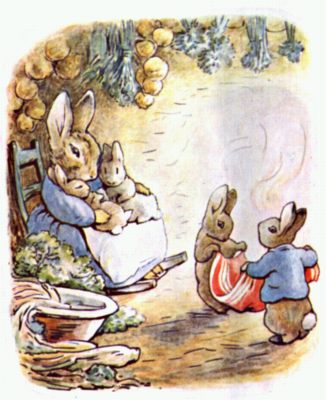
The detail also says something true about Benjamin as a character. He is practical to the last. He has survived an afternoon of real danger. He has also come away with something worth having. That is the kind of animal he is.
The First Sequel
The Tale of Benjamin Bunny is Beatrix's first true sequel in her published canon. It does not simply revisit the earlier book — it builds on it. It uses the known setting and the known character, but it adds someone new, shifts the balance of confidence, and shows the McGregor garden from a different angle.
Benjamin married Flopsy in later books. He appeared again, with his family, in The Tale of the Flopsy Bunnies in 1909. By then he had moved from bold young rabbit to harried parent, and the arc of his character across three books is a small comedy of domesticity. But in 1904 he was still at his best: calm, practical, and entirely sure of himself in a world that had frightened his cousin nearly to death.
The book was dedicated to the children of Sawrey — the village next to Hill Top, where Beatrix was beginning to make her life. It was a domestic dedication for a domestic story: a tale about family, competence, and the retrieval of a small boy's lost clothes on an otherwise quiet afternoon.
Read It in Full
That's how it was made. Now read The Tale of Benjamin Bunny itself, in the Complete Tales. Open The Tale of Benjamin Bunny →
Sources
The facts in this article are drawn chiefly from Leslie Linder, A History of the Writings of Beatrix Potter, and Linda Lear, Beatrix Potter: A Life in Nature, cross-checked against Judy Taylor's edition of Beatrix Potter's Letters. The history is theirs to record; the words here are our own.
Leave a Visiting Card
Consulting the visiting cards...