The Tale of Two Bad Mice is one of Beatrix Potter's funniest small books, and one of her most personal. It came from real things — two pet mice she had tamed and a doll's house she could see only in photographs. It was made, more closely than any book before it, in partnership with her publisher Norman Warne. And it ends with two small vandals who wreck a home and then, in their way, make it right.
Published in 1904 alongside The Tale of Benjamin Bunny, it is a story about smashing things and being sorry. It is also, quietly, the book in which Beatrix and Norman came to know each other well.
The Two Real Mice
The mice were real. Beatrix had rescued two of them from a cage-trap in a kitchen at Harescombe Grange in Gloucestershire, saving them from the cook. She brought them home and tamed them and gave them names: Tom Thumb and Hunca Munca.
Hunca Munca, the female, turned out to be an excellent model. Beatrix watched the two of them for hours and put what she saw straight into the book. "Hunca Munca is very ready to play the game," she wrote. "I stopped her in the act of carrying a doll as large as herself up to the nest, she cannot resist anything with lace or ribbon... I have had so very much pleasure with that box, I am never tired of watching them run up and down."
To keep them where she could draw them, she needed a proper cage. So she asked Norman Warne to build one — glass at the side, a little ladder, a nest up above — so she could watch the mice as they climbed. He did. It was the first of several things he made for the book.
The Doll's House She Could Not Visit
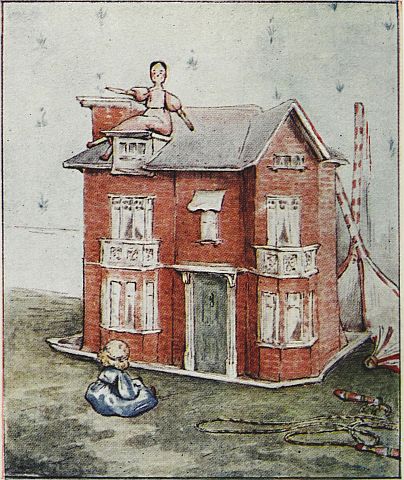
The doll's house in the story was real too. Norman had built it for his small niece, Winifred Warne, and it was a fine one — three storeys, brick-papered, with a grey slate roof and a flagstaff. It stood in the nursery of his brother Fruing's house in Surbiton, south of London.
Beatrix wanted to draw it from life. She could not. Her mother objected to her going out to Surbiton, and Beatrix did not have the spirit to insist. She wrote to Norman, plainly embarrassed: "I was very much perplexed about the doll's house; I would have gone gladly to draw it, and I should be so very sorry if Mrs. Warne or you thought me uncivil... I hardly ever go out, and my mother is so exacting I had not enough spirit to say anything about it. I have felt vexed with myself since, but I did not know what to do. It does wear a person out."
So Norman solved it. He photographed the doll's house and sent the pictures to her in London. Beatrix built the book's interiors from those photographs and from her own mouse-box. The whole house in the story — the rooms, the furniture, the little staircase — came to her secondhand, through a camera, because she could not cross the city to see it.
The Plaster Ham and the Dolls
Norman kept supplying the props. From a shop at Seven Dials, on the edge of Soho, he picked out two small dolls and sent them to her. They became Lucinda and Jane, the doll-house owners. "Thank you so very much for the queer little dollies," she wrote; "they are just exactly what I wanted and a curiosity—coming from Seven Dials... I think I shall make a dear little book of it. I shall be glad to get done with the rabbits."
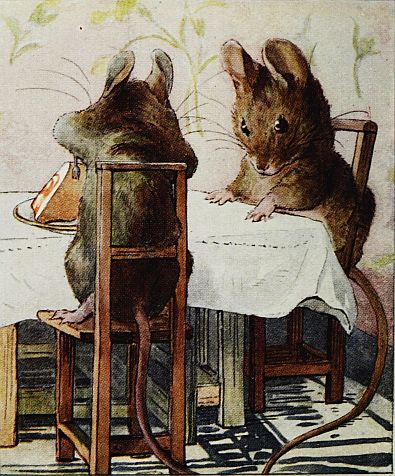
The food in the story is doll's-house food, bought from Hamley's, the toy shop. It is painted plaster, glued to the plates. That is the joke at the heart of the book: the mice break in to feast, and the feast is fake. Beatrix loved it. "The things will all do beautifully," she wrote when the parcel came; "the ham's appearance is enough to cause indigestion. I am getting almost more treasures than I can squeeze into one small book."
In the story, Tom Thumb and Hunca Munca find the splendid dinner is plaster and cannot be eaten. So they lose their tempers and smash it, and then ransack the house — pulling the feathers from the bolster, stealing the cradle and the clothes. The vandalism is real, but it is tiny, and that is what makes it funny rather than frightening.
→ Read The Tale of Two Bad Mice
A Mouse in a Travelling Box
Beatrix grew so attached to her models that she carried them with her. She took Hunca Munca on visits, smuggled in a box, along with a hedgehog. "Hunca Munca is very discontented in the small old box," she wrote during one trip; "I am accompanied by Mrs. Tiggy—carefully concealed—my aunt cannot endure animals!" The animals that filled her books travelled with her in secret, past disapproving relatives.
Norman kept finding the last props the book needed. When the story called for a policeman, he borrowed a tall policeman doll from his small niece Winifred — about a foot high, and rather out of scale with the little house, which is part of the comedy. Beatrix fussed happily over the small dishes too. "The little dishes are so pretty I am wondering if I have made enough of them?" she wrote. "Shall I squeeze in another dish? I regret the roast duck being left out!"
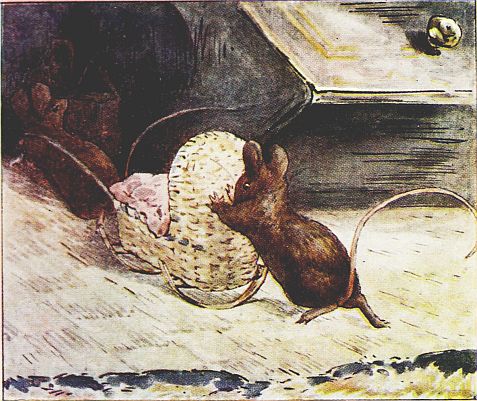
She was, by her own admission, glad of the change from rabbits. "It is a pleasant change from the interminable rabbit stories," she wrote as the book neared completion. The mice had given her something new to do.
"A Girl's Book"
Beatrix knew exactly who the book was for. "It is a girl's book," she wrote; "there must be a large audience of little girls. I think they would like the different clothes." She dedicated it to the child whose doll's house it really was — "For W.M.L.W., the little girl who had the doll's house," using Winifred's initials. She asked specially that they be printed, "to show more clearly that it belonged to a real child."
The book is also where her partnership with Norman became something more. Making it together meant constant letters, parcels, photographs, small problems solved between them. Linder noted that the two "came to know each other well" over this book — more closely than any earlier project had let them. The following year they became engaged. Norman died that same summer, in August 1905, before they could marry. But Two Bad Mice belongs to the months when they were simply working side by side, and it carries the warmth of that.
What the Mice Do Next
There is a sad footnote to the real mice. In the summer of 1905 Hunca Munca fell from a chandelier and died. Beatrix was heartbroken. "I have made a little doll of poor Hunca Munca," she wrote. "I cannot forgive myself for letting her tumble. I do so miss her. She fell off the chandelier; she managed to stagger up the staircase into your little house, but she died in my hand about ten minutes after."
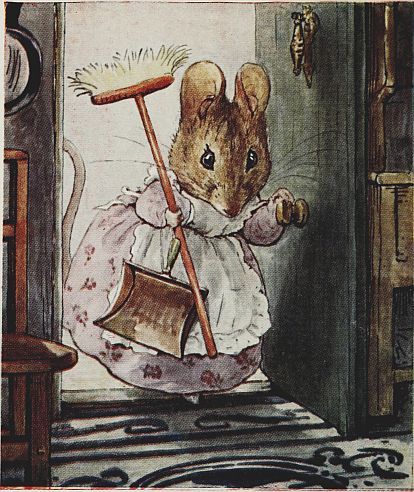
The book itself does not end in sorrow, though. The two bad mice make amends. In the spirit of the story, they pay for the damage they have done, and Hunca Munca takes to sweeping the doll's house every morning with a dustpan and brush.
Beatrix kept the joke going for years afterward in the tiny "miniature letters" she wrote to children, in the voices of the characters. Lucinda Doll writes stiff little notes about dusting. Tom Thumb writes back, signing himself "Yr obedient humble servant," asking forgiveness and a spare feather bed, "for the feathers are all coming out of the one we stole from your house." In one letter he admits his wife forgot to dust the mantelpiece — "I have whipped her" — and asks for a new kettle, because the old one is full of holes and "me & my wife do not think that it was made of tin at all."
It is the only one of her books that grew a whole correspondence around it. The mice were real, the house was real, and for years afterward, in letters to children, they went on living.
Read It in Full
That's how it was made. Now read The Tale of Two Bad Mice itself, in the Complete Tales. Open The Tale of Two Bad Mice →
Sources
The facts in this article are drawn chiefly from Leslie Linder, A History of the Writings of Beatrix Potter, and Linda Lear, Beatrix Potter: A Life in Nature, cross-checked against Judy Taylor's edition of Beatrix Potter's Letters to Children. The miniature letters are quoted from Linder's record of them. The history is theirs to record; the words here are our own.
Leave a Visiting Card
Consulting the visiting cards...