
The Potter family fortune did not come from books, or land, or old titles. It came from calico — printed cotton cloth — made in the mills of the north of England. By the time Beatrix Potter was born in 1866, two cotton families had already made that money: the Potters on her father's side, and the Leeches on her mother's. It was their money that paid for the tall, quiet house in London where she grew up. And it was the same money, years later, that helped her buy land of her own.
This is the story of where that wealth was made, how large it grew, and what it built.
Cotton country
Both sides of Beatrix's family came from the country around Manchester. By the time she was born, Manchester had grown into one of England's largest cities, and the beating heart of the cotton trade.
The Potters came from Glossop, a textile town in Derbyshire, south-east of the city. The Leeches, her mother's people, came from the Cheshire towns of Stalybridge and Hyde. Both were what the age called cotton families — Nonconformist in religion, hard-working, and on their way up.
Cloth was the business of the whole region. In Glossop Dale, where the Potters worked, there were around forty cotton mills. Nearly a third of the people there worked in cloth. This was the world the fortune grew out of: noisy, smoky, and very modern for its time.

Printed Calico
A machine-printed cotton sample — the kind of patterned cloth the Lancashire trade turned out by the mile.
Walter Crum & Co., 1878 (Wikimedia Commons) · Public domain

Edmund Potter and the calico works
The man who built the Potter side of the fortune was Beatrix's grandfather, Edmund Potter.
He was born in 1802, into a hard-working merchant family that valued education. In 1825, with his cousin Charles, he took over a failing spinning mill at Dinting Vale, a small village just south of Glossop. There the two of them set up a calico-printing business. They pressed wooden blocks, cut with patterns, onto plain cotton, using good dyes. The prints were fresh and they sold well.
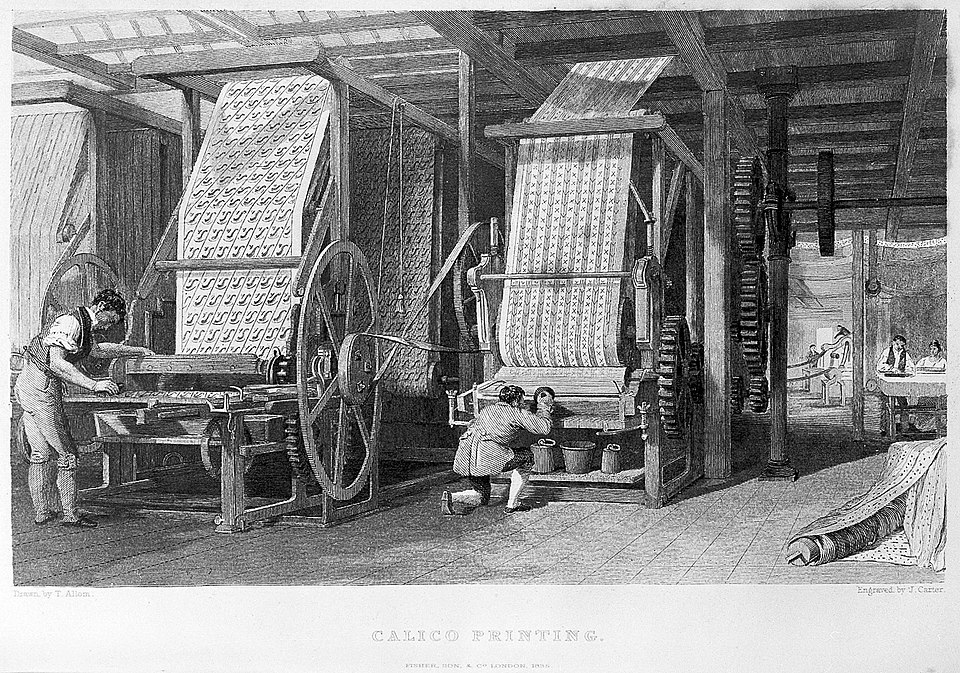
Calico Printing
The trade Edmund Potter built his fortune on — an 1835 engraving of a calico-printing works.

The early years were not smooth. A tax fell only on printed cotton, demand rose and fell, and the first firm went broke. The cousins parted ways. Edmund started again on his own, as Edmund Potter & Company, and by 1837 he was out of debt and running a better mill than before.
Then the work grew, and grew. In 1845 the railway reached Dinting Vale and Glossop, which opened up far wider markets. Lear records the scale it finally reached: by 1862, no calico-printing firm in the world was bigger than Edmund Potter & Company. The works at Dinting Vale turned out more than sixteen million yards of printed cotton a year.
There is one small thread that ties the mill to the books. Years later, when Beatrix was choosing the patterned endpapers for the fine editions of her tales, she found out which calico pattern her grandfather's firm had sold the most of. It was a little crossed-broom design on a blue ground. He had drawn it himself.
Edmund was more than a mill owner. In 1856 the Royal Society made him a Fellow, honouring his work in the science of printing. In 1862 he won a seat in Parliament, as the Liberal member for Carlisle — by just three votes. He handed the business to his eldest son and moved to London, and sat as an MP for the next twelve years.
The full story of the man — his schools for mill children, his Unitarian faith, what Beatrix took from her summers with him — belongs to his own page. Here we are following the money.
"Ready Money Jack": the Leech side
Beatrix's mother's family, the Leeches, were every bit as rich, and their money came from the same place — Lancashire cotton.
Her grandfather there was John Leech, of Stalybridge. He was known around the Manchester Exchange by a nickname that tells you the kind of man he was: "Ready Money Jack." He built his mills, then built a great house above the town called Gorse Hall, with a lake and gardens and a long view of the Pennines. By 1848 his firm had a fleet of ships trading round the world, and was the largest business of its kind in the area.
John Leech died in 1861, five years before Beatrix was born, so she never knew him. But the money he left shaped her family all the same. His personal estate came to over £200,000 — something like £30 million in today's money. On each of his daughters he settled £50,000 (about £7.5 million now). One of those daughters was Helen Leech — Beatrix's mother — who married Rupert Potter and carried Leech money into the Potter household.
The two families had long been linked by trade, by their Unitarian faith, and by a shared interest in art. When Helen Leech married Rupert Potter, two cotton fortunes met.
How big was the Potter family fortune?
It is hard, across this distance in time, to feel what these sums meant. But the bare figures are striking enough.
When Edmund Potter died in October 1883, he left an estate of £441,970 — roughly £65 million in today's money. That went mostly to his wife, Jessy. A large part of it passed, in time, to his son Rupert — Beatrix's father. The Leech money, the £50,000 on her mother's marriage and more besides, sat on the other side of the family.
These were not the savings of a careful professional. They were industrial fortunes, made in one or two lifetimes, out of cloth.
A word of caution about those modern figures. They are the roughest of guides — plain inflation, nothing cleverer — and different methods give wildly different answers; measured against the wages of the day, the same fortunes would count as larger still. Take them only for the feel of the thing. What is safe to say is plainer and just as telling: this was wealth on a scale that meant nobody in the next generation strictly had to earn a living.
What the money built
The first thing the fortune built was the house.
Rupert and Helen settled in London, and around the time of Beatrix's birth they chose a home in a newly built road in Kensington: 2 Bolton Gardens. It was a tall, granite-faced, four-storey house, with a small garden in front and a larger one behind, and its own stable and carriage at the back. The road was full of well-off professional families from trade backgrounds — people, like the Potters, who were doing well and meant everyone to know it.
This was the house Beatrix later called her "unloved birthplace." It was her home for the next forty-seven years. The cotton money paid for all of it. The four storeys, the carriage, the cook and the butler and the groom. The nursery on the top floor, where she kept her mice and her drawings.
The money shaped her father's life too, though here the simple story needs care. Rupert had trained as a barrister and was called to the bar in 1857. The easy version is that he never really worked, and lived in idle comfort on his father's wealth. Lear argues this view has to be softened. Rupert did build some standing in the law early on. His inheritance, large as it was, came to him only in pieces. A first share when his father's estate was settled in 1884. More when his mother died in 1891. The rest in 1905. And like his father, he put money into investments, which Beatrix noted often left him anxious.
What is fair to say is that the family money gave Rupert room. He kept what one might call a casual schedule as a barrister in his later years. He spent his afternoons at his clubs — the Reform Club, the Athenaeum — and behind his camera, photography being a passion he could afford to follow. The inherited cotton wealth, his own investments, and what work he did all added up. By the early 1890s, Lear notes, he was an extremely wealthy man.
The thread to her own land
There is a long, quiet line from the calico works to the fells of the Lake District.
The same fortune behind Bolton Gardens was the one Beatrix eventually came into. She had her own money too — first from her books, later a real income from royalties — and that is a story of its own. But the family wealth behind her mattered. It is what made it possible, in middle age, to start buying farms and fields in the country she loved, and to keep buying them.
Money made in Lancashire mills, out of patterned cotton, ended up holding open a stretch of England's hills. That was not what Edmund Potter built his firm to do. But it is, in the end, part of what the calico paid for.
Sources
The facts in this article are drawn chiefly from Linda Lear's biography Beatrix Potter: A Life in Nature, with Margaret Lane's The Magic Years of Beatrix Potter used to cross-check the account of Edmund Potter and the calico trade. The estate figures, the Dinting Vale output, and the detail of Rupert's finances are Lear's. The history is theirs to record; the words here are our own.
Leave a Visiting Card
Consulting the visiting cards...