
The Tale of Ginger and Pickles
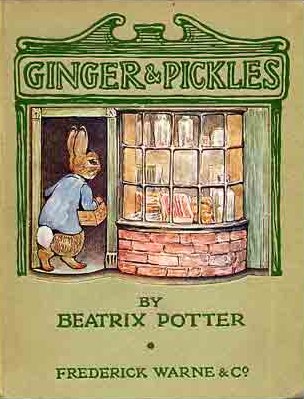
A yellow tom-cat called Ginger and a terrier called Pickles run a little shop in the village of Sawrey. They give credit to everyone. Peter Rabbit comes in with no money. Squirrel Nutkin comes in for nuts. Mrs. Tiggy-Winkle leaves goods on her account. The book is overflowing with old friends and slowly running out of cash.
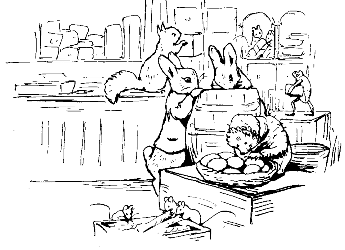
Beatrix wrote the manuscript at Christmas 1908 as a present for Harold Warne's daughter Louie. The shop in the book was the actual village shop in Smithy Lane, just by Hill Top — beautifully drawn down to the meat hooks in the ceiling. She added Old John Taylor, the real owner, to the story when she rewrote it for publication.
"Celebrates the actual little village shop," wrote Margaret Lane, "with such appreciative feeling that its pages almost smell of candles and tea." Half the cast of her earlier books wanders in for tobacco or soap. Sawrey laughed at it: "they are all quite jealous of each other's houses and cats getting into a book."
The cover shown is the original edition. Amazon carries the copies in print today.
Buy on Amazon→❦ Everything else in the Sanctuary is free, and this is the shelf that keeps it so. Bea's Corner is an Amazon Associate — buy through these links and a little comes back to us, at no extra cost to you. With thanks for keeping the doors open.
Particulars
- Trade edition
- 1909, Frederick Warne & Co.
- Setting
- The actual village shop in Smithy Lane, Sawrey
- Dedication
- "DEDICATED with very kind regards to old Mr. John Taylor who 'thinks he might pass as a dormouse'"
- Manuscript
- Christmas 1908, given to Harold Warne's daughter Louie. 21 pages of text, 17 pen-and-ink sepia drawings, 3 watercolours
- Position in series
- Most populated of all her books — nearly every Hill Top character makes a cameo
Curiosities
- ❦The village shop was real. Old meat hooks in the ceiling of the back room — where Ginger and Pickles made up their accounts — were still there in 1951.
- ❦Beatrix added a real local character when she rewrote the story for publication: Old John Taylor, the actual shopkeeper of Sawrey, who appears as the dormouse who "thinks he might pass as a dormouse."
- ❦Beatrix kept a careful eye on the prices in her manuscript. The original draft listed butter at 10d/lb in July and 1/1½d/lb in November — a real seasonal price. The published version simplified it to a single year-round price.
- ❦The American edition was edited so that "halfpenny" became cents and dollars. Beatrix wrote: "I don't know whether they require dog licences in America."
- ❦Beatrix found one of her sketches better than her finished painting: "I think the drawing of 'Lucinda and Jane' had better be used, as I don't believe I can hit it off again — It is rather spotty." The original sketch made it into the book.
From the same shelf
Your Sanctuary Collection
Your collection is currently empty.