The Tale of Jemima Puddle-Duck, published in 1908, looks on the surface like a straightforward farmyard story. A duck wants to hatch her own eggs and keeps having them taken. She finds a secret place in the woods. She meets a polite gentleman who offers her the use of his shed. The story ends with a rescue.
But look at it a second time and it is something more unsettling. Jemima never understands what nearly happened to her. She escapes not through intelligence but through luck and the intervention of a dog. The villain is never punished in any meaningful way. And Beatrix Potter, who wrote the book, had a very clear view of her central character's limitations.
A Real Duck
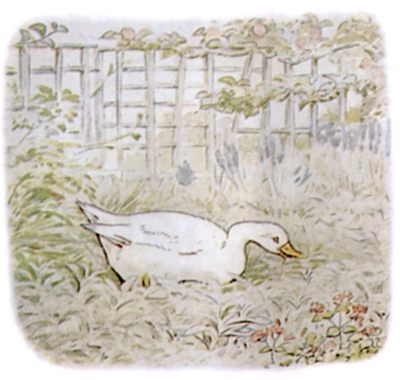
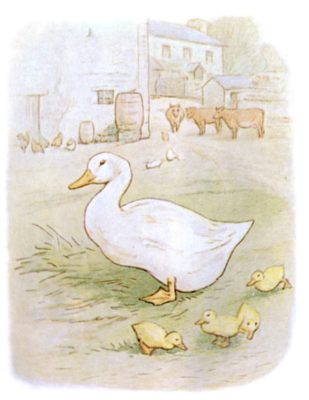
Jemima was a real duck at Hill Top. Beatrix had ducks, and one of them — Jemima — was in the habit of trying to nest in inconvenient places. The farm at Hill Top kept chickens and ducks, and it was common practice to take the duck eggs away and give them to hens to incubate, since ducks were considered poor sitters.
Mrs Cannon — the wife of Beatrix's farm manager at Hill Top — held this view firmly. She collected the eggs. Jemima resented the interference. The tension between a duck who wanted to hatch her own eggs and a farm woman who thought this impractical was the domestic situation Beatrix turned into a book.
She made it funnier, and stranger, and considerably more dangerous than the original.
The Opening Choice
Beatrix made a small but deliberate decision at the start of the book. She had considered opening with the phrase "a gratifying thing" and decided against it. The phrase she chose instead was "a funny sight."
The difference matters. "A gratifying thing" would have placed the reader inside Jemima's perspective, sympathising with her satisfaction at finally finding a nest. "A funny sight" keeps the reader slightly outside — watching Jemima, rather than inhabiting her. The reader sees the comedy before they understand the danger.
This choice established the tone for the whole book. Jemima is presented with affection. She is also presented as a figure who cannot quite see what is right in front of her.
The Fox as Literary Villain
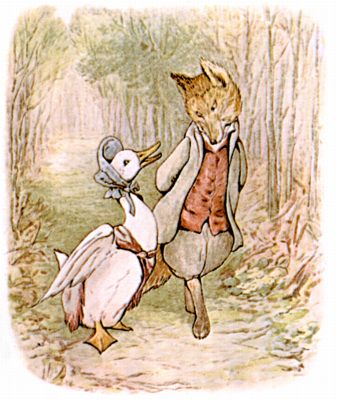
The sandy-whiskered gentleman is the most fully realized villain in all of Beatrix's published work. He is not dangerous in the way Mr McGregor is dangerous — straightforwardly threatening, obviously something to be escaped. The fox is charming. He listens carefully. He agrees to everything Jemima asks. He builds her confidence.
Beatrix gave him a large library of books and a shed full of feathers. These are the clues that any older reader will catch immediately. Jemima misses them entirely.
The fox's charm is his menace. Beatrix wrote him as a type she recognized: someone who appears to help while planning to harm. She gave him real manners and a real attractiveness. He is better company than most of the animals in the farmyard. He is also planning to eat Jemima and her eggs for his dinner.
For Leslie Linder, this created one of the most psychologically sophisticated books Beatrix produced. The comedy depends on the reader seeing what Jemima cannot. The menace depends on the fox being genuinely appealing. Both things have to be true at once.
The Cannon Family in the Illustrations
The Hill Top farm workers appear in the book directly. Mrs Cannon and her children, Ralph and Betsy, are drawn into the illustrations. This was Beatrix's habit with the Hill Top books — she used the people she knew and the places she lived in, and she acknowledged the connection without making a fuss about it.
Kep, the collie who rescues Jemima, was a real dog at Hill Top. He was Beatrix's working dog, and she was fond of him. The rescue in the book — Kep arriving with hound puppies to chase off the fox — is handled with characteristic restraint. The hounds eat Jemima's eggs. Jemima is saved but loses what she had wanted. The ending is not entirely happy.
Beatrix drew Kep's character carefully. He is sensible, capable, and not given to fuss. He is everything Jemima is not. The contrast is gentle but it is there.
→ Read The Tale of Jemima Puddle-Duck
What Beatrix Said About Jemima
Beatrix was direct in her assessment of her central character. Jemima, she said, was a simpleton. She made this observation without cruelty — it was a description, not a criticism. Some creatures, she understood, are simply not equipped to read the danger in a situation. They are trusting, they are optimistic, and they miss what is obvious to everyone watching them.
She dedicated the book to the Cannon children, Ralph and Betsy, who appeared in the illustrations. It was a farmyard dedication for a farmyard story. But the book she gave them was more complicated than the setting suggested.
After Beatrix Potter's death, her ashes were scattered near the wood in the story. It was the wood where Jemima had met the fox. That detail, small and private, suggests something about how the book sat with her over the years: a place she had imagined with care, which had become real enough to matter at the end.
The Farmyard World
The Tale of Jemima Puddle-Duck is the most fully inhabited of the Hill Top farmyard books. The illustrated world extends beyond the immediate action of the story — into the barn, the rhubarb patch, the kitchen garden gate, the aerial views of the fields and lanes around Near Sawrey.
Beatrix painted these landscapes with genuine affection. She had chosen to live there, in the farm she had bought with the money from her first few books, and the world she drew in the Jemima illustrations is the world she could see from her own windows.
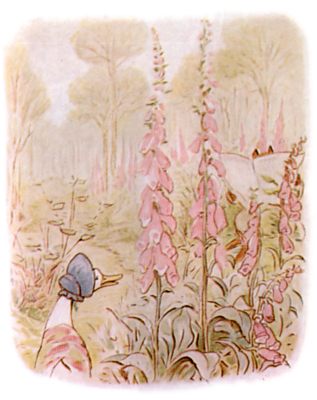
The fox's wood is also real, in the sense that Beatrix had a specific place in mind. She knew the character of mixed woodland above a Lakeland farm — the tree roots, the dead leaves, the light filtering through in summer. The illustrations for the wood scenes carry a different atmosphere from the farmyard scenes. The farmyard is warm and social. The wood is quiet and watchful.
That contrast — between the safe, familiar farmyard and the beautiful but dangerous wood — is the emotional structure of the whole book. Jemima crosses the boundary between them without understanding what the crossing means. The reader understands it from the moment the fox appears.
The Name Jemima
Beatrix chose the name Jemima with care. She almost certainly had in mind Jemima Blackburn, the ornithological painter and illustrator whose book Birds from Nature she had been given for her tenth birthday. She had met Blackburn in person in 1891 and admired her work.
To name the duck Jemima was an affectionate tribute — private, unlikely to be noticed by most readers, but present. The duck was foolish and the painter was not. The connection was in the name, and Beatrix knew both bearers of it.
This kind of layered reference runs through her work. She named things after people she knew and animals she had. She placed her farm workers in the illustrations and her neighbours in the background. The world of the books was built from the specific, observable world she inhabited, and every name was chosen rather than invented at random.
Why the Book Lasts
The Tale of Jemima Puddle-Duck asks its readers to do two things at once. It asks them to like Jemima — to feel her desire to hatch her own eggs, to follow her into the wood, to hope she will be all right. And it asks them to see clearly what Jemima cannot see.
That double perspective, held together without irony or contempt, is the achievement of the book. Beatrix liked Jemima. She thought her foolish. Both things were true.
The fox is charming. The rescue is imperfect. The eggs are gone. Jemima is safe but unchanged. She will try again next season.
It is one of the most honest endings in children's literature.
Read It in Full
That's how it was made. Now read The Tale of Jemima Puddle-Duck itself, in the Complete Tales. Open The Tale of Jemima Puddle-Duck →
Sources
The facts in this article are drawn chiefly from Leslie Linder, A History of the Writings of Beatrix Potter, and Linda Lear, Beatrix Potter: A Life in Nature, cross-checked against Judy Taylor's edition of Beatrix Potter's Letters. The history is theirs to record; the words here are our own.
Leave a Visiting Card
Consulting the visiting cards...