
The Story of Miss Moppet is one of the smallest things Beatrix Potter ever published. It is a single chase, told in a handful of pictures with barely any words: a kitten, a mouse, and a trick that does not quite work. It was made for very young children — the youngest audience she ever wrote for.
It came out in 1906 in an unusual fold-out form, and that form turned out to matter as much as the story. The little book is a window onto something Beatrix was learning at this point in her career: who her readers really were, and how books actually reached them.
The Borrowed Kitten
The kitten in the book was real, and she was a handful.
Beatrix borrowed her in July from one of the masons who were working on Hill Top while she was there. The kitten proved very hard to draw — far too lively to sit still. Beatrix described her in a phrase that has stuck: "very young & pretty and a most fearful pickle." A "pickle," in her usage, meant a small creature bent on mischief.
This is how she nearly always worked. She did not invent her animals from nothing. She found a real one, watched it closely, and drew what it actually did. A restless borrowed kitten gave her exactly the wriggling, pouncing energy the story needed — even if it made the drawing harder. The liveliness on the page is the liveliness she struggled to pin down.
The Story
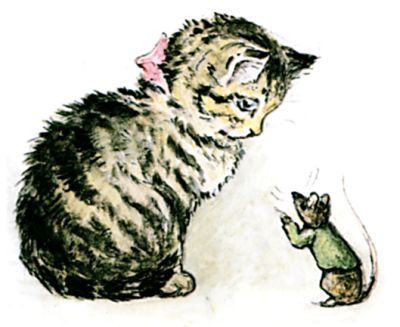
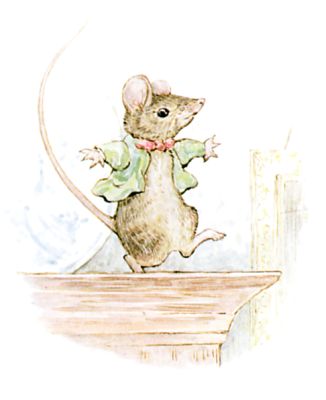
The plot is the simplest she ever wrote. Miss Moppet, a kitten, is teased by a mouse who darts in and out, just out of reach. She pounces and misses, and bumps her head.
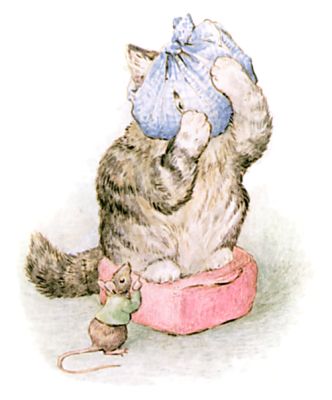
Then she has an idea. She ties herself up in a duster, as if she were hurt and harmless, and pretends to be ill. The mouse, curious and bold, creeps closer to look. Miss Moppet springs and catches him. But she is too pleased with herself. She tosses the mouse about in her duster — and he slips out through a hole in the cloth and escapes up out of reach, where he dances and mocks her.
That is the whole book. It is a chase with a twist and a small comeuppance, pitched at children far too young for a longer tale. There is no real danger and no lesson driven home. A clever trick is undone by a kitten's own showing-off, and the mouse gets the last laugh.
A Name That Came Back
There is a thread here worth following gently. The name Miss Moppet did not stay with this kitten alone. A kitten called Moppet later turns up as one of the small sisters in Beatrix's farmyard family of cats — a household of kittens forever losing their clothes and getting into trouble.
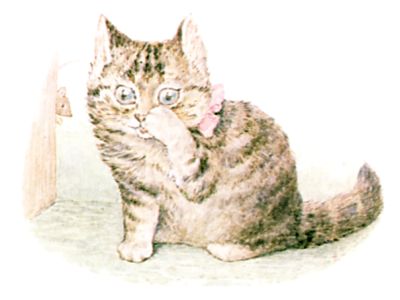
It is tempting to see the lively borrowed kitten of this book as a first sketch toward those later, better-known kittens. The connection is really one of names and family rather than a single continuing character, and Beatrix never spelled it out. But the spirited little cat she struggled to draw here — the "most fearful pickle" — clearly belongs to the same imagination that would soon fill a farmhouse with naughty kittens. Miss Moppet is an early, miniature version of a kind of creature she returned to again and again.
The Fold-Out Form
The book was not printed as an ordinary little book. Like its companion experiment of the same year, it came out as a panorama — the pictures and text mounted on a long strip that folded up concertina-style and tucked into a flat wallet. A child opened out the strip and read along it.
→ Read The Story of Miss Moppet
It was a genuinely new idea, aimed squarely at the very youngest readers: something to unfold and look at, simpler and more toy-like than a bound book. Beatrix and her publisher were trying to make a different kind of object for a different kind of reader — the child too small for a proper story, who wanted pictures to spread out and point at.
For the youngest children, the form had real charm. The trouble was everyone else in the chain between the artist and the child.
Made for the Youngest Reader
Miss Moppet was pitched lower than any of her famous tales. The little books about Peter and Benjamin were for children who could follow a real story. Miss Moppet was for the child below that age — the toddler who wanted a picture to look at and a single thing happening on each page.
That is why the story is so bare. There is no garden full of dangers, no cast of characters, no lesson set out. There is one kitten, one mouse, one trick, and one escape. The whole book can be taken in by a child far too small for a chapter. Beatrix had built her name on stories with real shape and feeling. Here she was trying something different: how little a story could contain and still work for the very youngest eyes.
The wrap-around, fold-out design was part of that aim. A small child does not read so much as point and turn. A strip that opened out, with a big picture and a few words at each step, was meant to suit hands and minds that were not yet ready for a proper book. It was an honest attempt to make a first book — the kind a baby meets before any other.
The borrowed kitten gave it just the right energy. A "most fearful pickle" of a cat, too lively to sit for her portrait, became a kitten too pleased with herself to keep hold of her mouse. The fault that makes Miss Moppet lose is the same restlessness Beatrix had wrestled with in the real animal. Watching a restless cat closely, she had found the very flaw that drives the story.
What the Experiment Taught Her
The fold-out books did not sell, and the reasons had nothing to do with the stories. The shops defeated them.
Beatrix saw it clearly. The strip books, she said, "got unrolled and so bad to fold up again," and the shops "sensibly refused to stock them." A panorama that fanned open on the counter and would not go neatly back into its wallet was a headache for a bookseller. Worse, customers could not handle the book before buying it. You cannot leaf through a folded strip the way you flip through a bound book, and booksellers protested that the format put buyers off.
This was a real education for Beatrix. She was learning that a book is not only a story and a set of pictures. It is also an object that has to survive a shop — to be stacked, shelved, picked up, examined, and put back. A format that fought against all that would fail, however much a child enjoyed it once it was home.
So she drew the lesson and acted on it. In 1916 Miss Moppet was reissued as an ordinary bound book, slightly smaller than the others, with a new frontispiece. The fold-out experiment was over. It had given her a small, tidy story and a larger, more lasting piece of knowledge about her own trade — that the way a book is made and sold matters as much as what is printed inside it.
Miss Moppet survives now in that bound form: a tiny tale of a kitten outwitted by a mouse, and a quiet reminder that even Beatrix Potter had to learn how the book business really worked.
Read It in Full
That's how it was made. Now read The Story of Miss Moppet itself, in the Complete Tales. Open The Story of Miss Moppet →
Sources
The facts in this article are drawn chiefly from Leslie Linder, A History of the Writings of Beatrix Potter, and Linda Lear, Beatrix Potter: A Life in Nature, cross-checked against Judy Taylor's edition of Beatrix Potter's Letters to Children. Beatrix Potter's description of the borrowed kitten and her account of the format's failure are from her own letters as recorded by Linder. The history is theirs to record; the words here are our own.
Leave a Visiting Card
Consulting the visiting cards...