

The story of Jeremy Fisher had a long journey to the bookshop. Beatrix began sketching a fishing frog as early as 1893, sent the first version as a picture letter to a child named Eric, and sold an early draft to a German publisher called Nister in 1894. She then bought it back for six pounds. By the time Frederick Warne published the book in 1906, the frog had been in her mind for more than a decade and had passed through at least three distinct forms.
What the final version contained was something more careful than any of those earlier attempts. It was a book with a very specific pond, an exactly described ecology, and a set of illustrations that have never quite been matched for the accuracy of their natural history.
The Picture Letter and the Early Draft
The story that reached Nister in 1894 was set on the River Tay in Scotland. This was not a pond the reader could visualise precisely — it was a broad river, and the atmosphere was quite different from the confined, intimate world of a small lake.
When Beatrix bought the manuscript back, she was not recovering a finished piece of work. She was recovering raw material. She had changed her ideas about where Jeremy should live.
The setting that eventually appeared in the book was Esthwaite Water. This is the small lake to the south of Hawkshead, clearly visible from Hill Top on a fine day. By the time she was working on the final version, Beatrix knew that water intimately. She had walked beside it, sketched from its edges, and observed the animals that lived in and around it.
The move from the River Tay to Esthwaite Water was not simply a change of address. It changed the whole character of the book. A river is wide and open and moving. Esthwaite Water is still and enclosed. Its banks are close. Everything that happens in it feels more contained, more observable, more under the reader's eye.
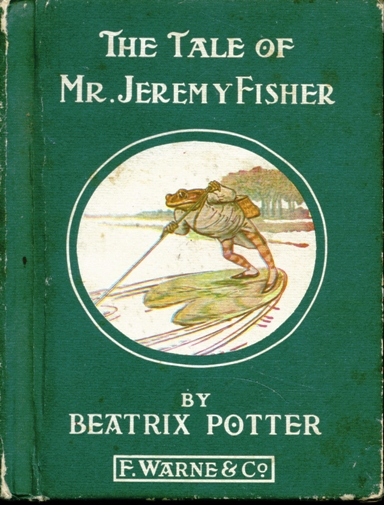
The Pond as Character
Jeremy Fisher's pond is not described loosely. Beatrix draws it from knowledge.
The water-lily leaves on which Jeremy sits are exactly the right size and give exactly the right way beneath his weight. The mud at the bottom of the pond has been observed and recorded. The water-boatman that rows across the surface, the fish that darts below — these are not decorative details. They are field notes translated into watercolor.
Beatrix had spent years as a naturalist, recording the behavior of small animals and plants with the precision of a scientist. She had studied pond life as a young woman with the same attention she brought to fungi and beetles. When she drew the subaquatic world around Jeremy's fishing line, she was drawing from a mental archive that had been building for twenty years.
The result is a book that works differently from the rabbit stories. The rabbits' world is a garden world — domestic, planted, shaped by human hands. Jeremy's world is wild. The pond does not care about him. The trout that attacks him is simply an animal doing what trout do. The water snail that escapes is simply an animal staying alive. There is no moral dimension to any of it, beyond the fact that a frog who goes fishing may become something else's dinner.
The Attack Under Water
The moment of real danger comes with a trout. Jeremy has his line in the water and is sitting on a lily leaf when a large trout shoots up from below and seizes him.
Beatrix drew this with controlled violence. The trout is large. The frog is small. The water explodes. Jeremy escapes by losing his mackintosh — the fish spits him out because the coat tastes wrong. He swims to the bank, shaken and miserable, with his legs bitten and his fishing rod lost.
This is one of her least softened moments. The attack is sudden and the rescue is not heroic — it depends entirely on a trout disliking the taste of a macintosh. Jeremy does not outsmart the trout or escape by cleverness. He simply tastes wrong.
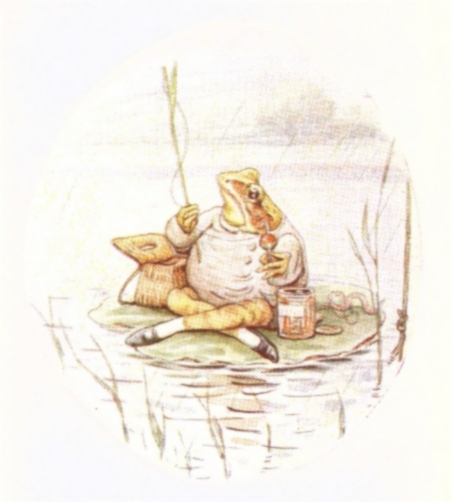
What follows is equally honest. He gives up fishing. He goes home. His friends come for dinner instead, and they eat roasted grasshopper with ladybird sauce — a meal that has made generations of children laugh and grimace in equal measure. The ending is warm. But the warmth is earned by a genuinely frightening middle section.
The Natural History in the Pond
Beatrix drew the pond life in Jeremy Fisher with more precision than she brought to almost any other natural setting in her work.
The water-boatman rowing across the surface is drawn correctly — the right posture, the right legs, the right motion. The great water-snail that Jeremy nearly catches is a real freshwater species, drawn with its exact shell and its exact way of moving. The stickleback and the dragonfly are observed, not sketched from memory.
→ Read The Tale of Mr. Jeremy Fisher
She had studied freshwater pond life since childhood. The natural history records she kept in her journal during the 1880s and 1890s included detailed observations of pond creatures. When she came to illustrate Jeremy's world, that archive was available to her.
The accuracy matters for the book's tone. Jeremy Fisher is not a human being in frog's clothing — he is a frog who happens to fish and wear a mackintosh. Beatrix held both things true simultaneously. He has a frog's relationship to the pond. He also has a gentleman's domestic arrangements and a passion for angling.
The trout that attacks him is drawn as a large, real trout — a brown trout of the kind that lived in Esthwaite Water. Its violence is drawn accurately. The book is funny, but the pond underneath the comedy is a real pond.
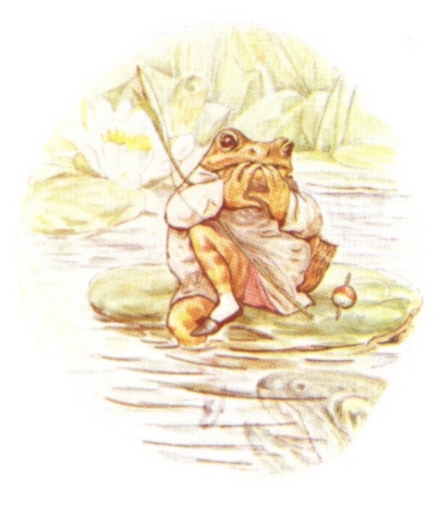
Esthwaite in the Illustrations
The illustrations for the book have a quality of light that is specific to Esthwaite Water on a still day. The water is grey-green. The margins are soft. The plants at the edge of the water are depicted with botanical accuracy — the right rushes, the right sedges, the right shapes of leaf.
Beatrix worked on the illustrations over a long period and was careful about them. She produced more sketches for this book than the number of finished plates suggests. Many were discarded or reworked.
The finished pictures are quiet in a way that few of her other books are. The frog in his mackintosh, sitting on a lily leaf with his rod, is a figure at rest in a world that is entirely indifferent to his comfort. That indifference is drawn beautifully. The pond is not hostile — it simply exists on its own terms, as natural places do.
The Dinner Party
After the failed fishing trip, Jeremy Fisher has his friends to dinner. This is where the book becomes something more than an adventure story.
Alderman Ptolemy Tortoise brings salad in a string bag. Sir Isaac Newton (a newt) and another water-rat guest arrive. Jeremy serves roasted grasshopper with ladybird sauce. This is a meal Beatrix described with complete seriousness. The guests are served at table. The setting is domestic and correct.
The choice of menu is the joke. But the detail goes deeper than that. Beatrix gave her characters the right kind of domestic life for their species. A frog's dinner party would involve insects. Of course it would. The comedy comes from the formality — the correct setting, the invitation, the proper menu for the wrong species.
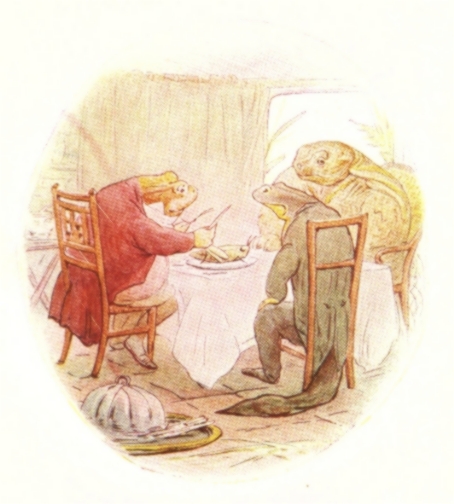
This is the same habit she brought to Mrs Tittlemouse's burrow and Mrs Tiggy-Winkle's washhouse. The animal's home is exactly right for the animal it belongs to. The domestic arrangements are appropriate. The result is a world that feels consistent from the inside.
Jeremy Fisher's pond house, with its mud floor and its lily-pad furniture, is as specific and as convincingly inhabited as any setting in her work. The dinner party at the end of the book is earned because the setting has been believed throughout.
Dedicated to a Child She Hardly Knew
The book was dedicated "For Stephanie from Cousin B." Stephanie was a child in the extended family of Beatrix's friends. The dedication was affectionate but at a small distance — not the close friendship that had shaped the Mrs Tiggy-Winkle or Peter Rabbit dedications.
It fits the book's tone. Jeremy Fisher is a little more solitary than most of Beatrix's creations. He lives alone in his damp house among the buttercups. He has his fishing hobby, his dinner parties, his waterproof mackintosh. He is content with a life that does not require much from other people.
That contentment, and the precise, quiet world in which she placed him, make the book one of her most particular achievements. It is not the most loved of the small books. But it may be the most carefully observed.
Read It in Full
That's how it was made. Now read The Tale of Mr. Jeremy Fisher itself, in the Complete Tales. Open The Tale of Mr. Jeremy Fisher →
Sources
The facts in this article are drawn chiefly from Leslie Linder, A History of the Writings of Beatrix Potter, and Linda Lear, Beatrix Potter: A Life in Nature, cross-checked against Judy Taylor's edition of Beatrix Potter's Letters. The history is theirs to record; the words here are our own.
Leave a Visiting Card
Consulting the visiting cards...