CHAPTER XIV
DEMERARA SUGAR
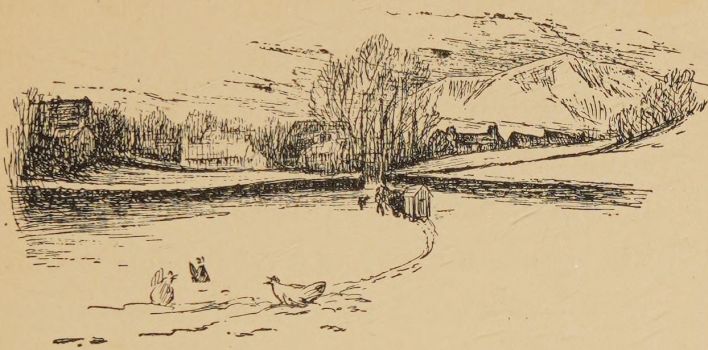
UPON fine days in spring the parrot’s cage was set out of doors upon top of the garden wall, opposite the farmhouse windows. In the intervals of biting its perch and swinging wrong-side up, the parrot addressed remarks to the poultry in the yard below.
The words which it uttered most frequently in the hearing of those innocent birds were, “Demerara sugar! demerara sug! dem, dem, dem, Pretty Polly!” The chickens listened attentively.
When the chickens were feathered, they were taken to live in a wooden hut on wheels in the stubble field. They picked up the scattered grain; and grew into fine fat pullets. In autumn the farmer talked of taking the hen-hut home. But he was busy with other work; he delayed till winter.
In the night before Christmas Eve there came a fall of snow. When Tappie-tourie looked out next morning the ground was white. She drew back into the hut in consternation.
Then Selina Pickacorn and Chucky-doddie looked out. None of them had ever seen snow before; they were April hatched pullets without a single experienced old hen to advise them.
“Is it a tablecloth?” asked Chucky-doddie.
They knew all about tablecloths because they had been reared under a hen-coop on the drying green. They had been scolded for leaving dirty foot-marks on a clean tablecloth which was bleaching upon the grass.
The hens slid nervously down the hen ladder on to the snow. No; it was not a tablecloth.
Said Tappie-tourie: “I’ll tell you what! I do believe it is the parrot’s demerara sugar!” (Now the parrot ought to have told them that demerara sugar is not white.)
Selina Pickacorn tasted a beakful. “It is nothing extra special nice; he need not have talked so much about it.”
“How horribly cold and wet it feels.”
Just then the farmer came into the field with a horse and cart. He drove the hens back into the hut, fastened the door with a peg, and tied the hut behind his cart with a rope in order to drag it homewards through the snow.
The hen-hut did not run smoothly; it had a tiresome little waggling wheel at one end, that caught in ruts. It bumped along; and the pullets inside it cackled and fluttered.
Before the procession had got clear of the field the hut door flew open. Out bounced Tappie-tourie, Chucky-doddie, Selina Pickacorn, and five other hens. The farmer and his dog caught five of them, none too gently. But the three first-named birds flew back screaming to the spot where the hen-hut had stood originally, before it had been removed.
The farmer was obliged to leave them for the present.
Tappie-tourie, Chucky-doddie, and Selina wandered around in the snow; the field seemed very large and lost under its wide white covering.
“The hut is gone,” said Tappie-tourie, with a brain wave.
“That is so,” agreed Selina Pickacorn, “we fell out of the hut.”
“What shall we do?” asked Chucky-doddie.
“I see nothing for it but a Christmas picnic,” said Tappie-tourie; “here is sugar in plenty, but where is the tea and bread and butter?”
Large flakes of snow commenced to fall.
“Perhaps this is the bread and butter coming,” said Tappie-tourie, looking up hopefully at the darkening sky.
“My feather petticoat is getting so wet,” grumbled Chucky-doddie; “let us try to walk along the top of that wall, towards the wood.”
The wall had a thick white topping of snow; it proved to be a most uncomfortable walk, with frequent tumblings off. They crossed Wilfin Beck on a wooden rail. The water below ran dark and sullen between the white banks.
By the time they had reached the wood it was dusk; for the last hundred yards the hens had been floundering through snowdrifts.
“If this is a Christmas picnic—it is horrid! Let us get up into that spruce tree, and roost there till morning.”
They managed to fly up. They perched in a row on a branch, fluffing out their feathers to warm their cold wet feet. They were one speckled hen and two white hens, only the white hens looked quite yellow against the whiter snow.
“The picnic is a long time commencing,” said the speckled hen, Tappie-tourie. It was soon black as pitch amongst the spreading branches of the spruce.
Down below in the glen the waters of the stream tinkled through the ground ice. Now and then there was a soft rushing sound, as the wet snow slipped off the sapling trees that bent beneath its weight, and sprang upwards again, released. Far off in the woods, a branch snapped under its load, like the sound of a gun at night.
The stream murmured, flowing darkly. Dead keshes, withered grass, and canes stood up through the snow on its banks, under a fringe of hazel bushes. Between the stream and the tree where the hens were roosting, there was a white untrodden slope.
Only one tree grew there, a very small spruce, a little Christmas tree some four foot high. As the night grew darker—the branches of this little tree became all tipped with light, and wreathed with icicles and chains of frost. Brighter and brighter it shone, until it seemed to bear a hundred fairy lights; not like the yellow gleam of candles, but a clear white incandescent light.
Small voices and music began to mingle with the sound of the water. Up by the snowy banks, from the wood and from the meadow beyond, tripped scores of little shadowy creatures, advancing from the darkness into the light. They trod a circle on the snow around the Christmas tree, dancing gaily hand-in-hand.
Rabbits, moles, squirrels, and wood-mice—even the half blind mole, old Samson Velvet, danced hand-in-paw with a wood-mouse and a shrew—whilst a hedgehog played the bag-pipes beneath the fairy spruce.
Tappie-tourie and her sisters craned forward on their branch.
“Is the Christmas picnic commencing? May we fly down and share it? Shall we, too, join the dance?”
They slid and sidled forward, shaking down a shower of melting snow and ice. “Cluck, cluck!” cackled the hens, as they clutched and fluttered amongst slippery boughs.
The lights on the Christmas tree quivered, and went out. All was darkness and silence.
“I’m afraid the Christmas picnic was only a dream; we shall have to roost here till morning.”
“Hush! sit still,” said Tappie-tourie, “it was not us that frightened them away. Something is stirring near the stream! What is it?”
The moon shone out between the clouds, throwing long shadows on the snow; shadows of the hazels and tall keshes. A little figure, questing and snuffling, came out into the moonlight: a small brown figure in a buttoned-up long coat. He examined the footsteps on the snow round the Christmas tree.
Then, horrible to relate! he came straight up the snowy slope and stood under the spruce; looking up at the hens. He was a disagreeable fusky musky person, called John Stoat Ferret.
(At this point Charles thought it necessary to apologize to Jenny Ferret who was knitting on the caravan steps. She accepted the apology in good part, and said of course she was not answerable for disagreeable relations—a horrid fusky musky smelly relation, with short legs, and rather a bushy tail.)
First he tried to climb the tree, but he could not do so. Then he cried, “Shoo! shoo!” and threw sticks at the hens. And then he butted against the tree, and tried to shake them down. They clung, cackling and terrified, in the boughs high over head.
Then John Stoat Ferret thought of another plan; he determined to make them dizzy. He set to work. He danced. It was not at all nice dancing.
At first he circled slowly; very, very slowly; then gradually faster, faster, faster, until he was spinning like a top. And always a nasty fusky musky smell steamed upwards into the tree.
Tappie-tourie, Chucky-doddie, and Selina Pickacorn, overhead, watched him. They had left off clucking; they watched him in fascinated terrified silence, craning over their branch. And still he spun round and round and round, and the fusky smell rose up into the spruce.
Tappie-tourie twisted her head round, following his movements as he danced. And Chucky-doddie twisted her neck round. And Selina Pickacorn not only twisted her head, she began to turn round herself upon the branch.
All the hens were growing giddy. John Stoat Ferret danced and spun more furiously, the fusky musky smell rose higher. All three hens commenced to turn round dizzily. In another minute they would fall off. John Stoat Ferret capered and twirled.
But all of a sudden he stopped. He sat up, motionless, listening. Voices were approaching up the cart road that skirts the wood.
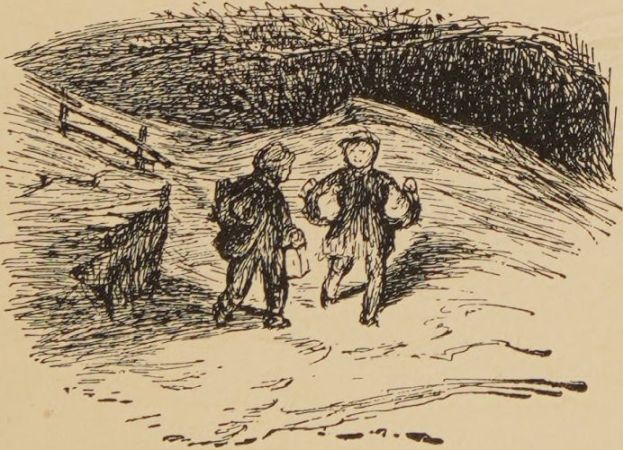
Upon Christmas Eve it is a pleasant custom amongst the Big Folk for carol singers to go singing from farm to farm; even to the lonely cottages on the outskirts of the great woods. Two small boys, who had been out with the carollers, were going home to supper. Their Christmas picnic had been more prosperous than poor Tappie-tourie’s. Their pockets were full of apples and toffy and pennies.
“George,” said Jimmy, “give us a ginger snap.”
“Na-a!” said George, “it will gummy your teeth tegidder, that you cannot sing. Whooop!” shouted George, jumping into a snowdrift, “sing another—
“Wassail, wassail! to our town! The bowl is white, and the ale is brown; The bowl is made of the rosemary tree, and so is the ale, of the good bailee. Little maid, little maid, tirl the pin! Open the door, and let us come in!”
John Stoat Ferret listened intently. “Whooop!” shouted Jimmy, kicking the snow about, and swinging his candle lantern; “sing another one—
“Here us comes a wassailing, under the holly green, Here us comes a wandering, so merry to be seen. Good luck good Master Hodgin, and kind Mistress also, And all the little childer that round the table go! Your pockets full of money, your cupboards of good cheer, A merry Christmas, Guizzards, and a Happy New Year!”
“Jimmy!” exclaimed George suddenly, “I smell stoat. Look over the wall with the lantern.”
John Stoat Ferret departed hurriedly. And as if a spell were broken, Chucky-doddie, Tappie-tourie, and Selina found their voices. They cackled loudly, up in the tree.
“Eh, sithee!” said George, “them’s our three hens that father lost out of t’ hen-hut. Fetch ’em down: I’se haud lantern.”
“This wall’s gaily slape!” giggled Jimmy, balancing himself on the slippery top stones. He reached up into the tree, and got hold of Tappie-tourie first, by the legs. “Ketch!” said he, and flung her out into the snowdrift in the lane.
“Here’s another fat ’un!” He threw Chucky-doddie across. Selina flew after them of her own accord.
The boys picked the hens out of the snow, and trudged homewards; George, with a hen tucked under each arm; and Jimmy, with one hen and the candle lantern. It was an inglorious ending to Tappie-tourie’s Christmas picnic; but at one time it looked like ending much worse—“very much worse, Cluck-cur-cuck-cuck-cluck!” said Charles the cock.
Sandy looked thoughtful. “Was the parrot an elderly bird?”
“Very aged by his own account, if truthful,” replied Charles.
“I wonder whether he was the same parrot who had an adventure with a hawk, long ago. The parrot, which I am referring to, belonged to Squire Browne of Cumberland. The Squire also had a chestnut cob on which he went out riding; and he employed an old groom-gardener, named John Geddes. When Squire Browne came downstairs on fine mornings, he called through the open staircase window to John Geddes in the stable-yard. He said, ‘I’m riding today, John Geddes!’ Then he scratched the parrot’s head, and read the newspaper, and had breakfast.
Now the parrot was so tame that he was allowed to come out of his cage; and one day he was waddling about on the lawn, when—shocking to say—a large hawk swooped down from the sky, and seized poor Polly in its claws.
The hawk rose into the air, over the house and stable-yard; and the parrot, looking down for the last time at its home, saw the old groom-gardener sweeping with the yard broom.
‘I’m riding today, John Geddes!’ shouted Polly.
Whereupon the hawk was so startled that it let go the parrot, who skimmed downwards from the clouds to safety.”
“Cuck, cuck, cluck! I think I have heard that anecdote before,” said Charles.
“Possibly,” replied Sandy, bristling up his moustache, “possibly. But Squire Browne’s parrot was the first one it happened to.”
Xarifa intervened hastily, in the cause of peace, “Was it not Miss Browne, a very, very old lady, who told us the story?”
“It was,” said Sandy, eyeing Charles, the cock.
“And did she not tell us other pretty stories?” continued Xarifa, “the story of the fairy clogs; and that pretty tale about the water-lilies? How they went adrift and sailed away, along the lake and down the river? In each water-lily flower was a fairy sitting, with golden curls, in the white lily flowers; and a fairy in green, on each broad round leaf, rowing with oars made of rushes?”
“What was the end of that story, Xarifa?” asked Tuppenny.
“Unfortunately, I do not remember. I don't think it had any end; or else I fell asleep.”
Leave a Visiting Card
Consulting the visiting cards...