CHAPTER XV
PONY BILLY’S SEARCH
WHILST Sandy and the poultry were entertaining each other in the orchard, Pony Billy, saddled and bridled, trotted away in search of the truant Paddy Pig.
He passed in front of the farmhouse windows, clink! clink! went his shoes on the cobblestones in the yard. Mrs. Hodgson darning stockings in the sunny window-seat looked up and listened. Nothing could she see; she threaded her needle in and out, out and in, through the stocking foot.
Pony Billy passed by the sweet-smelling wallflowers in the old-fashioned garden, where beehives, all a-row, stood on a deep stone shelf of the wall that faced the sun. The bees were stirring busily after their drowsy winter’s sleep.
He came along a cart-track, and through a gate, on to the public road. Little sunshiny whirly winds had powdered white dust upon the king cups under the hedge; belated March dust in April.
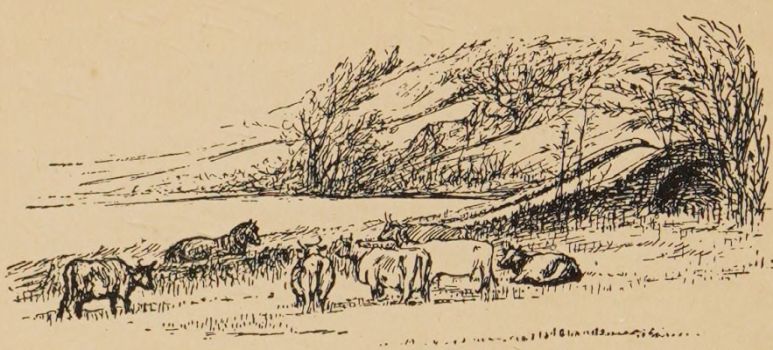
The cows looked over the hedge at Pony Billy. Said White-stockings to Fancy:
“There goes a brave little saddle pony! Look how proudly he arches his neck, and tosses his cunning head! See the brass lockets glittering in the sun, and the stirrup irons, and the saddle leather. Look at his long flowing tail; and how gaily he picks his steps! He lifts his feet as prettily as Merry-legs or Cricket, who won the prize at Helsington. Where is he trotting to, think you?” said Buttercup Cow to Nancy.
Pony Billy trotted along. It was dinner time with the Big Folk. He met nobody except old Quaker Goodman, jogging leisurely homeward in a low two-wheeled tub.
The fat Quaker pony could see Pony Billy in spite of fern seed; it swerved across the road to leave him room to pass. Old Mr. Goodman laid his whip very gently along the ribs of the fat pony, as it were patting her with the handle of the whip:
“What Daisey! Why, Daisey? What is thee shying at, Daisey? Tch-tckk-tckk!”
Staid iron-gray Daisey plodded steadily on; her thick bob-tail swung from side to side.
Horses can see things where the Big Folk can see nothing—nothing but a silly white stone, or a stump on the roadside bank. But horses can see. So likewise can little young children. Two toddling youngsters at play in the dust caught a fleeting glimpse of the fairy pony; they prattled baby talk, and clapped their dirty chubby hands.
Pony Billy breasted the hill at a canter; he slackened his pace to a walk as he came along over the croft. He pricked his ears and looked down at the village. The Big Folk were all in-doors at dinner.
Maggret, the Codlin Croft mare, dozed under the pent-house at the smithy. Farmer Hodgson was gossiping at the inn, whilst he waited for the blacksmith.
Pony Billy came down the croft at a quick, high-stepping trot; his brass lockets shone in the sun; his bright eyes sparkled. He hailed the smithy with eager neighings:
“Hinny ho! Mettle! Bellows and shoes, Mettle! Hinny ho!”
Out came Mettle, barking—a hard-haired yellow terrier, wearing a little leather apron:
“Good-day to you, Pony Billy! So the caravan is round again? What can I do for you this time? Another hoop? Another new circus trick?”
“I wish to have my shoes removed and put on backwards.”
“Certainly; four removes; we will soon have them off,” said Mettle. “It does not sound very comfortable; but just as you please. I will blow up the fire (c-r-e-a-k, puff; Mettle leaned upon the handle of the bellows, c-r-e-a-k, puff, puff), they will require a little fitting. (Mettle turned the shoe upon the hearth amongst the small hot coal, puff, puff.)
I will take it out in tickets; and treat our smithy cat to an outing (puff, puff!). I owe her one. I pulled her tail. She did scratch me (puff, puff)! Why did I do it? (C-r-e-a-k, puff, puff!) I did it because she was black. I thought she was a stray black cat! She went up the chimney tortoise-shell and white, and she came down black! Cheesebox, our smithy cat.”
Farmer Hodgson’s mare yawned dismally.
“I am sorry, Maggret, I cannot offer to fit your shoes; your feet are so large I could not lift them.” (The mare laid her ears back.) “No offence to a lady! My master says he likes a horse with a big open foot.”
Mettle took the white-hot horseshoe from the hearth with a little pair of tongs and hammered it daintily on the anvil; “Now your shoes are little fairy shoes, Pony Billy”; tick, tock, tap, tock! hammered Mettle merrily and sang:
“Shoe the horse and shoe the mare, but let the little colt go bare! Now lift up your foot till I fit it. Have you ever gone short of fern seed since that night in the snow, Pony Billy?”
“Never,” said Pony Billy, shaking his mane to feel the precious packet nestling against his neck.
Tap, tap, tap! hammered Mettle, “Here a nail and there a trod; now the horse is well shod! Yes, Cheesebox and I will be coming to the circus this evening.”
Then Maggret pricked her ears and whinnied at sound of hob-nailed boots; her master and the blacksmith came into the pent-house together. Just then Pony Billy came out. Farmer Hodgson did feel as though he had bumped against something soft; but there was nothing to be seen. It might have been the door-post.
Pony Billy walked up a stony lane picking his footsteps carefully. It is not agreeable to trot amongst stones with four newly-shod back-to-front shoes. He stepped in the softest places. By banks and hollows and turnings, by muddy places and dry, always leaving back-to-front horseshoe marks behind him, as though he had come down the lane, instead of having gone up.
He turned into another lane, crossed a shallow ford; came roundabout behind the wood, and looked over a tumble-down wall.
Pringle Wood lay before him, silent, still; crowned with golden green in a pale spring afternoon. Almost silent, almost still; save for a whispering breath amongst the golden green leaves, and a faint tingle ringle from the bluebells on the fairy hill of oaks.
How blue the bluebells were! a sea of soft pale blue; tree behind tree; and beneath the trees, wave upon wave, a blue sea of bluebells.
Below the low stone wall, between it and the wooded hill, was a tangly boggy dell, matted with brambles and wild raspberry canes, and last year’s withered meadow-sweet and keshes. Young larch trees and spruces struggled through the briars; a little stream slid gently round the hill, beneath ellers and hazel bushes.
Pony Billy got over a gap in the wall, and pushed his way through the tangle, leaving back-to-front footsteps as he squelched through the black earth and moss. Briars tugged his mane; raspberry canes pulled his tail as though they were fingers; he left tufts of his shaggy coat upon the brambles.
He whinnied: “Hinny ho! where are you hiding, Paddy Pig?”
No one answered. Only there seemed to be a faint tingle ringle of laughing from the thousands of bluebells in the wood.
Pony Billy got out of the bog with a jump and a scramble up the steep grassy slope of the hill. Round and round and round he went underneath the oaks; always going widdershins, contrary to the sun; always leaving back-to-front misleading marks behind him.
Six times round he went; and he saw nothing but the bluebells and the oaks. But the seventh time round he saw a little Jenny Wren, chittering and fussing round an old hollow tree.
“What are you scolding, you little Jenny Wren?”
She did not stay to answer; she darted through the wood twittering gaily.
“I had better go and look inside that hollow tree myself,” thought Pony Billy. He walked up to it, and looked in. “Ho, ho! what are you doing in there, Paddy Pig? Come out!”
“Never no more,” replied Paddy Pig. He was sitting huddled up inside the tree, with his fore-trotters pressed against his tummy; “never again. I cannot break through the ropes.”
“Ropes? don’t be silly! there is nothing but cobwebs.”
“What, what? no ropes?”
“Come out at once,” said Pony William, stamping.
“I am ill,” replied Paddy Pig; he pressed his trotters on his waistcoat.
“What have you been eating?”
“Tartlets.”
“Tartlets in Pringle Wood! more likely to be toadstools. Come out, you pig; you are keeping the circus waiting.”
“Never no more shall I return to the go-cart and the caravan.”
Pony Billy thrust his head through the spider webs in the opening, seized Paddy Pig’s coat-collar with his teeth, and jerked him out of the tree.
“What, what? no ropes? but it is all in vain.” He sat upon the grass and wept.
“Try a potato? I brought you some on purpose.”
“What, what? potatoes! but is it safe to eat them?”
“Certainly it is,” said Pony Billy, “they did not grow in Pringle Wood. Eat them while I have my nosebag. Then I will carry you home again pig-a-back.”
“We will be chased. And I will fall off.”
He ate all the potatoes. “I feel a little better; but I know I will fall off. Oh, oh, oh! Something is pinching my ears!”
Whatever might be the matter, Paddy Pig’s behaviour was odd. He got up on a tree-stump, and he tried to climb into the saddle. First he climbed too far and tumbled over the other side; then he climbed too short and tumbled; then he fell over the pony’s head; then he slipped backwards over the crupper, just as though someone were pulling him.
He sat upon the ground and sobbed, “Leave me to my fate. Go away and tell my friends that I am a prisoner for life in Pringle Wood.”
“Try once more. Sit straight, and hold on to the strap of lockets,” said Pony Billy, trampling through the bluebells.
He came out from under the trees into the sunshine. He trotted across the green grass of the open meadow, and carried Paddy Pig safely back to camp.
Leave a Visiting Card
Consulting the visiting cards...