
By 1909, when The Tale of the Flopsy Bunnies appeared, Beatrix Potter had been producing picture books for seven years. She was tired of drawing rabbits. She had said so herself in a letter to Frederick Warne: "I must try and do another rabbit book — all the little boys and girls like the rabbits best." The admission is characteristic — honest about her own reluctance, practical about her commercial situation.
The book she made under those conditions is not one of her sharpest. It is gentler, quieter, and more forgiving than the rabbit books that preceded it. But it is also, in its own way, exactly right — a sequel that knows what it is and does not try to be something more.
Benjamin and Flopsy
The story establishes, in its first few lines, that Benjamin Bunny has grown up. He married his cousin Flopsy. They have a large family of children. The family is not well managed — the Flopsy Bunnies eat too much and get into trouble through sleepiness rather than disobedience.
This is a significant shift from Peter's story or even Benjamin's own. Peter was disobedient. Benjamin was bold. The Flopsy Bunnies are simply drowsy. The moral texture is different. There is no deliberate wrongdoing here — just a family of small animals who fall asleep in the wrong place and need to be rescued.
Beatrix gave the book a married couple at its center. Benjamin and Flopsy together are steady domestic adults. They are not characters in the way Peter was a character — vivid, individual, psychologically present. They are parents, and the story moves around them rather than through them.
The Flopsy Bunnies themselves are essentially unnamed. They are a group, not individuals. This is a different mode of storytelling, and it makes the book feel less intimate than the earlier rabbit stories.
Gwaynynog and Mr McGregor's Garden
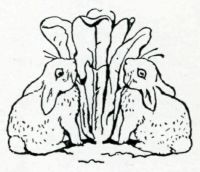
The setting is the garden at Gwaynynog, the Welsh estate belonging to her uncle Fred Burton. Beatrix had visited there and found a kitchen garden with the kind of productive abundance that old walled gardens produce — too much of everything, a constant overflow of vegetables.
Mr McGregor's rubbish heap appears in this garden, and it is here that the Flopsy Bunnies make their mistake. They eat the outer leaves of lettuces that have been discarded by the gardener, fall into a sleepy state, and are found by Mr McGregor, who pops them into a sack.
Mr McGregor in this book is a more domestic figure than the alarming gardener of Peter Rabbit. He is old. He forgets things. He puts the sack down while he goes to find something to tie it with, and his wife wonders what is in it. The tension is mild. The children understand they are not in the same danger that Peter was in.
This lowered temperature is not accidental. Beatrix calculated the register carefully. The Flopsy Bunnies needed to be sympathetic without being frightening, amusing without being satirical. She found that register by slowing the pace and reducing the stakes.
"Soporific"
The word that opens the book's middle section is "soporific." It means causing sleep.
Beatrix chose it with care. She was aware that it was not a word most young children would know, and she was aware that this was the point. The sentence — "It is said that the effect of eating too much lettuce is soporific" — is gently comic because of the gap between the formal word and the small sleepy bunnies it describes.
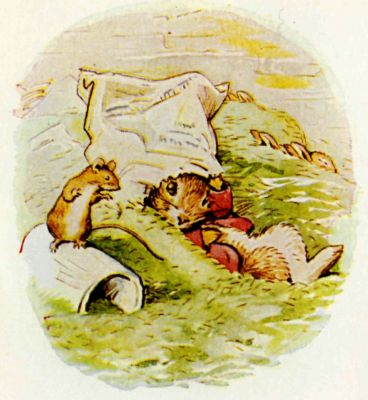
She had been precise about language throughout her career, choosing words for their sound and weight as well as their meaning. "Soporific" in this sentence does several things at once: it is funny, it explains the plot device, and it gives the passage a dry, slightly learned tone that contrasts with the helpless heap of sleeping rabbits in the next illustration.
For Leslie Linder, this was characteristic of Beatrix at her most playful. She trusted young readers to enjoy a word they did not fully understand, knowing that the picture would carry the meaning and the word would carry the tone.
The Letter to Warne
Beatrix's letter to Frederick Warne about this book is one of her most candid statements about the relationship between her artistic ambitions and her commercial situation.
→ Read The Tale of the Flopsy Bunnies
She was tired of drawing rabbits. She said so plainly. But she also understood, with equal clarity, that the rabbits were what her readers wanted. The letter captures the tension without self-pity: here is the situation, here is what she plans to do about it. She will do another rabbit book.
The discipline in that decision was real. It would have been easier to move on to something entirely new. She had plenty of other ideas — she was working on several projects at the time. But she was also a professional, and professional work meant meeting her readers where they were, even when she would have preferred to be somewhere else.
The book she made under those conditions is a better argument for professionalism than almost anything she could have said about it.
Mrs Tittlemouse Saves the Day
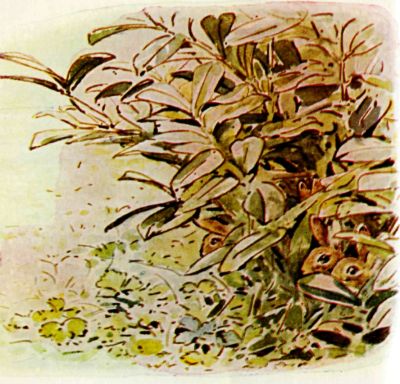
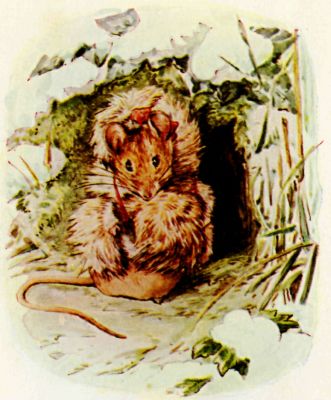
The rescue comes from an unexpected figure. Mrs Tittlemouse — a wood mouse, and the subject of Beatrix's next book — is present in the garden and helps the Flopsy Bunnies escape. She chews through the sack while Mr McGregor is distracted.
The appearance of Mrs Tittlemouse here is one of the few places in Beatrix's published work where a character crosses from one book into another. It is a gentle acknowledgment of a shared world — the small animals of Near Sawrey and the surrounding countryside who appear and reappear as the books progress.
The escape is, again, not heroic. Nobody shows particular cleverness or courage. The Flopsy Bunnies wake up and run away. Benjamin and Flopsy retrieve the family. Mr McGregor finds his sack full of vegetables and rabbit fur.
The Gwaynynog Garden
The garden at Gwaynynog was one Beatrix knew from visits to her uncle Fred Burton in Wales. It was a productive kitchen garden in the old style — walled, orderly, with an abundance of vegetables at every stage of growth.
Mr McGregor's garden in this book has a different quality from the one in Peter Rabbit. That garden was specific in its danger — its cold frames, its pursuit, its tight spaces. The Gwaynynog garden is more generous. The rubbish heap at its edge is where the lettuces have been discarded — too old, too outer-leafed to use. The lettuces that make the Flopsy Bunnies sleep are themselves cast-off things, not stolen from the heart of the garden.
Beatrix drew the garden with the familiarity of someone who had sketched there on holiday afternoons. The illustrations have a Welsh summer quality — warm, slightly overgrown, abundant with the vegetables of late season. It is a less threatening garden than the one Peter Rabbit entered.
That lower temperature suits the book's purpose. The Flopsy Bunnies are not in Peter's kind of danger. They are drowsy children caught napping. The garden is not the engine of their crisis — their own sleepiness is.
What the Book Reveals
The Tale of the Flopsy Bunnies is sometimes treated as a minor work. It is less vivid than Peter Rabbit, less inventive than Squirrel Nutkin, less psychologically interesting than Jemima Puddle-Duck. But it is not nothing.
It is the book Beatrix made when she was tired of rabbits and made one anyway. It demonstrates a reliable professionalism — the ability to produce good work within familiar constraints, without pretending those constraints did not exist.
The dedication reads: "For all little friends of Mr. McGregor and Peter and Benjamin." It was an affectionate gesture toward an existing readership. The book was written for children who already knew the garden and wanted to return to it.
Beatrix gave them what they wanted. She did it honestly, with her eyes open, and she did it well.
Read It in Full
That's how it was made. Now read The Tale of the Flopsy Bunnies itself, in the Complete Tales. Open The Tale of the Flopsy Bunnies →
Sources
The facts in this article are drawn chiefly from Leslie Linder, A History of the Writings of Beatrix Potter, and Linda Lear, Beatrix Potter: A Life in Nature, cross-checked against Judy Taylor's edition of Beatrix Potter's Letters. The history is theirs to record; the words here are our own.
Leave a Visiting Card
Consulting the visiting cards...