
The Tale of Samuel Whiskers is Beatrix Potter's tribute to her own house. More than any other book, it is built from the actual rooms of Hill Top Farm — the thick walls, the staircase, the dresser, the long window. It is also her most genuinely frightening story for small children. A kitten is caught by rats, rolled in dough, and very nearly cooked.
The book first appeared in 1908 under a different name: The Roly-Poly Pudding. Beatrix loved the old farmhouse it celebrates, and she loved the real rats that gave her the plot. The two things came together in a story that is part documentary and part nightmare.
A House Full of Rats
Beatrix bought Hill Top in 1905 and found it overrun. The rats were a real and serious problem, and they gave her the idea for the book almost at once.
Her letters from those first months are full of the house and its vermin in the same breath. In April 1906 she wrote, after exploring it: "It really is delightful—if the rats could be stopped out! There is one wall four foot thick with a staircase inside it. I never saw such a place for hide and seek and funny cupboards and closets." The delight and the infestation were one and the same.
That autumn the rats won a round. "The rats have come back in great force," she reported; "two big ones were trapped in the shed here, besides turning out a nest of eight baby rats in the cucumber frame... They are getting at the corn at the farm." A week later: "Mrs. Cannon has seen a rat sitting up eating its dinner under the kitchen table in the middle of the afternoon. We are putting zinc on the bottoms of the doors."
A book about rats in the walls was not a flight of fancy. She was living it.
The House in the Pictures
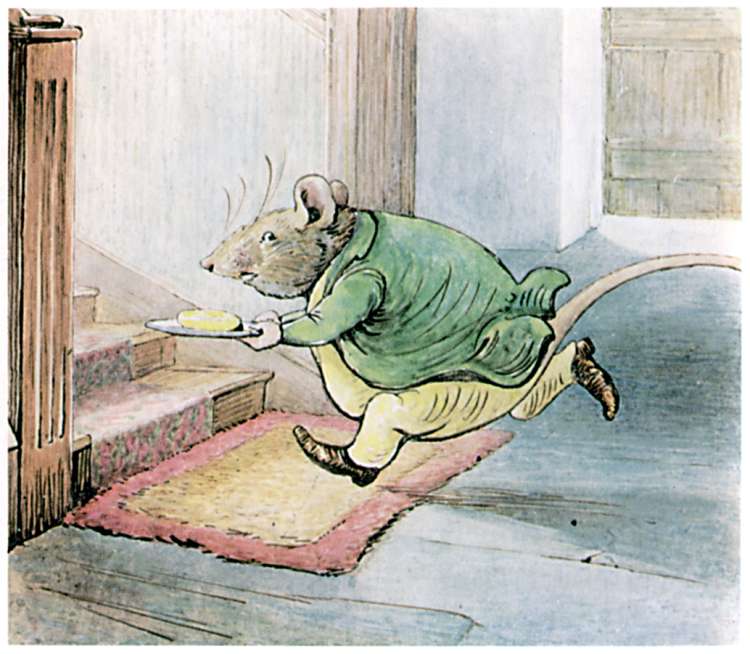
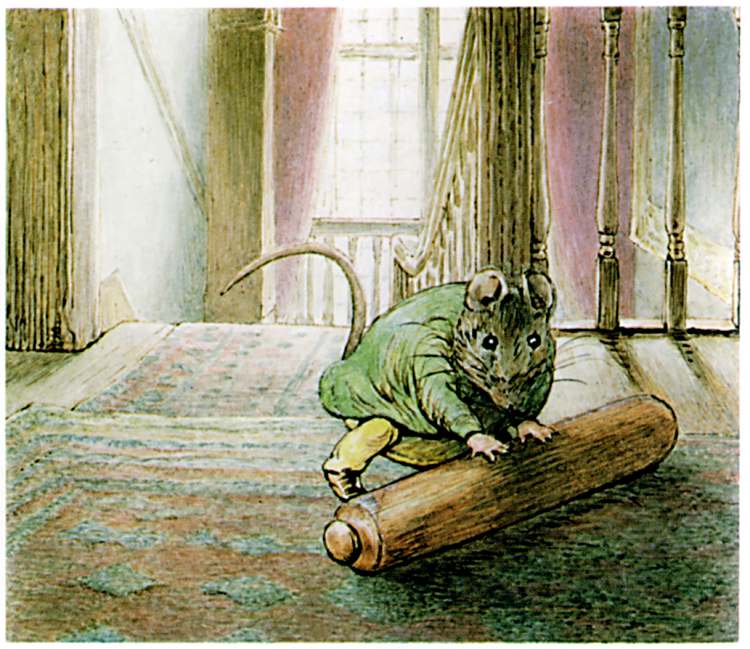
Beatrix drew Hill Top room by room and put it straight into the book. The staircase, the half-landing, the long window with its claret-coloured curtains, the kitchen range, the dresser with its plates — all of these are the real interiors of the farmhouse.
She was deliberate about it. When she furnished the front rooms she had the book in mind. "I have not meddled with the fireplace," she wrote; "I don't dislike it, and besides it is wanted for the next book. I have got a pretty dresser with plates on it and some old fashioned chairs; and a warming pan that belonged to my grandmother." The house and the book were being arranged together.
The outdoor world is real too. Farmer Potatoes, who appears near the end, was copied from a photograph she took of her neighbour, the farmer Postlethwaite. John Joiner, the carpenter dog who saws Tom Kitten free, was named after the son of old John Taylor, the village shopkeeper. And in the very last picture Beatrix drew herself into the scene, at the foot of Smithy Lane near the village shop, looking across toward the barn.
The book mattered to her for the rest of her life. She once wrote of Hill Top simply: "It is a funny old house, it would amuse children very much." In her will she asked that "the rooms and furnishings used by me at Hilltop Farm may be kept in their present condition." They were. The house she drew in this book can still be visited, much as she left it.
The Story, and Its Real Danger
The plot follows Tom Kitten, who escapes his mother's wash and climbs up the chimney. Lost in the walls of the old house, he is captured by two rats — Samuel Whiskers and his wife, Anna Maria. They mean to make him into a "roly-poly pudding." They smear him with butter and roll him in dough.
It is genuinely alarming, and Beatrix drew it with such care that some children wondered whether she had used a live model — a kitten "trussed up with string, like breast of lamb with stuffing." His mother, Tabitha Twitchit, and his cousin Ribby search the house for him. He is saved only when John Joiner the dog saws through the floorboards and pulls him out, dough and all. The rats escape Hill Top with their stolen goods in a wheelbarrow.
→ Read The Tale of Samuel Whiskers
This is the darker face of the farmyard world. Most of Beatrix's animals live in safe kitchens and warm burrows. Here the walls hide predators, and a small creature can vanish into them and very nearly not come back.
A Real Rat Named Sammy
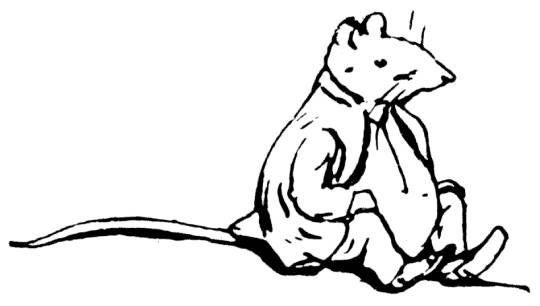
The book's dedication is one of her most affectionate. It honours a real rat — a tame white one she had kept years before, named Sammy. The dedication reads: "In remembrance of 'SAMMY', The intelligent pink-eyed Representative of a Persecuted (but Irrepressible) Race! An affectionate little Friend, and most accomplished Thief!"
She remembered him with real fondness. "I have memory of him waddling along the floor, waiting to be picked up," she wrote. "One of his scrapes was to cut a neat round piece, size of our half crowns, out of the middle of a sheet. He carried a curious collection of stolen articles to his box." When an editor questioned the word "pink-eyed" in the dedication, she stood firm: "I should like 'pink-eyed' to stand, as 'Sammy' was an albino."
So the same book that makes rats the villains also opens with a loving memorial to a pet rat. Beatrix held both feelings at once. She would set traps and zinc the doors against the wild rats of Hill Top, and grieve a tame one she had loved.
The Word She Would Not Change
Beatrix took the same care over the words as over the rooms. When an editor questioned her use of "scuttered" — a north-country word for scurrying — she dug in. "I have been looking for 'scutter' in Halliwell Phillip's Archaic words and I cannot find it," she wrote, "rather to my surprise. I think it is common Lancashire and probably good Anglo Saxon." Then her clinching argument: the word "appears on p. 69 of the immortal Peter Rabbit which is a classic!" She would defend a single dialect word by citing her own most famous book.
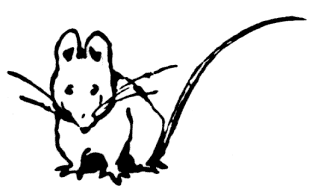
The large first edition gave her room for flourishes she clearly enjoyed. She designed a special colour title page: Samuel Whiskers perched on his rolling-pin at the top, the kittens at the sides, the rats below, and at the centre poor Tom Kitten rolled up in his dough, head poking from one end and tail from the other. On the reverse of the half-title page she drew a mock coat of arms for Samuel Whiskers, with the grand motto "Resurgam" — Latin for "I shall rise again." It was a joke worthy of the irrepressible rat. When the book was shrunk to the small format in 1926, that book-plate was one of the things dropped to save space.
Two Titles, Two Sizes
The book had an unusual life in print. It was written in 1906 — the manuscript was a Christmas gift that year to Norman Warne's niece Winifred, inscribed "The Roly-Poly Pudding." It was published in 1908 in a large format, bigger than the standard little books, which gave Beatrix room for the fine detail she loved.
In 1926 it changed. To match the rest of the series, it was reprinted in the ordinary small size — which pleased her — and the title was changed from The Roly-Poly Pudding to The Tale of Samuel Whiskers. A mock heraldic book-plate she had drawn, complete with the motto "Resurgam," was dropped from the smaller edition. The American copies kept the old title.
So the same story carries two names. Older readers may know it as The Roly-Poly Pudding; the book on the shelf today usually says The Tale of Samuel Whiskers. They are the same tale of the same house and the same rats.
Like the doll's house mice before them, the rats lived on in the small letters Beatrix wrote to children. Samuel Whiskers writes to Farmer Potatoes refusing to leave — "I inform you I shall not go, and you can't turn us out" — and to a friend to arrange a "midnight flitting" by the light of the full moon, carrying everything they own, "96 of us" in all. The rats she fought in her own walls became, on paper, characters she could not quite stop writing.
Read It in Full
That's how it was made. Now read The Tale of Samuel Whiskers itself, in the Complete Tales. Open The Tale of Samuel Whiskers →
Sources
The facts in this article are drawn chiefly from Leslie Linder, A History of the Writings of Beatrix Potter, and Linda Lear, Beatrix Potter: A Life in Nature, cross-checked against Judy Taylor's edition of Beatrix Potter's Letters to Children. The dedication and the miniature letters are quoted from Linder's record. The history is theirs to record; the words here are our own.
Leave a Visiting Card
Consulting the visiting cards...