
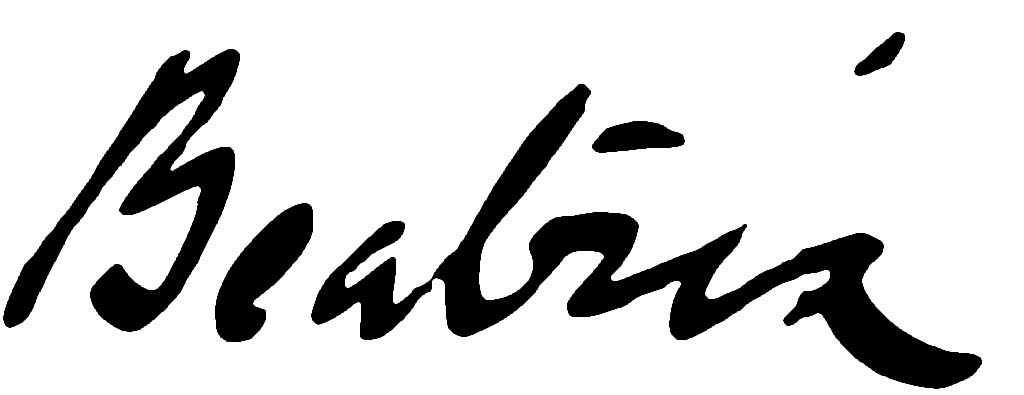
On the morning of 4 September 1893, Beatrix Potter sat down at Eastwood House in Dunkeld, Perthshire, and wrote a letter to a sick child. She had no particular plan. She did not know the letter would matter to anyone beyond the boy who received it. She just needed something to say to a small child who was too ill to go outside.
She drew pictures as she wrote. By the time she sealed the envelope, she had filled eight pages of text with sixteen or seventeen pen-and-ink sketches. The boy's name was Noel Moore. The story she told him was about a rabbit called Peter.
That letter, written in a rush of affection for one particular child, became the seed of the most famous children's book in the English language.
Dunkeld, and a Child in Bed
The Potters took their summer holidays in Scotland every year. In 1893 they stayed at Eastwood House, a large rented property near Dunkeld in Perthshire. It was good countryside — wooded, quiet, the River Tay nearby. Beatrix was twenty-seven. She had her sketchbooks, her field notes, her pet rabbit. She was always working, even when the family was not.
Back in London, in the Moores' house in Wandsworth, Noel was sick.
Noel Moore was the eldest son of Annie Moore, who had been Beatrix's governess and remained one of her closest friends. Annie's children were among the few young people Beatrix knew well — not at the polite distance she kept with most people, but warmly, with real affection. She wrote to them often. When she heard that Noel was sick in bed, she wanted to help.
Childhood illness in the 1890s was not a mild thing. Noel was confined to bed, cut off from the ordinary run of his days. There was not much anyone outside the house could do. But Beatrix could write.
The Letter
She began simply. "My dear Noel, I don't know what to write to you, so I shall tell you a story about four little rabbits whose names were — Flopsy, Mopsy, Cottontail and Peter."
The opening is plain and direct. It admits she has no plan, and then immediately has one. A child reading it would feel spoken to directly — not lectured or performed at, but genuinely addressed, person to person.
The story that followed was almost exactly the one published nine years later. Peter's mother warns her children not to go into Mr McGregor's garden, because their father had an accident there and ended up in a pie. Flopsy, Mopsy, and Cottontail are sensible and go to gather blackberries. Peter goes straight to the garden. He eats too much. Mr McGregor chases him. He loses his jacket and his shoes. He hides in a watering can. He escapes, exhausted, and goes home to bed.
The sketches ran alongside the text. They showed the family of rabbits in their burrow, Peter squeezing under the gate, the chase through the vegetable rows, Mr McGregor looming with his rake. They were small, quick drawings — pen and ink, no colour. Each one caught something true: how a rabbit moves, how a garden looks from low down, how fear feels.
The whole letter measured roughly 180 millimetres by 115 millimetres. It was, in other words, already small — small enough to hold in a child's hands, small enough to feel made to the right scale. That proportion would matter later.
Peter Was Real
The rabbit in the story was not invented. His name was Peter Piper. He was Beatrix's own pet — a Belgian buck rabbit she had bought herself and kept in her room at the family home in Bolton Gardens, London. She had drawn him from life many times. She knew how he sat, how he ran, what his ears did when he was startled. When Peter dashes through the garden and slips beneath the gate, that movement is observed, not guessed.
Beatrix had always worked this way. She drew from the thing in front of her, not from an idea of the thing. The fungi she painted were painted from actual specimens she collected herself. Her animal studies were done from life. Even as a child she had filled sketchbooks with close observation. Peter Rabbit's realism — the sense that he is a specific animal in a specific garden — comes directly from that habit.
"A Real Live Child"
Beatrix later wrote about what it meant to have a real child at the other end of the letter. Judy Taylor's *Beatrix Potter's Letters to Children* records her reflecting: "It is much more satisfactory to address a real live child; I often think that was the secret success of Peter Rabbit, it was written to a child — not made to order."
The word she chose was "satisfactory." Not "better," not "more artistic." Satisfactory — meaning it meets a real need, it does the work. Writing to Noel was not a literary exercise. It was an act of care. Something wanted to reach a specific person, and that want shaped everything: the plain words, the direct voice, the pictures that move the story along rather than decorating it.
A story made to order — aimed at a general audience, at what children are assumed to want — arrives at the reader differently. It has been aimed at no one in particular. Beatrix believed the letter worked because it had been aimed at someone particular.
The tone of Peter Rabbit — that intimacy, the sense that the reader is being told something just for them — was set in Dunkeld on 4 September 1893. For one child who was ill and needed cheering.
The Day Before
The morning before she wrote the letter, Beatrix had spent time in the Dunkeld countryside painting a rare fungus — Strobilomyces strobilaceus, known as the Old Man of the Woods. It was a careful, precise piece of scientific work, done with the close observational focus she brought to everything.
She was twenty-seven, in the middle of an intense period of mycological study. The 3 September painting was the kind of work that demands full attention — counting details, getting the proportions right, nothing approximate.
The next morning she wrote the letter.
It may be nothing more than proximity. But the same eye that measured a mushroom was the eye that drew a rabbit fleeing down a row of cabbages — specific, accurate, alive.
Seven Years in a Drawer
Noel recovered. The letter went into a drawer in the Moores' house and stayed there.
Beatrix kept writing to the Moore children over the years — Noel, his brother Eric, his sisters Norah and Freda. The letters she sent were full of pictures: frogs, hedgehogs, mice, cats. These were not illustrations in waiting. They were letters. She did not think of them as anything else.
Then in 1900, Annie Moore made a suggestion. She had been rereading the old letters and thought there might be enough material in them for a book. She told Beatrix. Beatrix had to ask Annie to lend them back — she no longer had her own copies.
She borrowed the 1893 Noel letter and others alongside it. She copied out the text, redrew the sketches on fresh paper, expanded the story, and worked up finished watercolour illustrations. She approached six publishers. All six said no. So she published it herself — in 1901, at her own expense, in a small private print run for family and friends.
That edition caught the attention of Frederick Warne and Co., who offered to publish it properly. The book came out in October 1902.
From the letter in 1893 to the book in 1902 was nine years. Most of those years were silence. But the letter itself had not changed. The voice Beatrix found when writing to Noel — that direct, unhurried voice — is the voice on every page of the published book.
What the Letter Became
The 1893 original is held at the Victoria and Albert Museum in London. The copy she made in 1900 for publication is at the Beatrix Potter Gallery in Hawkshead, catalogued as NT 242253. Side by side, the two versions tell the same story with very little changed. The core of the book was already there, in those eight pages, written in Scotland at the end of an ordinary summer.
Noel Moore grew up and recovered fully. He became a priest and spent his working life in the poorer parts of London. The letter he received as a sick child is now in a museum. The copy made from it is in the Lake District. The book that grew from both is in print in dozens of languages.
It all began in Dunkeld, when Beatrix did not know what to write, so she told a story instead.
Sources
- Linda Lear, Beatrix Potter: A Life in Nature (Allen Lane, 2007)
- Judy Taylor (ed.), Beatrix Potter's Letters to Children (Frederick Warne, 1992)
- National Trust Collections, NT 242253 (Beatrix Potter Gallery, Hawkshead)
Leave a Visiting Card
Consulting the visiting cards...