The Tale of Little Pig Robinson sits at the very edge of Beatrix Potter's canon. It was the last of her tales to be published, in 1930, when she was sixty-four and had long since stopped writing little books. Yet she had begun it among the very earliest of all. Parts of it date back to when she was a girl on holiday in Devon. Leslie Linder put it plainly: it "was the last of Beatrix Potter's stories to be published, but it was one of the first she ever wrote."
That alone makes it an outlier. It is also longer than the small books, set by the sea rather than the fells, and built from holiday sketches made nearly fifty years before it reached print. To read it is to look back across her whole working life at once.
A Seed from Childhood
The earliest trace goes back to 1883. Beatrix was seventeen, on a family holiday at Ilfracombe on the Devon coast. She described a harbour scene in a letter, and years later pencilled a note on the envelope: "Worth keeping, an early impression leading to Pig Robinson."
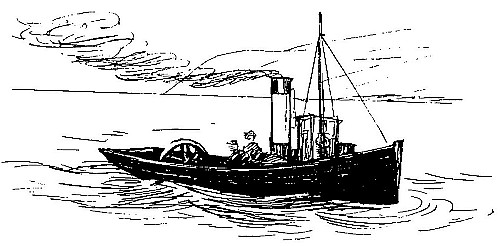
The real beginning of the story, though, came from another seaside holiday. In March 1894, writing from Falmouth to the small boy Eric Moore, she described a pig she had seen aboard a ship: "I went up a bank where I could see onto the deck & there was a white pig with a curly tail walking about. It is a ship that goes to Newfoundland & the sailors always take a pig... but when the sailors get hungry they eat it. If that pig had any sense it would slip down into the boat at the end of the ship & row away."
That is the whole book in a few lines. A pig on a ship. Sailors who mean to eat it. An escape by boat. She would spend the next thirty-six years turning the idea over.
A Story Written in Pieces
The composition history is unusually well recorded, because Beatrix dated her own drafts. One exercise book carries the note: "Written first at Falmouth 189— / Sidmouth April 1901 / Copied again April 1902." Another draft she found late in life was "dated 1893." Six weeks before she died, sorting old papers, she came across it: "I found an old draft of Pig Robinson's first chapters dated 1893—! I remember that story stuck on board the Pound of Candles."
In 1943 she wrote a short recollection of how it began: "The Tale of Pig Robinson was invented very long ago. I have some recollections of writing down this first part of the book in 1901." Its first title was different too — "The Tale of Poor Pig Robinson" — and that early version simply stopped when the pig fainted on the deck of his ship.
So the book existed for decades as half a story in an old exercise book. The first part was written. The pig's later adventures waited until somebody wanted them.
How It Finally Reached Print
What wanted them, in the end, was a publisher's need.
In 1929 Beatrix had brought out The Fairy Caravan, but only in America, through the Philadelphia publisher David McKay. That left her London publisher, Warne, disappointed. When McKay asked for another book, she offered Pig Robinson to both firms at once, to make up for the slight. She was candid about the reason. She finished it, she said, "when I had left off writing and was scraping together something to appease my publishers."
It was published in September 1930, in Britain and America together. Warne printed only five thousand copies and was soon caught short — the book sold better in Britain than expected, and they had to reprint. The American edition was the fuller one, with twelve more black-and-white drawings and a set of small "heads and tails" at the chapter ends. She dedicated that edition to McKay's three children, Margery, Jean and David.
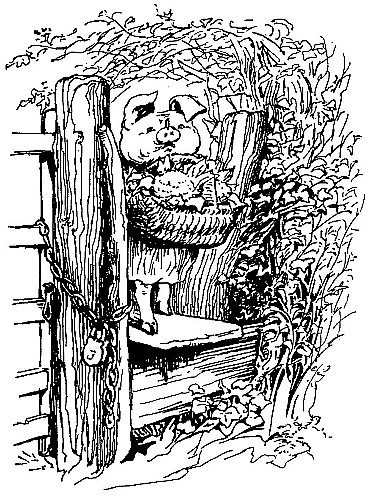
She was fond of the pictures. "I think Pig Robinson looking into a shop window is the best black-and-white I ever did," she wrote. And of the chapter ends: "I think myself that some of the 'chapter ends' are the best drawings of any."
The Coast, Stitched Together
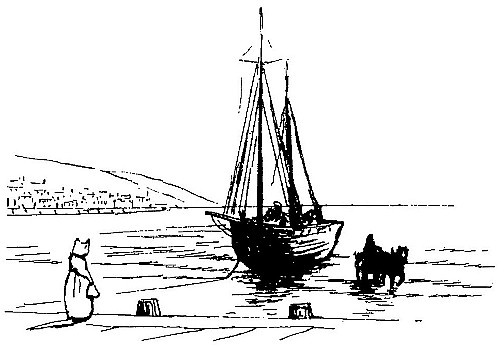
The setting is the sea, and it was built from many real places. Years later Beatrix listed them in a letter: "Ilfracombe gave me the idea of the long flight of steps down to the harbour... The shipping—including a pig aboard ship, was sketched at Teignmouth, S. Devon. 'Stymouth' was Sidmouth on the south coast of Devonshire. Other pictures were sketched at Lyme Regis; the steep street looking down hill into the sea, and some of the thatched cottages were near Lyme. The tall wooden shed for drying nets is (or was?) a feature of Hastings, Sussex—so the illustrations are a comprehensive sample of our much battered coasts."
→ Read The Tale of Little Pig Robinson
The market town of the book, Stymouth, was Sidmouth. The harbour steps were Ilfracombe's. The pig on its ship was Teignmouth. The steep street running down to the water was Lyme Regis. She had gathered the whole coast over a lifetime of holidays and set it down in one book.
She had read widely too. The story leans on Edward Lear's poem "The Owl and the Pussy-Cat" — Robinson reaches the same land of the Bong tree — and her biographer Linda Lear notes a debt to Daniel Defoe's Robinson Crusoe in the castaway ending.
The Story
Little Pig Robinson lives in Devonshire with his two stout aunts. They send him to the market town to do their shopping. There the ship's cook of a vessel called The Pound of Candles lures him aboard, meaning to fatten him for the table. Robinson is so seasick that he grows thin, which keeps him alive while they feed him up.
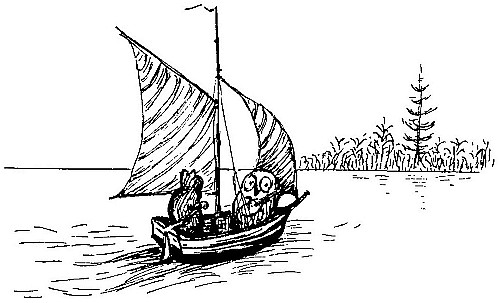
The ship's cat, Susan, befriends him. After she quarrels with the cook, she helps Robinson escape in a boat. He rows to an island and lives there happily ever after, visited — in the end — by the Owl and the Pussy-Cat in their pea-green boat.
The last line gave Beatrix and her American publisher a small, cheerful fight. She wanted to write that Robinson "grew fatter and fatter and more fatterer." McKay objected that "fatterer" was not a word. She held her ground: "Of course there is no such word; but it is expressive! If you don't like it, say 'fatter and fatter and more fat'. It requires three repeats to make a balanced ending." The word stayed.
Borrowed Stories
Little Pig Robinson is the most bookish of her tales — it leans openly on stories she had loved. The ending sends Robinson to live on an island, where the Owl and the Pussy-Cat come to call in their pea-green boat. That is Edward Lear's famous poem, and Beatrix used it on purpose. Her own text points to it: "You remember the song about the Owl and the Pussy Cat... Now I am going to tell you the story of that pig, and why he went to live in the land of the Bong tree."
She had illustrated Lear's poem years before, for her own amusement, "some time in the 90s." So Robinson is, in a sense, a backstory she invented for a pig glimpsed in someone else's verse. Her biographer Linda Lear adds a second debt — to Daniel Defoe's Robinson Crusoe, the original tale of a man cast away on an island. The pig's very name nods to it.
There are small real touches woven in too. When she worked on the American edition, she put in a friendly dog named Gypsy — drawn from a real airedale belonging to one of her publisher's children, who had sent her a photograph of it. Even in a book built from old holiday sketches and borrowed poems, she kept reaching for the living model.
At the Edge of the Canon
Little Pig Robinson does not feel quite like the other tales, and it was never meant to. It is longer. It is set by the sea, not on her own fells. Its hero is a pig at large in the wide world rather than a small animal in a familiar garden. And it was assembled, late, from the oldest material she had — a holiday idea from her girlhood, a draft begun at thirty, finished at sixty-four to keep two publishers happy.
Final drawings were held up when she fell ill with bronchitis. She did them anyway, spreading the last chapters so they would not feel rushed. When the American edition arrived she was pleased with it: "It is much more concise and understandable for children than The Fairy Caravan."
It was the last new tale she would publish. There is something fitting in the fact that her final book was also her oldest idea — a story about a small creature who slips the trap, takes to the open water, and is never caught.
Read It in Full
That's how it was made. Now read The Tale of Little Pig Robinson itself, in the Complete Tales. Open The Tale of Little Pig Robinson →
Sources
The facts in this article are drawn chiefly from Leslie Linder, A History of the Writings of Beatrix Potter, and Linda Lear, Beatrix Potter: A Life in Nature, cross-checked against Judy Taylor's edition of Beatrix Potter's Letters to Children. The composition dates are from Beatrix Potter's own notes on her drafts, as recorded by Linder. The history is theirs to record; the words here are our own.
Leave a Visiting Card
Consulting the visiting cards...