
Appley Dapply's Nursery Rhymes is the book Beatrix Potter kept almost making for twenty years. The rhymes and the pictures in it go back to the early 1890s, before Peter Rabbit existed. She proposed the book again and again. It was put off again and again. When it finally appeared in 1917, it was not because the moment was right — it was because her publisher was in crisis and needed the money.
So this small book of rhymes carries a long and surprising history. It is a collection of old work, gathered up at last in an emergency, by an author who had wanted to publish it for half her career.
Rhymes from the 1890s
The oldest pieces in the book date back to the early 1890s. As far back as 1893, Beatrix had illustrated the rhyme about the old woman who lived in a shoe. The drawings of Old Mr Pricklepin the hedgehog and the amiable guinea-pig come from the same early period. These were made years before she was famous, when she was a young woman drawing animals for her own pleasure and for the children she wrote to.
She had always loved nursery rhymes. Linder notes that she "had always been interested in traditional rhymes," though "the majority of the Appley Dapply rhymes were of her own composition." That is the key point: most of these are not old folk verses but Beatrix's own, written in the style of the traditional ones.
She had a model in mind. Her father owned around thirty original drawings by Randolph Caldecott, the great illustrator of nursery rhymes, and Beatrix admired him deeply. "I have sometimes thought of trying some of the other nursery rhymes about animals," she wrote, "which he did not do." Appley Dapply was, in part, her attempt to carry on Caldecott's kind of work in her own way.
The verses hold up. The folklorist Peter Opie, a great authority on nursery rhymes, judged that "these pieces appear to be all by the same hand, and are certainly not traditional." And then, generously: "One or two of them are delicious."
Always Proposed, Always Put Off
Beatrix first offered Warne a rhyme book very early. In 1902, as the Peter Rabbit drawings were nearing completion, she put forward "a new idea — a book of Nursery Rhymes which she would try to do better than Peter Rabbit." It was a serious plan, not a passing thought.
In 1904 and 1905 she worked it up properly. A large-format dummy was made. She sent Norman Warne an exercise book of some thirty proposed rhymes, and he went through them, marking his approval on twenty-one with his initials. The book seemed ready to happen.
Then two things stopped it. First, Warne preferred her narrative tales — the stories about Peter and Benjamin and the rest sold better than a book of rhymes promised to. The rhyme book kept being passed over for another tale. Second, and far worse, Norman Warne died in 1905. After his death the rhyme project was set aside and, as Linder puts it, "left untouched for many years." The book that he had marked up with his own initials became too painful, and too low a priority, to push forward.
So it waited.
The Guinea-Pig Who Ate Blotting Paper
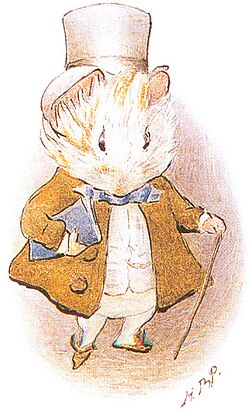
One of the rhymes carries a small, sad true story behind it. The amiable guinea-pig in the book, the one who "brushed back his hair like a peri-wig," grew out of a real animal Beatrix had borrowed in 1893 to draw.
She told the tale in her journal at the time. She had borrowed "a very particular guinea-pig with a long white ruff, known as Queen Elizabeth," from a Miss Paget. The creature did not thrive in her care. "This wretched pig took to eating blotting paper, pasteboard, string and other curious substances," she wrote, "and expired in the night." She found it in the morning "a damp—very damp disagreeable body." She made her peace with its owner by giving her the drawing.
→ Read Appley Dapply's Nursery Rhymes
So the cheerful, well-groomed guinea-pig of the rhyme began as a borrowed pet that ate itself to death on stationery. It is a very Beatrix Potter sort of origin: a real animal, closely observed, turned years later into something light and funny on the page. The drawing outlived the guinea-pig by a quarter of a century before it finally reached a book.
The Crisis That Brought It Out
What finally forced the book into print, in 1917, was a disaster at the publishing house.
That spring, Harold Warne — Norman's brother, by then the managing partner — was arrested and charged with passing a forged bill of exchange. The fraud was large. He had forged documents totalling some twenty thousand pounds, siphoning money out of the publishing company to prop up a failing fishing business on Jersey. In April 1917 he pleaded guilty and was given eighteen months' hard labour. The firm of Frederick Warne was left on the edge of bankruptcy.
Beatrix was caught in the middle of it. She was the firm's most valuable author and, as it happened, its largest creditor — the company owed her money it could not easily pay. Norman's youngest brother, Fruing Warne, took over the wreckage and tried to save the business. To bring in cash quickly, Beatrix went through her old portfolios for something that could be published fast.
Appley Dapply was the answer. She wrote to Fruing with grim good humour: "According to the proverb, half a loaf is better than no bread (and such bread too). Would it be too shabby to put Appley Dapply into a booklet the size of Miss Moppet? I find I could scrape together sufficient old drawings to fill one; they would require some 'linking up'." The grand original plan — a large book with decorated borders — was dropped as too slow and too costly. "It would mean large expensive plates," she wrote, "and more time and eyesight than I see my way to at present."
She hoped it would do its job in hard times: "I hope Apply Dap will be in time to be useful... and that it will be as good a season as can be had during this war."
What the Years Had Changed
By the time the book came out, much had changed since the rhymes were first drawn.
It appeared as a small, plain book — about the size of one of her tiniest tales — rather than the large illustrated volume she had once imagined. It was abridged. Six of the old rhymes were kept and a single new one added, and the verses appeared plain, stripped of the decorative frames she had first planned around them. The First World War, paper shortages, and the firm's near-collapse had all worked to shrink her grand idea down to something modest and quick.
There was also the simple fact of time passing. The drawings were old. Some came from before Peter Rabbit; one of the pig pictures was adapted from a much later book. Pulling them together meant "linking up" work made across twenty-five years into a single small volume. The book is, in a real sense, a scrapbook of her own long career — early sketches and later ones bound between the same two covers.
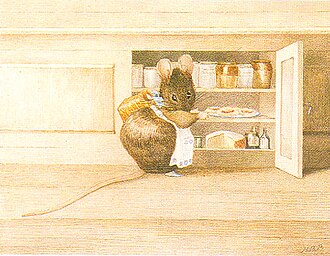
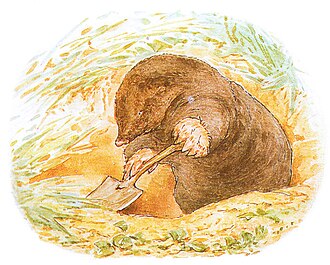
The rhymes themselves are a delight. There is Appley Dapply, "a little brown mouse," who "goes to the cupboard in Somebody's house." There is Diggory Diggory Delvet, "a little old man in black velvet," who is a mole. There is the amiable guinea-pig "who brushed back his hair like a peri-wig." They are light, funny, and exact.
Beatrix was happy with the finished thing, despite the rush and the trouble behind it. "I am much pleased with Appley Dapply," she wrote; "it makes a pretty little book." Years later, finding the abandoned old dummy in a drawer at Hill Top, she pencilled a wistful note on it: "It would have been a pretty book, nid, nid, noddy!" The grand version never happened. The small one, born of a crisis, did — and it carried two decades of her drawing safely into print at last.
Read It in Full
That's how it was made. Now read Appley Dapply's Nursery Rhymes itself, in the Complete Tales. Open Appley Dapply's Nursery Rhymes →
Sources
The facts in this article are drawn chiefly from Leslie Linder, A History of the Writings of Beatrix Potter, and Linda Lear, Beatrix Potter: A Life in Nature, cross-checked against Judy Taylor's edition of Beatrix Potter's Letters to Children. The account of the Warne crisis and Beatrix Potter's letters about the book are recorded by Linder and Lear; Peter Opie's verdict is quoted from Linder. The history is theirs to record; the words here are our own.
Leave a Visiting Card
Consulting the visiting cards...