The Tale of Ginger and Pickles is the most sociable of Beatrix Potter's books. It is set in the real village shop of Near Sawrey, and into that one small shop she brought nearly every character she had ever drawn. Peter Rabbit comes in. So do Squirrel Nutkin, Jemima Puddle-Duck, Mrs Tiggy-Winkle, Samuel Whiskers, Tom Kitten and his sisters. It is part village portrait and part family reunion.
Behind the counter are a yellow tom-cat named Ginger and a terrier named Pickles. They sell almost everything, and they give everybody endless credit — which is exactly why their shop cannot last.
A Real Shop in Smithy Lane
The shop was real. It stood in Smithy Lane in Near Sawrey, close to Hill Top, and it belonged to old Mr John Taylor. It was where the whole village came to buy, to visit and to gossip. Beatrix knew it well, and she put it into a book as faithfully as she put her own farmhouse into the last one.
She first wrote the story as a penny exercise book — a Christmas gift in 1908 for Louie Warne, the small daughter of her publisher Harold Warne. She inscribed it "With love to Louie from Aunt Beatrix." Then she rewrote and enlarged it for publication, adding the figure of the old dormouse who is really the village shopkeeper.
The book came out in 1909, at first under the bare title Ginger and Pickles, without the usual "The Tale of." Like a couple of her other books from these years, it was printed in the larger format. Only from 1930 was it reduced to the standard small size and given the longer title it carries now: The Tale of Ginger and Pickles.
The Cat, the Dog, and Unlimited Credit
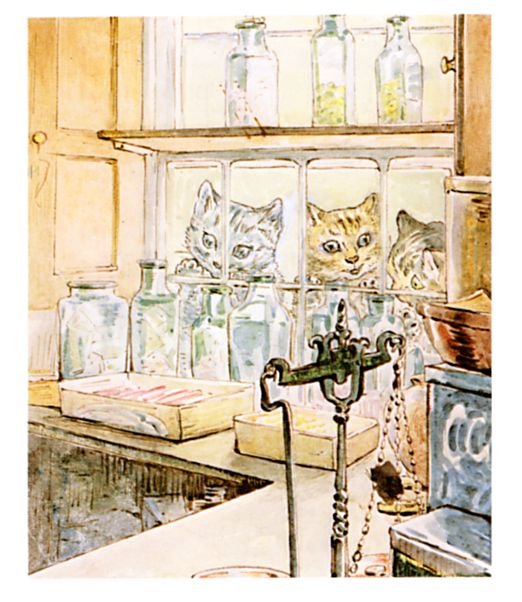
Ginger is a yellow tom-cat. Pickles is a terrier. Together they keep the shop, and they are very obliging. The trouble is that they let every customer buy on credit and never pay.
Beatrix explained the word for her young readers, in a sentence that is half lesson and half joke: "Now the meaning of 'credit' is this—when a customer buys a bar of soap, instead of the customer pulling out a purse and paying for it—she says she will pay another time. And Pickles makes a low bow and says, 'With pleasure, madam,' and it is written down in a book."
It is written down, and never collected. The shop gives away its goods and takes in no money. Eventually Ginger and Pickles cannot pay their own rates and taxes, or even the dog licence, and they have to close. The village suffers for it — the other shops raise their prices — until at last someone reopens a shop and order returns.
There is a second, quieter comedy underneath. Ginger is a cat, and some of his customers are mice; Pickles is a dog, and some are rabbits. The shopkeepers must hold back their natural instincts to keep the customers coming. Beatrix lets the reader notice this without ever spelling it out.
The Whole Cast Comes Shopping
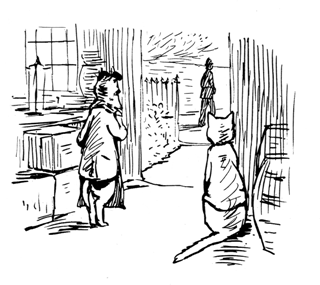
What makes the book a delight is the crowd. Beatrix used it as a reunion, filling the shop and its pages with characters from her earlier tales.
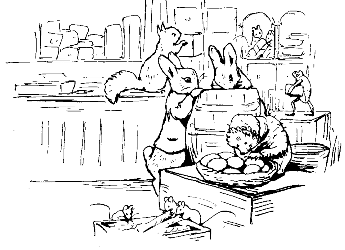
Peter Rabbit is there in his blue jacket. Squirrel Nutkin and his brother Twinkleberry come in. Mrs Tiggy-Winkle shops there. Mr Jeremy Fisher tries on galoshes. Samuel Whiskers and Anna Maria appear, and Jemima Puddle-Duck, and Tom Kitten with his sisters Moppet and Mittens peering through the shop window in the frontispiece. Even the dolls Lucinda and Jane from The Tale of Two Bad Mice turn up, and the little policeman doll.
It is the only one of her books that works this way — a gathering of her whole imagined village in one place. For readers who already knew the other tales, the shop became a kind of crossroads where all of them met.
→ Read The Tale of Ginger and Pickles
The real village loved being in it. "The 'Ginger and Pickles' book has been causing amusement," Beatrix wrote in November 1909. "It has got a good many views which can be recognized in the village which is what they like. They are all quite jealous of each other's houses and cats getting into a book. I have been entreated to draw a cat aged twenty 'with no teeth'."
The Cat Behind Ginger
Ginger had a model. He was a real yellow cat named Tommy Bunkle, who belonged to Mrs Bunkle, the Sawrey schoolmistress. Beatrix was almost sorry to dress him up. "His colour is so unusual," she wrote to Mrs Bunkle, "I thought it was rather a shame to cover him up with clothes in the pictures, but unfortunately there is a demand for comic animals in coats and trousers... animals in their own natural pretty fur coats don't sell so well as dressed up—and one has to consider the bills at this time of year."
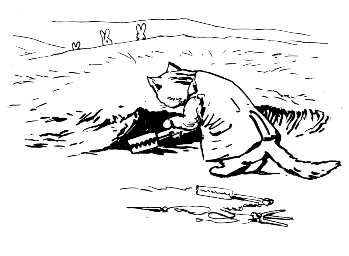
It is a small, honest glimpse of the working artist. She knew her readers wanted animals in clothes, and she gave them what they wanted, even when she thought the plain fur was prettier.
When the Shop Closes
The closing of the shop is the real engine of the book, and Beatrix follows it through to its effects. Ginger and Pickles give endless credit, take in no money, and at last cannot pay their own rates, taxes, and dog licence. So they shut up shop. The village feels it. With the friendly shop gone, the other traders raise their prices, and life becomes harder for everyone. Only when a new shopkeeper opens up — Sally Henny Penny, with a brisk "shop, shop, shop" — does ordinary village life return.
It is a gentle lesson in how a small place hangs together. A shop is not just a business; it is part of how neighbours live. Beatrix understood that, and she let the book carry it lightly, under the comedy of a cat and a dog who are simply too soft-hearted to ask for payment.
She kept an eye on the small practical details to the end. For the American edition, the prices had to be changed from shillings and pence into dollars and cents. "I suppose Mr. Leadbeater will edit the American text," she wrote; "he will no doubt change the coinage." She even wondered, drily, whether "they require dog licences in America." The back room of the real shop, where the two shopkeepers settle their accounts in the story, had old meat-hooks in the ceiling; they were still there decades later, and the arch in the passage can still be picked out today.
The Dedication to Old John Taylor
The most touching thing about the book is its dedication, and the story behind it.
John Taylor, who owned the real shop, was the village joiner and wheelwright. By this time he was bedridden — "failed in his legs," as Beatrix put it — but he was still the head of his family, and his wife and stout daughter Agnes Anne kept the shop going. He was a humorous old man. When Beatrix put his son John into an earlier book as John Joiner, old John professed to be jealous. She teased him: how was she to fit him into a book when he would not leave his bed? A week later, tucked in with a shop account, came a scrap of paper: "John Taylor's compliments and thinks he might pass for a dormouse."
So she made him a dormouse. The book is dedicated "to old Mr. John Taylor, who 'Thinks he might pass as a Dormouse' (Three years in bed and never a grumble!)." She wrote to Harold Warne about it with real feeling: "In a way—it ought to be Louie's book, but she can look forward; I sometimes think poor old John Taylor is keeping alive to see this one printed."
He did not quite. He was given up that September and rallied briefly — "now extremely lively smoking his pipe in bed," she wrote, asking that a copy be saved for him — but he died before the printed book arrived. The dedication stands as she meant it: a small monument to a kind old man and his village shop, set down in a book that everyone in Near Sawrey could recognise.
Read It in Full
That's how it was made. Now read The Tale of Ginger and Pickles itself, in the Complete Tales. Open The Tale of Ginger and Pickles →
Sources
The facts in this article are drawn chiefly from Leslie Linder, A History of the Writings of Beatrix Potter, and Linda Lear, Beatrix Potter: A Life in Nature, cross-checked against Judy Taylor's edition of Beatrix Potter's Letters to Children. The dedication, the John Taylor story, and the village reactions are from Beatrix Potter's letters as recorded by Linder. The history is theirs to record; the words here are our own.
Leave a Visiting Card
Consulting the visiting cards...