
The Tale of Timmy Tiptoes is the least English of all Beatrix Potter's books. Its animals are American. There is a grey squirrel, a chipmunk, and a black bear — creatures her readers in the Lake District would never have met. She drew them not from her own fields but from the zoo and from reference books. The result feels different from her other tales, and that difference is the whole point.
She made it, in large part, for her American readers. By 1911 Beatrix had a devoted following across the Atlantic, and Timmy Tiptoes was her way of writing toward them. The book is a small record of a transatlantic relationship that mattered to her career.
Animals from Across the Atlantic
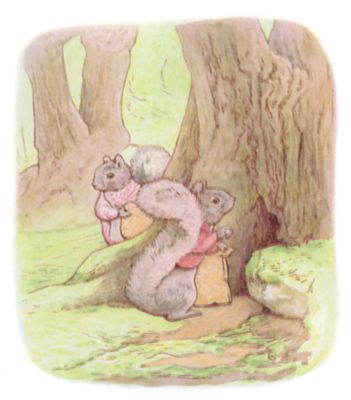
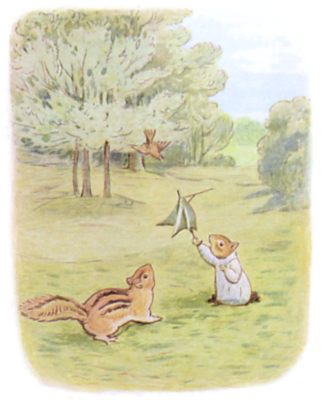
The cast gives the game away. Timmy Tiptoes and his wife Goody are grey squirrels. Their companion is a chipmunk named Chippy Hackee. There is a bear. None of these were familiar British animals.
The grey squirrel was, in fact, an American import — only beginning to appear in Britain at the turn of the century. The chipmunk and the black bear were purely American. To an English child these were exotic creatures. To an American child they were the animals of the back garden and the woods.
Linder is direct about why she chose them: "It is believed that The Tale of Timmy Tiptoes was written primarily for American children because they would be familiar with both chipmunks and bears." Beatrix was picking animals her American readers would recognise instantly — and that her British readers would find strange and new.
Writing Toward America
By this point Beatrix had a large American audience, and she knew it. Among her admirers were American children's librarians, an influential group who recommended her books widely. Her tales were read and loved across the United States.
Her biographer Linda Lear sets out the mix of reasons behind the book plainly. Beatrix made it "to satisfy demand from Warne's for another book, for the money, and to court her growing American audience." All three pressures were real. Her publisher wanted a new title each year. She needed the income. And she had a vast readership in America that she wanted to reach with something made for them.
She felt the reach of it. "I think I have little friends all over the world," she wrote around this time. Timmy Tiptoes was an attempt to write directly to some of them — to put American animals into an English picture book and send it back across the sea.
Drawn from the Zoo, Not the Field
Beatrix almost always drew from life. With Timmy Tiptoes she could not. She had no chipmunk in her garden and no bear on her fells. So for once she worked from substitutes — squirrels at the zoo, and the books and specimens she could consult at the Natural History Museum.
She studied hard, as always. Her notes survive. On the chipmunk she wrote: "According to 'American animals' the chipmunks dig out the sand from a back entrance, and then open a clean small hole from their burrow on to smooth grass scarcely noticeable." On the bear: "Intended to represent the American black bear, it has a smooth coat, like a sealskin coat." She wanted the natural history right even when she could not observe it herself.
There was a real model behind one character. Years later she explained: "Chippy Hackee belonged to a cousin, I drew the bear at the Zoo." So the chipmunk came from a relative's pet, and the bear from a zoo enclosure.
Even so, the drawings feel slightly different from her usual work. Lear notes that because these animals were not drawn from nature, "their images have a certain artificiality" — they look, she says, "more like 'stuffed animals'" than living ones, especially in the face. It is the difference between an animal Beatrix had watched for hours and one she had only studied secondhand. The care is there; the intimacy is not quite.
→ Read The Tale of Timmy Tiptoes
The Story
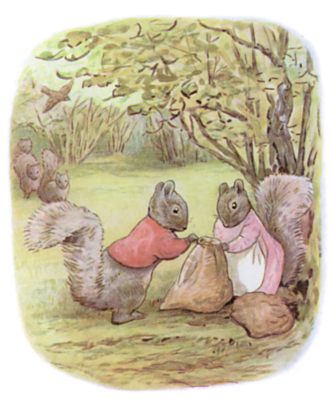
The plot turns on a misunderstanding. Timmy Tiptoes and Goody are careful, hard-working squirrels who store their nuts away for winter. But the songs of the little birds are mistaken for accusations — the other squirrels come to believe Timmy has been stealing nuts.
They set on him and push him through a woodpecker's hole into a hollow tree, meaning to trap him. The hollow tree turns out to be his own storehouse, full of nuts. Inside he finds Chippy Hackee, a chipmunk who has run away from his own wife and is hiding out. The two of them feast together in comfort — until Timmy grows so fat on the stored nuts that he can no longer fit through the hole to get out.
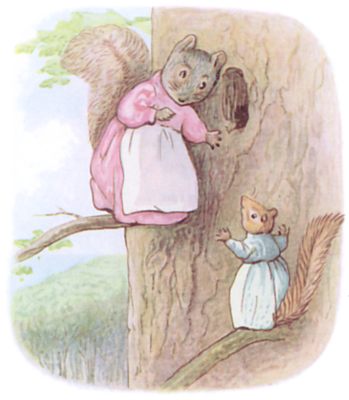
A storm finally rescues him. The top of the tree blows off, and the way is open. Timmy and Goody are reunited and go home, and this time they fasten their nut-store with a little padlock. Beatrix gave the singing squirrels a nice touch of comedy: "a fat squirrel voice and a thin squirrel voice were singing together."
Nuts, Birdsong, and Spelling
The making of the book shows her usual exactness, even with animals she had to study at a distance. When she sent the finished pictures to her publisher, she fretted over the small things. "I am sending 12 drawings," she wrote. "I have compressed the words in the earlier pages; but it seems unavoidable to have a good deal of nuts." The squirrels' whole world is nuts — storing them, hiding them, quarrelling over them — and she worried the word would crowd the page.
She worried about the birdsong too. The little birds in the story sing in nonsense syllables, and the comedy depends on how those syllables look in print. "The songs of the little birds will be easier to judge as to spelling," she wrote, "when one sees it in type." She was thinking about the shape of made-up words on a page — the kind of care that runs through all her work, here applied to an American wood she had never seen.
Behind the book lay a relationship she valued. Her American readers were many and devoted, and some of the most influential were children's librarians, a powerful force in deciding which books reached American children. They championed her tales. Writing a book stocked with American animals was, in part, a way of writing back to them — a gift across the ocean to readers who had taken her to heart. Her publisher, meanwhile, simply wanted another title to sell each year, and Timmy Tiptoes met that demand while reaching toward a new audience at the same time.
A Year of Difficulty
Timmy Tiptoes came out of a hard stretch in Beatrix's life, and that shows in how few books she was managing. At the start of 1911 she wrote: "I did not succeed in finishing more than one book last year... I find it very difficult lately to get the drawings done. I do not seem to be able to go into the country for a long enough time to do a sufficient amount of sketching... It is awkward with old people, especially in winter, it is not very fit to leave them."
She was caring for her ageing parents, and it cut into the time she had for her own work. The steady yearly output of her best years was slowing. Timmy Tiptoes was made in stolen hours, with the animals studied at a museum rather than at home.
She dedicated it oddly — "For many unknown little friends, including Monica." Monica was a child she had never met, the schoolfriend of a young cousin, who had asked for the honour. Beatrix agreed because, she said, "the name took my fancy." It is a fitting dedication for this particular book: a gesture toward all the unknown children, including the many across the ocean, who read her without her ever seeing their faces.
She was aware, too, of an old favourite left out. Of Louie Warne, the publisher's daughter who had inspired earlier books, she wrote: "I think Louie is rather ill used in not having had her name on a book; but she has got too big for these little books now." The children who had shaped her work were growing up. The audience she was now reaching toward was larger, more distant, and increasingly American.
Read It in Full
That's how it was made. Now read The Tale of Timmy Tiptoes itself, in the Complete Tales. Open The Tale of Timmy Tiptoes →
Sources
The facts in this article are drawn chiefly from Leslie Linder, A History of the Writings of Beatrix Potter, and Linda Lear, Beatrix Potter: A Life in Nature, cross-checked against Judy Taylor's edition of Beatrix Potter's Letters to Children. The American-audience motive is set out by Linder and Lear; the remark about Chippy Hackee and the bear is from Beatrix Potter's own letter. The history is theirs to record; the words here are our own.
Leave a Visiting Card
Consulting the visiting cards...