Cecily Parsley's Nursery Rhymes was the last of Beatrix Potter's little books. After it, the famous series that had begun with Peter Rabbit two decades earlier came to a quiet close. It is a book of nursery rhymes, gentle and short, and it was made — fittingly — from her very oldest drawings. To turn its pages is to reach the end of one of the great runs in children's publishing.
It came out at Christmas 1922. By then Beatrix was far more a Lake District farmer than an author, her eyesight was weakening, and she felt she had earned a rest. This small book is the sound of a door closing softly on her years as an illustrator.
Made from the Oldest Drawings
If Appley Dapply, its companion volume, was built from old work, Cecily Parsley reached back even further. Linder notes that "the rhymes and pictures used for this book have even earlier associations than those for Appley Dapply." Some of it was nearly thirty years old.
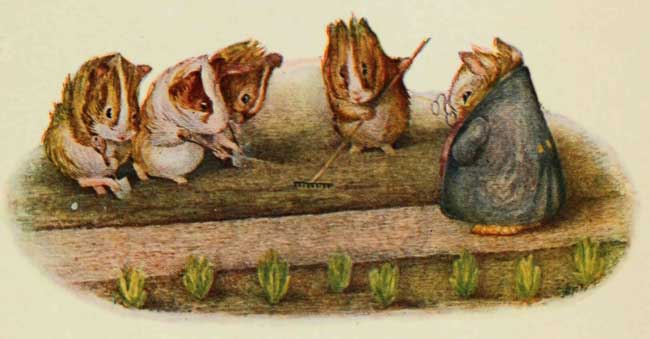
The paintings of guinea-pigs in their garden — for the rhyme "We have a little garden, a garden of our own" — date from 1893. One is inscribed in her own hand, "H.B.P. Jan. 93." The title rhyme itself, about Cecily Parsley, she had illustrated as a small booklet back in January 1897. Of Cecily she wrote: "I never met Cecily in print... it is an old rhyme; there is another version in Halliwell's Nursery Rhymes." The closing rhyme, "Ninny Nanny Netticoat," went back even further in feeling. It is an old riddle whose answer is a candle, and she had dated a manuscript of it in 1897.
So the book is a kind of gathering-up. Late in life, Beatrix went back to the drawings of her twenties and her thirties and pieced them together into one last volume. "I found time, somehow," she wrote, "to collect some old drawings and piece them together with some additions for a little book of nursery rhymes." She chose eight rhymes in all from her old collection.
"I Have Earned a Holiday"
By the early 1920s Beatrix did not much want to make books any more, and she said so plainly.
People kept asking her for more. Her answer was weary and honest: "People worry me for just one or two more books, but my eyes are getting weak and I am tired of doing them... and since the war there is so much to do... I have a big farm as well as my housekeeping; so I seldom sit down except to meals and necessary letters." She had given the better part of twenty years to the little books. She put it simply: "I have done about 30 books, so I have earned a holiday."
The farm now came first. Her days were full of sheep and land and household work, not drawing. The close, patient illustration that the little books demanded was getting harder for her eyes and harder to find time for. Cecily Parsley was assembled in stolen moments — "I would have got these done this week," she wrote one spring, "but I am plagued with visitors and poultry, and a bad drought!"
The book itself nearly did not happen. When she first proposed pulling the old rhymes together, around 1920, her publisher Fruing Warne was unenthusiastic and doubted they would sell. The project only revived after an American children's librarian, Anne Carroll Moore, visited and was delighted by the drawings. Her encouragement helped bring the last little book into being.
The Rhymes Inside
The book gathers eight rhymes, and they reach back across her whole life. The title rhyme tells of Cecily Parsley, who kept an inn and brewed for her guests. There is the old riddle "Ninny Nanny Netticoat," whose answer is a candle. That verse was rooted in the candlelit nursery teas of Beatrix's own childhood. They were presided over by a figure the children called Nanny Nettycoat — "that little old lady with white woollen stockings, black velvet slippers and a mob-cap." There is "Three Blind Mice" too, and the guinea-pigs in their garden, and other small traditional verses.
→ Read Cecily Parsley's Nursery Rhymes
Some of the rhymes she had hunted out herself, years before. In 1900 she went to the Reading Room of the British Museum to study an old book of them. "I went to the Reading Room at the British Museum this morning to see a delightful old book of rhymes," she wrote; "I shall draw pictures of some of them whether they are printed or not." That is how she worked — treating old nursery rhymes as seriously as she treated fungi or field mice, going to a library to get them right.
The guinea-pig garden rhyme — "We have a little garden, a garden of our own" — had a homely origin. The lines were partly the work of a visitor to Hill Top, Louie Choyce, and the bluebell wood in the pictures was a real one, "up Stoney Lane behind this house." Even in her last little book, made from her oldest drawings, the real places around her farm kept finding their way onto the page.
Small Battles Over the Rhymes
Even this gentle book had its editorial scuffles, and they show Beatrix still defending her work to the end.
Her editor wanted to soften the rhyme "Three Blind Mice" by cutting the line about the farmer's wife cutting off their tails. Beatrix first agreed, then changed her mind and insisted the line be put back — the rhyme felt incomplete to her without it. She knew that children do not want their old rhymes tidied up.
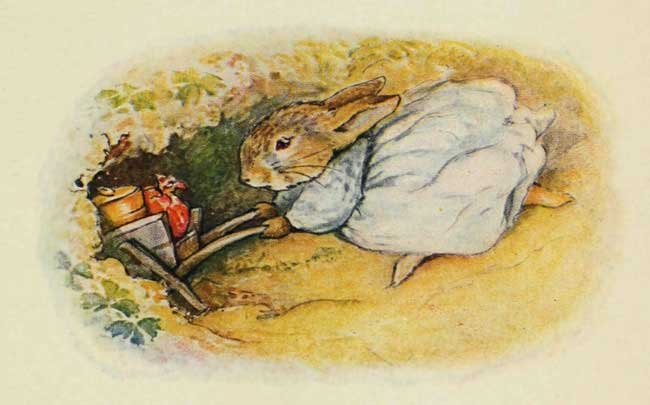
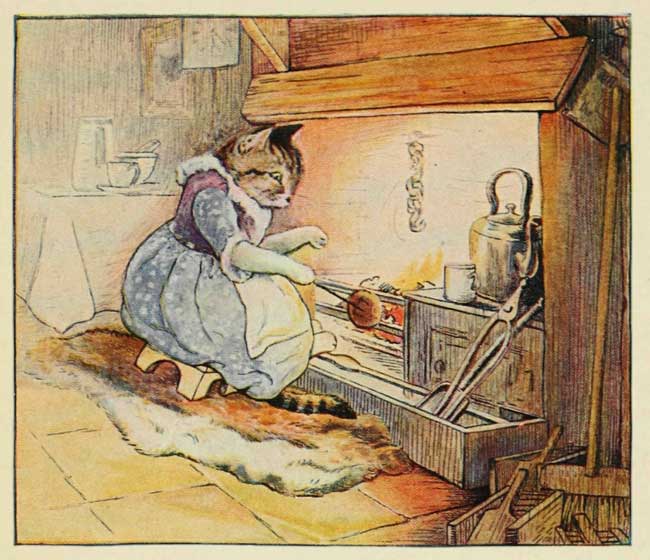
There was a funnier disagreement over the title picture. Beatrix had originally drawn Cecily Parsley brewing ale — "Cecily Parsley brewed good ale for gentlemen," as the old rhyme has it. Fruing Warne, apparently not noticing that ale is alcoholic, had her change the drink to cowslip wine. There was also a fuss about the cover. One drawing of a rabbit with a tray was judged too similar to the Appley Dapply cover. So it was demoted to a faint outline on the title page, and a picture of Cecily Parsley running off with a wheelbarrow became the cover instead. Beatrix had her own quiet view of the inn scenes: "I have never been able to imagine dressed up rabbits coming to the inn door; it comes to my mind's eye deserted!"
A Dedication, and an Ending
The book carries a tender dedication: "For little Peter of New Zealand." The child was Peter Tuckey, an orphan on the far side of the world. His father had been killed in France in the war, and his mother had died in the influenza epidemic of 1918 while nursing the sick. Beatrix, who had lost her own brother in 1918, sent her last little book across the oceans to a boy who had lost everything.
She was pleased with the finished volume. She had, she said, "always wanted Cecily Parsley's Nursery Rhymes as a companion volume to Appley Dapply," and now the pair were complete.
An era closed with it. Cecily Parsley ended the long series of small books that had started with The Tale of Peter Rabbit in 1902. After it, Beatrix turned to other things — longer, looser works written more for her own pleasure, and above all the farm and the fells she now loved more than drawing. The steady stream of little books was over.
There is something right in how it ended. The series that began with a young woman's pictures of a rabbit closed with that same woman, grown old and tired and content, reaching back into her drawers for the oldest drawings she had and binding them into one last small, sweet book. She had earned her holiday. Cecily Parsley let her take it.
Read It in Full
That's how it was made. Now read Cecily Parsley's Nursery Rhymes itself, in the Complete Tales. Open Cecily Parsley's Nursery Rhymes →
Sources
The facts in this article are drawn chiefly from Leslie Linder, A History of the Writings of Beatrix Potter, and Linda Lear, Beatrix Potter: A Life in Nature, cross-checked against Judy Taylor's edition of Beatrix Potter's Letters to Children. The dating of the old drawings, the editorial disputes, and Beatrix Potter's own weary letters are recorded by Linder and Lear. The history is theirs to record; the words here are our own.
Leave a Visiting Card
Consulting the visiting cards...