
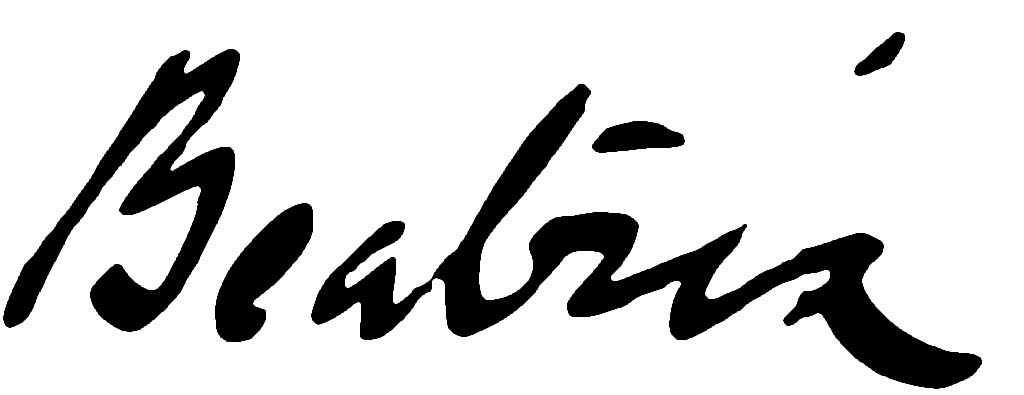
Nobody calls them the 450. The collection is known, informally, as "the 300" — but that number was always an undercount. The works now held at the Armitt Museum in Ambleside and at the Victoria and Albert Museum in London number well over 450 individual studies. They were made across roughly a decade, from 1887 to around 1898. Lear calls them among the most precise natural history watercolours produced by any British artist in the nineteenth century. And they were made by a young woman with no access to a laboratory, working from rented rooms and borrowed time.
She was not famous when she made them. The Peter Rabbit books were still years away. What she was, in those years, was a scientist looking for a discipline to belong to.
Two Kinds of Seeing
Beatrix Potter began painting fungi around 1887. At first the paintings were beautiful without being especially systematic. They recorded colour and form with the care of someone who had grown up in an artistic household and spent long summers in the Lake District and Scotland absorbing what she saw. But they were, at that stage, primarily the work of a natural history painter — faithful to appearance, not to structure.
That began to change with a meeting in October 1892.
The Potters had come to Birnam, near Dunkeld in Perthshire, for the summer. Beatrix had been trying all summer to gain an interview with Charlie McIntosh — the local postman, a self-taught mycologist, and the most knowledgeable observer of fungi in that part of Scotland. In late October, an intermediary arranged for McIntosh to call at Heath Park, the family's rented house, on the pretext of retrieving a book of dried ferns he had lent her. When they finally met, they talked for an hour and a half.
McIntosh looked at her paintings and told her, in his exacting way, what they were missing. She needed sections. Not just the cap and stem from the outside, but a cut-through view showing the interior, the gill attachment, whether the stem was hollow or solid. Without that information, a painting could identify the colour. It could not reliably identify the species.
Beatrix went back to her room and started again.
The shift in her paintings after 1892 is visible to anyone who looks. Earlier work tends toward single, upright specimens, elegantly posed. After McIntosh, she began cutting fungi open and painting what was inside. She added microscopic detail. She showed gill plates in close-up. She recorded whether the cap was sticky or dry, whether the veil had broken, how the spores were arranged. Between 1894 and 1895 she made seventy-three fungi drawings. Lear notes that she was incorporating McIntosh's suggestions and, in the process, becoming more attentive to the role of spores in reproduction. That question would drive her work for the next three years.
What the Paintings Look Like
Her Fly Agaric studies — Amanita muscaria, the iconic red cap with white spots — are among the most admired in the collection. Where most illustrations show the specimen from a standard angle, cap facing up and stem clean and vertical, her work places the fungus in its actual habitat: among leaf litter, fern, and bark. The painting is ecological as well as botanical. It tells you what the fungus lives among, not just what it looks like alone on a white page.
The Lepiota procera — the Parasol Mushroom — prompted close attention of the kind she brought to all her subjects. The scales of a mature Parasol cap break apart in a distinctive way. She recorded the texture with precision.
Then there is Coprinus comatus, the Shaggy Ink Cap, with its white cylindrical cap that dissolves into black inky fluid as it matures. She painted it at different stages, showing the autodigestion — the process by which the cap destroys itself to release spores. It is one of the stranger things a fungus does, and she recorded it accurately.
The Rare Find at Dunkeld
During the 1893 stay at Eastwood she found a fungus in the grounds that she could not immediately identify. It was dark, rough, and shaggy: Strobilomyces strobilaceus, known as the Old Man of the Woods. It is among the least common fungi in Britain. The specimen had previously been recorded in Scotland only once, at Drummond Wood in Crieff in 1889. Beatrix found it fresh on 3 September and painted it in situ. McIntosh sent the specimen off for further verification and the identification was confirmed. She made a detailed painting — at least one of which she gave to McIntosh so he would know where in the garden to look again.
This was not the only case where her records proved significant. Among her studies of Aleurodiscus amorphus — a crust fungus that grows on bark — she included small blobs on the surface of the fruiting bodies. She did not know what they were. She painted them because they were there.
According to some accounts, modern mycologists examining the collection identified those blobs as Tremella simplex, a parasitic fungus that grows on other fungi, and her painting may represent the earliest known British record of the species — described in the scientific literature decades later. She recorded something she could not have named, and the record survived.
McIntosh and the Standard She Set Herself
McIntosh was not an easy correspondent. He was exacting. He did not flatter. When a painting was insufficient, he said so. When a sectional view was missing, he asked for it. Lear describes his effect as giving Beatrix "the professional validation she longed for" — but that phrase perhaps understates how technical the exchange was. He wasn't approving of her work. He was teaching her to do something harder than she had been doing before.
She responded not by resisting but by raising her standard. She began making drawings of spore germination stages — around 70 in total — that formed part of her later scientific work. She looked at spores under magnification and drew what she saw. She was no longer painting fungi for the pleasure of the subject. She was building a record.
The Collection Now
The paintings are split between two institutions. The Armitt Museum and Library in Ambleside holds a significant portion of the collection. The Victoria and Albert Museum in London holds others as part of the Linder Bequest — the collection assembled by Leslie Linder, who spent decades acquiring Beatrix Potter material and donated it to the nation.
The V&A holdings include the most-studied individual works, including the Fly Agaric study. The Armitt collection is less visited. But it is no smaller in importance. Together, the two holdings sit in an uncomfortable gap between scientific illustration and fine art — belonging fully to neither, more valuable than either alone.
Scientists and mycologists do consult them. Not as curiosities, but as data. The Tremella simplex record and the Strobilomyces find are not the only cases where her paintings have contributed to the understanding of British fungal distribution. In a field where historical records are sparse, a careful and dated painting can function as a specimen record. Beatrix's work, made with the rigour McIntosh insisted on, meets that standard.
Why They Still Matter
The paintings are not famous in the way the Peter Rabbit illustrations are famous. They are not on nursery walls. Most visitors to Beatrix Potter's world have never seen them.
That is partly because they have been treated as a scientific detour — a preoccupation she left behind when she turned to children's books. But the paintings tell a different story.
She was asking the right questions. She was getting the right answers. Working alone, without a laboratory, without institutional support, in the years before women could attend scientific meetings in their own right — she produced work that scientists came back to a century later and found still useful.
That is a remarkable thing to have done.
Sources
Linda Lear, Beatrix Potter: A Life in Nature (Allen Lane, 2007)
The Journal of Beatrix Potter 1881–1897, transcribed by Leslie Linder (Frederick Warne, 1966)
Judy Taylor (ed.), Beatrix Potter's Letters (Frederick Warne, 1989)
Armitt Museum and Library, Ambleside
Leave a Visiting Card
Consulting the visiting cards...