
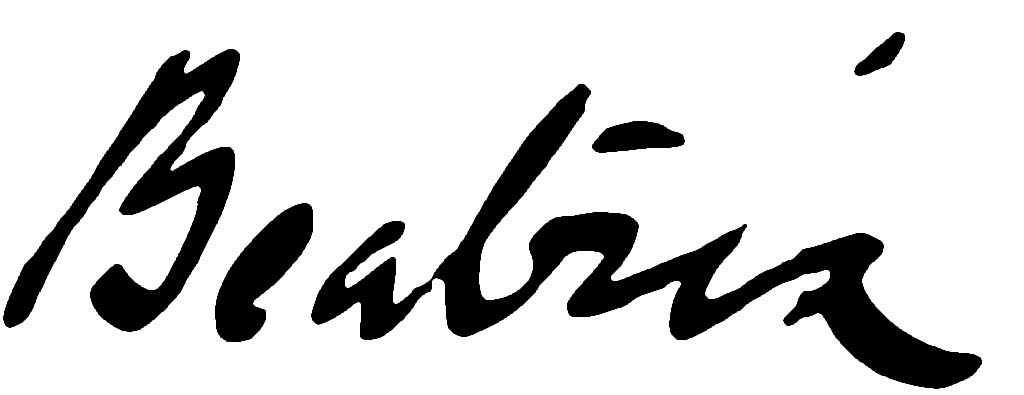
Beatrix Potter did not set out to save the Lake District. She became a conservationist slowly, almost by accident, over nearly twenty years. It began in 1905, when she bought one small farm because she loved it. It turned, in the summer of 1923, when she bought a huge one for a very different reason — to stop developers from building on it. Somewhere between those two purchases, a farmer became a guardian.
This is the story of that change. Not the land she bought or the fortune she left — those come later — but the quieter thing: when, and why, she started to see the saving of the countryside as her real work.
She Started as a Farmer, Not a Saviour
In the autumn of 1905, Beatrix bought Hill Top, a small working farm of thirty-four acres in the village of Sawrey. It was her first big independent purchase, bought largely from her own earnings — the money her little books had made.
That money mattered for more than the price. Beatrix was nearly forty and still living under her parents' roof in London, as unmarried Victorian daughters were expected to. A farm of her own, paid for with money she had earned herself, was a quiet act of freedom. It was hers, and no one could tell her what to do with it.
There was no grand plan behind it. She was not trying to protect a landscape or make a point. She simply wanted a foothold in the country she had loved since childhood. Her neighbours treated the whole thing as a joke — a London lady playing at farms, walking her fields with a tape measure. She even paid too much, and only found out later.
None of that dimmed her joy. For the first time she owned a piece of the Lakes outright. At this stage she was a landowner and a delighted amateur farmer. The conservationist was still years away.
Farming Changed How She Saw the Land
What changed her was the farming itself.
Owning Hill Top was not a hobby for long. Beatrix threw herself into it — the sheep, the crops, the buildings, the rhythm of the seasons. After she married the local solicitor William Heelis in 1913 and settled nearby, she became something rarer than a writer with a country house. She became a real fell farmer, accepted, in time, by the practical, no-nonsense people who farmed beside her.
The change in her was gradual, and it ran deep. The books that had made her famous slowly took second place. Year by year, the writer gave way to the farmer. She learned the work from the inside — not as a reader of the countryside, but as someone who got up in the dark for the lambing and worried about the price of wool.
And a farmer sees the land differently from a visitor. She saw how fragile the old hill farms really were. She saw how easily a valley could slip away — a farm sold off, broken up, its sheep scattered, its fields turned into plots for holiday cottages. She saw, up close, the very pressures that were eating at the Lakes from every side. To a tourist these were distant worries. To a farmer they were the talk of every market day.
This is not to say she had done nothing for the cause before. As far back as 1911 she had joined the protest against the seaplanes on Windermere, and over the years she gave quietly — and usually anonymously — to the National Trust's appeals. But those were supporting roles: lending her name, her pen, and her purse to battles that other people led. What was about to change was the scale of it, and whose hands held the land at the end.
She also saw what would be lost if it went. Not just scenery, but a whole way of life: the farms, the flocks, the customs, the people. The more she farmed, the more she understood that this world would not protect itself.
The Turning Point: Troutbeck Park, 1923
The change became real in the summer of 1923.
A large, run-down sheep farm called Troutbeck Park came up for sale — a magnificent place of nearly two thousand acres at the head of its valley, one of the biggest farms in the Lake District. Beatrix had loved it for years. She had walked its great Tongue of high ground since her first visits to Windermere, hunting for fossils, sheltering from the rain, listening to the wind.
Then she learned who else wanted it. Developers were ready to buy Troutbeck Park and build holiday houses across its valley bottom. The place she loved was about to become exactly the kind of thing she had watched ruin other valleys.
So she bought it — outbidding them to do it. And that is the moment everything turns. Hill Top, in 1905, she had bought for herself. Troutbeck Park, in 1923, she bought to save it. For the first time, she was using her money not just to own a beautiful place, but to keep it out of the wrong hands. That is what a conservationist does.
It was no coincidence. Canon Rawnsley's long campaign to protect the culture of fell farming had shaped her thinking for years. Now she was acting on it, in the most direct way possible — with a chequebook and a deed.
And once she had done it once, the logic was hard to set aside. If buying Troutbeck Park had saved one valley from the builders, then the same move could save others. A purchase was no longer just a purchase. It was a tool — perhaps the only tool that really worked. Where Rawnsley had spent his life persuading and protesting, Beatrix had found she could simply buy the danger away.
What She Was Really Trying to Save
It would be easy to think she was simply rescuing a pretty view. She was after something deeper.
A year after buying Troutbeck Park, Beatrix became one of the very few women in the association of Herdwick sheep breeders. That tells you what she valued. The Herdwicks — the tough little grey sheep bred to live on the high fells — were not just livestock to her. They were part of an ancient, fragile system: the hefted flocks, the shepherds, the dialect, the dry-stone walls, the whole inherited craft of farming hard country.
Save the farms, and you saved the sheep. Save the sheep, and you saved the people and the customs that went with them. Lose any one part, and the rest would unravel. Beatrix had grasped something that conservation would take decades to catch up with: that a landscape is not just rock and grass. It is the work of the people who live on it.
This was an unusual thing to understand in the 1920s. Most people who wanted to protect beautiful country thought of it as scenery — something to look at, to keep tidy and unspoilt. Beatrix knew better, because she did the work herself. A fell kept its beauty only as long as someone was up there farming it properly. Empty the valleys of farmers, and the landscape everyone loved would quietly fall apart.
So her aim was never to fence the Lakes off and freeze them like a picture. It was to keep them working — farmed the old way, by people who knew how. Preservation, to her, meant keeping a living thing alive, not pinning a dead one to a board.
How She Became a Conservationist
After Troutbeck Park, the writer of children's books had almost completely disappeared. Her energy went into farming, breeding sheep, and protecting land. She had become a steward — someone who holds a place in trust for those who come after.
She did not announce the change. There was no speech, no manifesto. It showed in what she did with her time and her money. Each year she thought less like an owner and more like a guardian, asking not "what is mine?" but "what can be kept?"
Consider how unlikely all this was. The shy London girl who had drawn rabbits in a nursery had become a fell farmer, a sheep breeder, and a buyer of mountains. The same care she had once given to a small painting she now gave to a whole landscape. It was the second great work of her life, and in the end the larger one.
That question would shape the rest of her life. Having decided that saving the land was her work, the next thing she needed was a method — a way to find the threatened places, buy them, and make sure they stayed safe long after she was gone.
That is where her real campaign begins.
Sources
The facts in this article are drawn chiefly from Linda Lear's biography Beatrix Potter: A Life in Nature, cross-checked against Beatrix Potter's own letters. The history is theirs to record; the words here are our own.
Leave a Visiting Card
Consulting the visiting cards...