
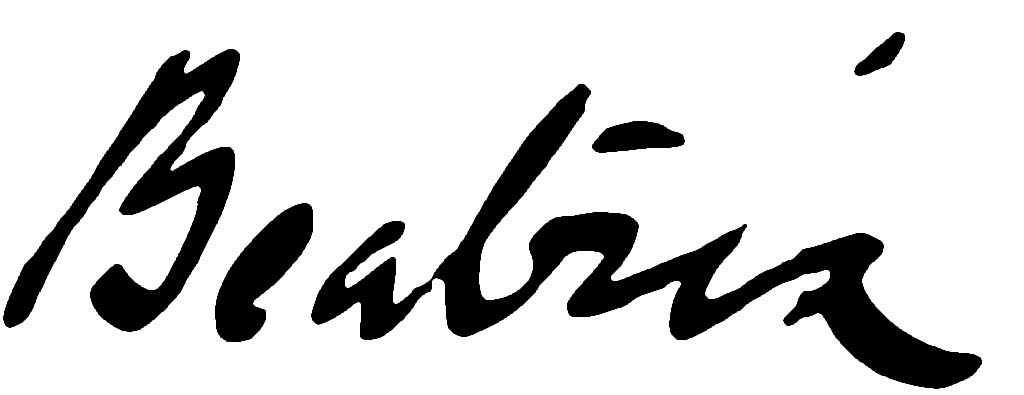
A fell farm in the Lake District ran by a calendar that no printed almanac could quite capture. The seasons set the rhythm, but the weather and the sheep set the pace. Some years lambing came early; some years a late snow undid a month of careful preparation. But the broad shape of the year was fixed, and every shepherd and fell farmer knew it by heart.
What follows is that year — the tasks, the rhythm, and the urgency of each season on a working Herdwick farm in the early twentieth century. Beatrix Potter's farms in Near Sawrey and Troutbeck Park are the illustration, but the calendar itself belonged to every fell farmer in the Lakes.
November: The Tups Go Out
The farming year, if it can be said to begin anywhere, begins in November. That is when the tups — the rams — are put to the ewes.
Tom Storey, Beatrix Potter's shepherd, described the November work at Troutbeck Park Farm in simple terms: "I put rams on to a thousand breeding ewes and I lambed them the following spring." A thousand breeding ewes at one farm. The rams went out in November, and the lambing count began from there. Storey marked his lambs by putting "a red pop on the hook" — the point of the thigh bone. The mark showed they were from Troutbeck Park.
The shepherd wrote to the lambing man in early April, telling him exactly when the tups had been put to the ewes. From that date, the roughly five-month gestation could be calculated, and the lambing date set. Everything ran from November.
Winter: Dark Months and Moving Sheep
Between tupping and lambing came the long, cold months. The fells in winter could be brutal. Snowstorms and hard frost were a constant anxiety for anyone with sheep on open ground.
The traditional answer to a severe winter was old and practical. Fell farmers kept crop ash and holly trees near the farmhouses. When the snow was deep and the grass buried, branches were cut and carried to the sheep. In the farmsteads, the hay made in summer — stored in the big barns throughout the autumn — became the farm's lifeline. Hill Top Farm, with about forty acres of meadow, mowed that hay each summer with a double-horse machine, then dried it in wind and sun. That hay was the sheep's winter ration.
Young sheep — the hoggs, as last year's lambs were called — were often moved off the high ground altogether. At Troutbeck Park, Anthony Benson, the shepherd, drove them down in two trips to lower winter grazings at Coniston and Tarn Hows. About 600 sheep in all, taken off the high fell before the worst weather. "The hoggs went on to Birker Moor," Benson recalled. In April, they were walked back up — a day's journey or more, stopping overnight at a friendly farmstead along the road.
April and May: Lambing
In early April the lambing man arrived. At Troutbeck Park, Beatrix employed Joseph Moscrop — a skilled shepherd from the north of Cumberland — every spring for seventeen years. She wrote to engage him each February, telling him the tupping date and confirming when she needed him. She included a postal order for half his fare.
Lambing on a fell farm was not a daylight occupation. It ran night and day, from early morning until last light, and then beyond it. A bad season was very bad. In a wet spring of 1917, Beatrix wrote to her publisher: "We have a wild day here — all day wet lambs before the fire — the third dead since breakfast has just expired! There is not an atom of grass & the hill flocks must be in a pitiable state."
The lambs that came in good weather were straightforward. The ones that came in cold rain were the measure of a shepherd. A chilled lamb could be brought back with warmth and a drop of gin on the tongue — a remedy Beatrix's shepherd Joe Moscrop used on many a cold night, speaking softly to the lamb and his dog alike.
The total gathered at Troutbeck in the spring of 1927, after Tom Storey had cleared the liver fluke and restored the flock to health, was a thousand lambs marked. It was the first good lambing in years, and Beatrix was relieved.
June and July: Clipping and Haymaking
The work of June and July was double. The sheep needed to be gathered from the fell and clipped. The meadow needed to be mown and dried for hay. Both had to happen in the same weeks of high summer.
The clip at Troutbeck Park was a large operation. Anthony Benson recalled that it covered between 2,000 and 3,000 sheep — all Herdwicks — and that it took a fortnight or three weeks. "I've seen us sit down of a morning at seven o'clock and clip, then get up and have our dinners, and back and sit down again, and clip till six o'clock." Four people clipping, all day, for weeks. "We fed well," he said, with satisfaction.
Before the sheep could be clipped, they had to be gathered from the high fell. At Troutbeck, the high grazing stretched as far as High Street — one of the highest fells in the Lake District. It took seven hours just to bring the sheep down.
Haymaking ran alongside. At Hill Top, with forty acres of meadow, the hay was cut in summer using a double-horse machine, then turned and dried before being stored in the large barn. The men who came for haytime were well fed and well watered. Beatrix, as was the custom, provided a barrel of ale.
August and September: The Shows
The sheep shows ran through August and September, when the clipped sheep were at their best and the harvest was done. The Herdwick show circuit ran through most of the fell farming valleys across the Lakes.
Show day was social as well as competitive. Flockmasters gathered from across the Lakes to walk the pens, talk sheep, and do quiet business. Tups were sometimes hired rather than sold — a hire charge of twenty-five to thirty shillings in the early 1960s. The arrangement kept blood fresh in the small self-contained fell populations without a permanent transfer of ownership.
The judging was serious. A good Herdwick needed a white hairy face, a broad nose, a strong back, and a fleece suited to turning the weather. Horns were thought less important. A first-prize card might go to an old tup with only stumps for horns, if the rest of the animal was right.
For Beatrix, the shows were more than a competition. They were a chance to study the breed at its best — to see what the high fell was producing, and to measure her own animals against it. In later years she was asked to judge, and took the role as seriously as she had taken competing.
The Autumn Sales
After the shows came the autumn sheep sales — the main commercial event of the year for most fell farmers. This was when store sheep (not yet fat) were sold for fattening on lowland farms, and when the year's trading was settled.
The sales could be good or very bad. In the early 1930s, in the depth of a worldwide agricultural depression, prices fell sharply. "The sheep sales have been bad this autumn, disastrous prices," she wrote to her American correspondent Bertha Mahony Miller. "I am fortunate in not having to pay rent, as I farm my own land. The tenant farmers are having a severe struggle."
After the autumn sales came the preparation for winter: making sure hay stores were adequate, moving the young sheep to their winter grazings, setting the tups ready for November.
And then the year began again.
The Unchanging Rhythm
What is striking about this calendar is how little it changed from decade to decade. The machinery improved. Horse-drawn mowers replaced the scythe. Motor lorries replaced the drover's road. But the essential rhythm of the year was fixed by the sheep and the seasons, not by fashion or convenience.
Tupping in November. Lambing in April. Clipping in June. Shows in August. Sales in the autumn. A shepherd who had worked the fells in 1880 would have recognised every stage of the year Beatrix Potter's shepherds were working in 1940. The calendar was the fell itself — as old as the Herdwick breed and as steady as the seasons.
Sources
The facts in this article are drawn from J. W. R. Mitchell's Beatrix Potter: Her Lakeland Years, which records the seasonal work of Tom Storey, Anthony Benson, and Joseph Moscrop in their own words, and from Linda Lear's biography Beatrix Potter: A Life in Nature, which covers the lambing seasons and farming year at Troutbeck Park and Hill Top in detail. Beatrix's own letter about wet lambing weather comes from Beatrix Potter's Americans: Selected Letters (edited by Jane Crowell Morse). The history is theirs to record; the words here are our own.
Leave a Visiting Card
Consulting the visiting cards...