
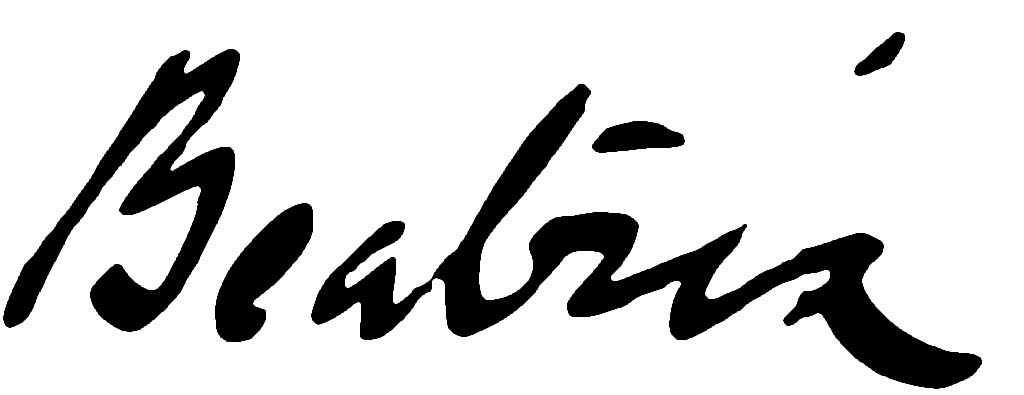
Wanting to save the Lake District was one thing. Actually buying it was another. Land does not protect itself, and good farms rarely come up for sale twice. So how Beatrix Potter bought land — and bought it before anyone else could — became a craft in its own right. She relied on her solicitor husband's inside knowledge. She moved fast and paid in cash. She bought whole estates and then sold part to the National Trust. And she worked discreetly, keeping the Trust's role out of her negotiations and shunning any public credit. It was less a hobby than a campaign, run like a business.
This is how that campaign worked.
The Lesson of Hill Top
Her method began with a mistake.
When Beatrix bought her first farm, Hill Top, in 1905, she paid nearly twice what the previous owner had paid — and only found out afterwards, when it was too late to argue. For a careful, businesslike woman, it stung. She took the lesson to heart. In future she would do her homework, learn the real value of a place, and have a good local solicitor at her side before she signed anything.
That lesson shaped everything that followed. She would never again be the naïve buyer paying over the odds. From then on she went into every purchase knowing the ground, the price, and the people — and with an expert beside her.
It also set the tone of how she worked. Beatrix approached land the way she had once approached her books and her merchandise: carefully, shrewdly, with an eye on the figures. She read deeds. She walked boundaries. She checked what a farm was really worth before she offered. The dreamy author of the nursery tales was, in business, as hard-headed as any of her Lancashire trading ancestors.
Her Secret Weapon: William Heelis
That expert became her husband.
William Heelis was a country solicitor in Hawkshead, and Beatrix married him in 1913. For her land-buying, he was perfect. He knew the law, he knew the valleys, and — most useful of all — he knew which properties were quietly coming up for sale, often before anyone else did. He had old connections to the local families and their estates. He could read a deed, handle a negotiation, and drive a hard bargain.
Again and again, it was William who brought her the tip that mattered. When the run-down Troutbeck Park came up in 1923, it was William who learned that developers were circling, ready to build holiday houses on it — and with his help Beatrix outbid them. He was not just her husband. He was her scout, her lawyer, and her negotiator, all in one.
His inside track could be remarkable. For years William had acted as the solicitor for the family that owned the huge Monk Coniston estate — so when that land finally came up for sale, no one understood it better, or knew sooner, than the Heelises. A connection like that was worth more than money. It meant Beatrix often heard about the most important sales while other buyers were still in the dark.
The two of them also balanced each other well. Beatrix was blunt and quick to decide; William was patient and tactful, an easygoing local man trusted by the old farming families. She supplied the will and the money. He supplied the law, the local standing, and the calm. Without him, she once as good as admitted, she could never have become the landowner she did.
Speed and Cash
Here was the heart of her advantage: she could act fast.
When a good property came up, the people who might want to save it — the National Trust, the Forestry Commission — were slow. They were committees. They had to hold meetings, launch appeals, and find the money before they could make an offer. By the time they were ready, a developer with cash in hand had often already bought the place.
Beatrix had no such problem. She had her own money, from her books and her investments, and she could decide in an afternoon. Where an institution needed months, she needed days. That speed, backed by ready cash, let her step in at the very moment a place was in danger and simply take it off the market before anyone else could. It was her single greatest weapon.
Buy the Whole, Then Share It
Her cleverest move was what she did after she bought.
The danger to the Lakes was rarely one building. It was the breaking-up of estates — a big farm sold off in pieces, each parcel going to a different buyer, the whole landscape slowly chopped into plots. Once an estate was scattered like that, it could never be put back together.
So Beatrix did the opposite. When the great Monk Coniston estate came up in 1930 — nearly four thousand acres of farms, cottages, woods, and open fell straddling two valleys — she made an offer for all of it, in one go. Buying the whole thing kept it whole.
Then she shared it out. The National Trust raised a public appeal and bought back about half from her — at cost, not for profit; she had said plainly she could not afford to simply give it away, because buying it meant selling off the investments she lived on. The other half she kept and managed for the time being, but it, too, was promised to the Trust, to pass to them in the end. She even handed over some parcels outright and anonymously. So while it took years to finish, the whole estate was being delivered to the nation, piece by piece — half bought back at once, the rest to follow. She kept none of it for herself.
It was an elegant solution. One quick, decisive buyer could rescue an entire estate in a single stroke — far better, as she put it, than letting it be picked apart. The Trust got land it could never have bought fast enough on its own. The valley stayed in one piece. And once it was done, the Trust even asked Beatrix to go on running the estate for them — which she did, for years, unpaid. She had carried the cost, the risk, and then the work, because she was the only one who could.
Out of the Limelight
There was a discreet quality to how she worked — though not in the way you might guess. Beatrix was famous, and her wealth was no secret; when she bought the Monk Coniston estate, the seller knew perfectly well it was Mrs Heelis he was dealing with. A sale that size could hardly be hidden.
What the seller did not know was that the National Trust was her silent partner. The plan to resell half the estate to the Trust was kept out of the negotiation entirely. As far as he was concerned, he was selling to a private buyer who wanted the whole thing for herself.
There was a plain reason for that. The Trust had no money ready and could not be a party to the deal. Beatrix had to commit to buy the entire estate herself, on her own credit, and only afterwards arrange for the Trust to raise an appeal and buy its half back. So she fronted the purchase alone — with William, who had once been the seller's own solicitor, handling the talks.
The deeper discretion was personal. Beatrix disliked being thanked. For years she had given to the Trust's appeals as an anonymous donor, and when she gave land outright she preferred her name left off it. On one occasion the Trust printed her name against a gift in its annual report by mistake, and it annoyed her no end. She wanted the places saved, not the credit.
And she could not lean on public sympathy in any case. Her family's wealth was so well known, she complained, that no one would subscribe to an appeal to help her — they assumed her rich mother could simply pay. Her mother would not give a penny. So Beatrix did it herself, with her own money and her own nerve.
Where the Money Came From
All of this depended on having money of her own — and that came, in the end, from Peter Rabbit.
The earnings from her little books, sold steadily for decades and increasingly popular in America, gave Beatrix something most women of her time never had: a private fortune she controlled herself. A legacy from an aunt had helped her buy Hill Top; the books did the rest. Her royalties were, as she put it, the mainstay of her income.
Buying land, though, meant putting that income at risk. To raise the cash for a big estate, she often had to sell off safe investments and replace a reliable income with the patchier returns of farm rents. She felt that risk keenly, and weighed every purchase against it. This was not careless spending. It was a woman backing her own judgement with her own savings, knowing exactly what each deal might cost her.
A Campaign, Not a Whim
Put it all together and a clear picture emerges. This was not a rich woman buying pretty fields on impulse. It was a planned, patient strategy: know the market through William, move faster than any institution, buy whole estates to keep them whole, pass the surplus to the Trust, and keep the whole operation quiet.
It worked, and it kept working for the rest of her life. Piece by piece, deal by deal, she gathered farm after farm into safe hands, each purchase made on the same patient, businesslike terms. The next question is simply how much, in the end, she managed to save — and exactly what those acres were.
Sources
The facts in this article — the Monk Coniston purchase, the role of William Heelis, and Beatrix Potter's dealings with the National Trust — are drawn chiefly from Linda Lear's biography Beatrix Potter: A Life in Nature, cross-checked against her own letters. The history is theirs to record; the words here are our own.
Leave a Visiting Card
Consulting the visiting cards...