
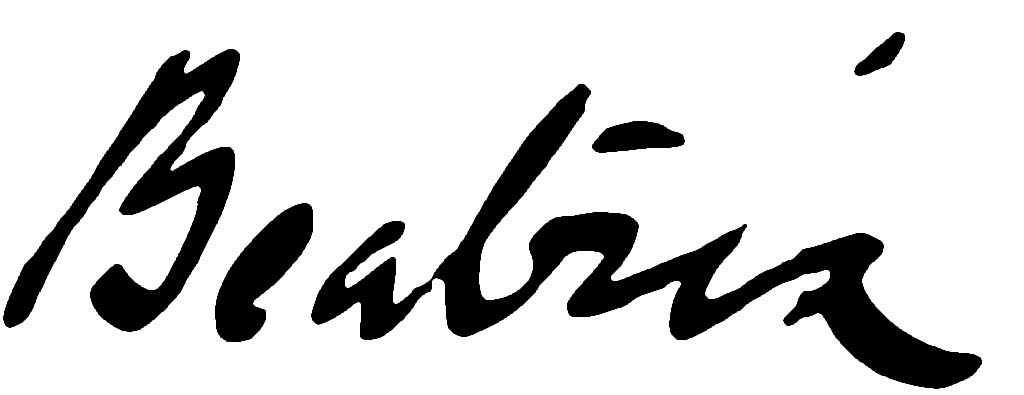
In December 1901, Beatrix Potter spent £11.
That money paid for 250 copies of a small book she had written and illustrated herself. She had offered the manuscript to six publishers. All six had passed. So she paid for the printing herself, sent copies to friends, and waited.
The copies sold. Every one.
That was the market test. She had proved, with eleven pounds and a few weeks of patience, that people would buy the book.
The Gamble
The self-published edition of The Tale of Peter Rabbit was modest by any measure. It had no colour plates. The print run was small. But 250 copies in circulation meant 250 copies that could be seen, lent, and talked about.
The publisher Frederick Warne and Co. had already declined the manuscript once. Now they came back. They had seen the private edition. They had seen it sell. In the summer of 1902 they offered a trade contract.
The terms were standard for the period: a royalty of roughly ten per cent of the retail price. The book would sell for one shilling. On every copy, Beatrix received around 1.2 pence.
That sounds small. What followed was not.
The Numbers in the First Year
The trade edition of The Tale of Peter Rabbit appeared in October 1902. The initial print run was 8,000 copies.
By the end of that year, 28,000 copies had sold.
At 1.2 pence per copy, the first-year royalties on Peter Rabbit alone came to approximately £140. For context: a domestic servant at the time earned around £20 a year. A clerk might earn £60. A first-year royalty of £140 from a single children's book — a book that had already paid back its printing costs — was real money.
Linda Lear, in A Life in Nature, describes how quickly Beatrix grasped the commercial logic. She was not naive about money. She had kept accounts for years. She understood the relationship between print run, retail price, and return.
The Tale of Squirrel Nutkin followed in 1903. It was an immediate success — Beatrix wrote to Norman Warne that she was "delighted" by the response, and the first distribution run of 10,000 copies sold quickly.
The pace was now clear. One new book per year. Each title boosted sales of the ones before. Readers who found Squirrel Nutkin went back to Peter Rabbit. Readers who found Peter Rabbit came forward to The Tailor of Gloucester. The backlist earned its keep every year, not just in the year of publication.
The Pace of Publication
Between 1902 and 1913, Beatrix produced nearly one book per year. Peter Rabbit (1902). Squirrel Nutkin (1903). The Tailor of Gloucester (1903). Benjamin Bunny (1904). Two Bad Mice (1904). The list continued, year after year, through Pigling Bland in 1913.
Each book was small, cheap, and precisely calibrated. Lear notes that the format — the square little books, the one-shilling price — was Beatrix's own insistence. She understood that children could hold them. Parents could afford them. The format was not sentiment. It was commercial calculation.
By 1905 — just three years after the trade publication of Peter Rabbit — the combined royalties from the first four books had given her something she had never had.
Financial independence.
What She Did with the Money
In 1905, Beatrix Potter bought Hill Top Farm in Near Sawrey, in the Lake District. The price was £2,805.
She paid for it from her book royalties.
This was not a small decision. She was thirty-nine years old. She had spent her entire life in London, under her parents' roof, living as her parents expected. The farm was a way out. Not a dramatic gesture — a quiet, deliberate purchase. She used the proceeds of her work to buy herself a place of her own.
She continued to live in London with her parents for much of the year. But the farm was hers. It represented an income stream turned into land and stone.
In 1909, she bought Castle Farm for £1,573. Again, the purchase came directly from book income. Judy Taylor's edition of Beatrix Potter's Letters shows her writing about property values, farm yields, and purchase prices with the same attention she gave to print runs and royalty statements.
The books were buying her a landscape.
The Norman Warne Relationship
The business relationship with Frederick Warne and Co. was managed by the youngest Warne brother, Norman.
He was meticulous. He handled the production decisions — paper, binding, colour blocks — and he handled the correspondence with Beatrix.
Beatrix scrutinised every aspect of her books. She proofed the colour blocks. She argued about binding cloth. She inspected every plate. Leslie Linder, in A History of the Writings of Beatrix Potter, documents how closely she tracked the technical quality of each edition. This was not an author who delivered a manuscript and waited for the finished copy. She was present at every stage.
That working partnership turned personal. Beatrix and Norman became engaged in the summer of 1905, over her parents' objection that a trade publisher was beneath the family. He died of leukaemia that August, a month later.
After Norman
The surviving Warne brother, Fruing, took over the business relationship. He was competent and steady. The commercial machine continued.
The books kept appearing. Mrs. Tiggy-Winkle in 1905. Mr. Jeremy Fisher in 1906. Tom Kitten in 1907. Each year a new title, each year the backlist selling steadily.
But there was a problem that no new title could solve.
In America, her books were being reprinted without permission or payment, and the copyright law of the day gave her little redress. The lost United States sales — one of the largest book markets in the world — were income the books earned but she never saw. It was a permanent leak in an otherwise rising account.
What the Machine Looked Like in 1913
By the time Pigling Bland appeared in 1913 — her last major book before her marriage to William Heelis — Beatrix had built a publishing record that was unusual by any standard.
Nearly twenty books in eleven years. A backlist that sold continuously. Two Lake District properties purchased outright. A royalty income sufficient to fund a working farm.
She had done this with books that retailed for one shilling each.
The relationship with Warne was genuine on both sides — professional respect, long acquaintance, shared attention to quality. But it was also a business. Beatrix understood that. She tracked the accounts. She pushed back on decisions she disagreed with. Even late in life, when Warne proposed changes to the books, she resisted. The quality of the printing, the accuracy of the colour reproduction: these mattered because the books were her product as much as her art.
Leslie Linder's history of her writings records how thoroughly she understood the commercial life of each title. She knew which books sold and which struggled. She had opinions about why.
What the Books Bought
The common account of Beatrix Potter's life runs something like this: a repressed childhood, a talent quietly nourished, books that gave her freedom, a farm, a countryside life, a marriage.
The books are the hinge.
Without the royalties, there is no Hill Top. Without Hill Top, there is no Pigling Bland, no Tom Kitten, no Mrs. Tiggy-Winkle — all of which drew directly on the farm and its surroundings. Without the backlist income, there is no Castle Farm. No expanding estate. No standing in the Lake District farming community that eventually made her one of the most significant supporters of the National Trust's work there.
She spent £11 in December 1901 and proved a market existed. Warne gave her a trade contract eight months later. For the next eleven years, she produced a book a year and watched the money come in.
She spent it on land.
The books bought her the life she then went on to live.
Sources
Linda Lear, A Life in Nature (Allen Lane, 2007). Judy Taylor (ed.), Beatrix Potter's Letters (Frederick Warne, 1989). Leslie Linder, A History of the Writings of Beatrix Potter (Frederick Warne, 1971).
Leave a Visiting Card
Consulting the visiting cards...